.svg&w=384&q=75 "Naijagoal logo")
Como Secures 1-0 Victory Against Hellas Verona in Serie A Clash
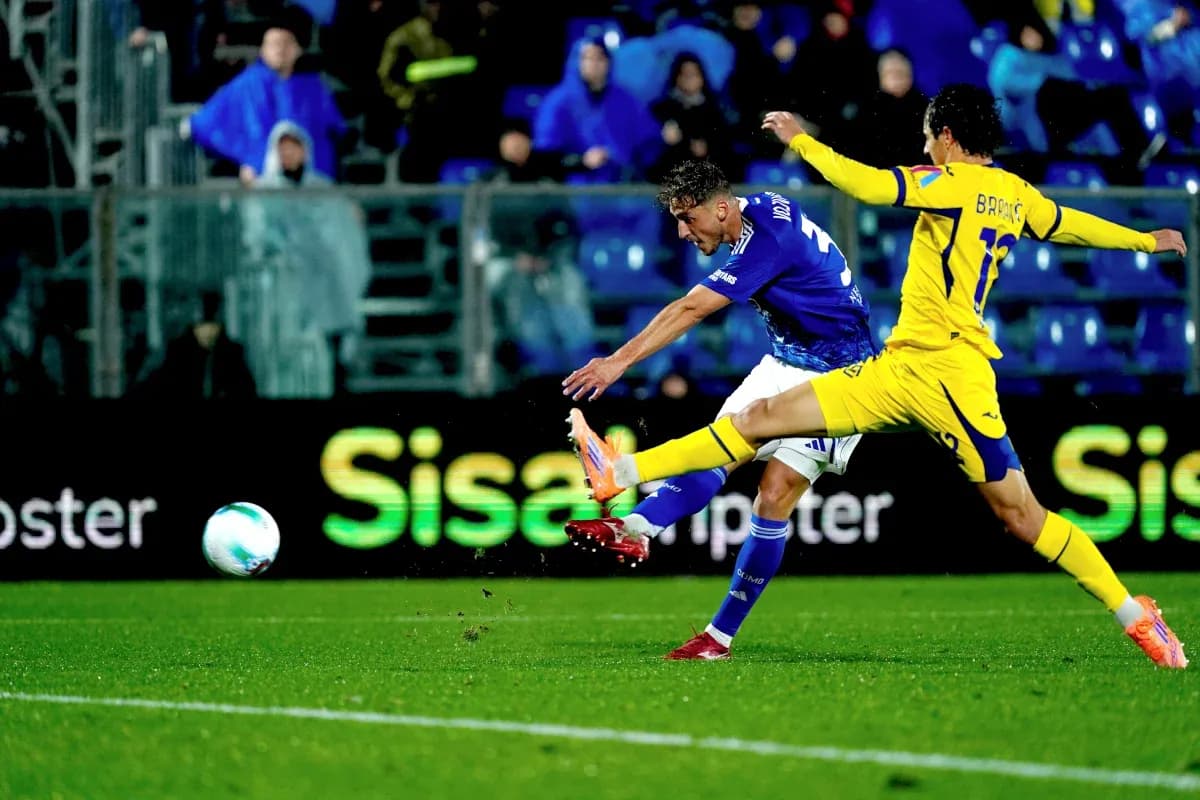
Hellas Verona’s 0-1 home defeat to Como at Stadio Marcantonio Bentegodi unfolded as a controlled away performance built on possession and a single, well-constructed second-half strike. In a Serie A Regular Season - 36 fixture refereed by Marco Di Bello, Verona’s 3-5-1-1 struggled to convert territory into clear chances, while Cesc Fabregas’ 4-2-3-1 gradually asserted technical dominance. Despite an even shot count (11-11), Como’s superior ball circulation and structure with the ball allowed them to manage the game once A. Douvikas delivered the decisive goal on 71 minutes.
Disciplinary Log
61' Maxence Caqueret (Como) — Persistent fouling
89' Martin Frese (Hellas Verona) — Foul
Card verification step: Hellas Verona: 1, Como: 1, Total: 2.
The match’s key tactical hinge points were clustered around substitutions and that single goal. Como’s first wave of changes came early: at 36', A. Moreno (IN) came on for A. Valle (OUT), subtly shifting the balance on the left side and adding more progressive passing from the back. Then, at 46', Fabregas reset almost an entire line: I. Smolcic (IN) for M. Vojvoda (OUT), M. Caqueret (IN) for M. Perrone (OUT), and M. Baturina (IN) for J. Rodriguez (OUT). This triple change effectively reconfigured the double pivot and left side of the back four, giving Como more control in the first and second build-up phases.
Caqueret’s entrance was tactically central. Although he was later booked at 61' for “Persistent fouling,” his aggression without the ball underpinned Como’s higher pressing and midfield compactness. Verona’s response came at 63', when S. Lovric (IN) replaced A. Bernede (OUT), a move aimed at injecting more vertical passing and late runs from midfield within Paolo Sammarco’s 3-5-1-1. Yet, the structural problem remained: Verona’s front two lines, T. Suslov behind K. Bowie, were often isolated from the deeper three central midfielders, leaving large gaps in the half-spaces for Como’s pivots and No. 10 to exploit.
The decisive moment arrived on 71'. A. Douvikas finished the only goal of the match for Como, assisted by centre-back M. O. Kempf. Tactically, this underlined Como’s willingness to use their defenders not just as circulation points but as line-breaking passers. Kempf stepping in and finding Douvikas reflected the benefit of Como’s 64% ball possession: their back line was comfortable holding a high position, compressing Verona, and picking moments to play into the final third. For Verona, the three-at-the-back of N. Valentini, A. Edmundsson, and V. Nelsson was pinned deep, reducing their ability to step out and contest that vertical connection.
Chasing the game, Verona doubled down on attacking changes. At 80', Isaac (IN) came on for J. Akpa Akpro (OUT), adding a more direct, forward-running profile, and at 81', I. Vermesan (IN) replaced R. Belghali (OUT), tilting the 3-5-1-1 into a more aggressive, striker-heavy shape. Almost simultaneously, Como refreshed their right side: at 81', I. Van der Brempt (IN) came on for A. Diao (OUT), shoring up defensive transition and maintaining energy in wide areas. Despite Verona’s late push, their offensive structure remained too vertical and predictable, culminating in frustration rather than clear chances — symbolized by Martin Frese’s 89' yellow card for “Foul” as he overcommitted in the late press.
From a goalkeeping perspective, both L. Montipo for Verona and J. Butez for Como delivered solid, unspectacular performances. Each recorded 3 saves, aligning with relatively modest xG figures: Verona at 0.97 and Como at 0.9. The “goals prevented” metric at 0.73 for both sides indicates that each keeper slightly outperformed the quality of shots faced, but there was no extreme shot-stopping display. Instead, the tactical story was about limiting shot quality: Verona allowed 10 of Como’s 11 attempts from inside the box, but many were from controlled, crowded zones; Como, meanwhile, restricted Verona to 8 box shots that rarely found clean separation.
Structurally, Verona’s 3-5-1-1 aimed to congest central zones and spring transitions, but their execution lagged behind Como’s positional play. The wing-backs R. Belghali and M. Frese had to manage both wide defensive duties and provide width in attack. With only 36% possession and 277 total passes, 202 accurate (73%), Verona were forced into longer phases without the ball. Their 17 fouls and 3 offsides underline a team trying to disrupt and then break quickly, but the lack of sustained sequences meant Suslov and Bowie rarely received the ball between lines in advantageous positions.
Como’s 4-2-3-1, especially after half-time changes, was built around control. They completed 506 total passes, 442 accurate (87%), and held 64% of the ball. The double pivot, first with M. Perrone and L. Da Cunha, then stabilized by Caqueret, provided constant outlets. The attacking midfield line of A. Diao, N. Paz, and J. Rodriguez (later Baturina) rotated intelligently, occupying Verona’s wing-backs and pulling the wide centre-backs out of shape. The result was territorial control without reckless risk: 11 total shots, 10 inside the box, but a measured xG of 0.9, reflecting selective, high-quality entries rather than volume shooting.
Statistically, the match was balanced in raw attempts (11-11 shots) and corners (7-7), but Como’s superior possession, passing accuracy, and control of field position translated into a cleaner attacking pattern and ultimately the only goal. Verona’s Overall Form in this match was that of a reactive side: high foul count, low possession, and late, structurally destabilizing substitutions. Como’s Defensive Index was quietly efficient: only 3 saves required from Butez, 14 fouls, and a back four that, even after personnel changes, maintained compact distances and denied Verona clear central routes. In the end, the data and the tactical picture align: a narrow 0-1 away win built on control, structure, and a single, well-timed vertical action from the back.