.svg&w=384&q=75 "Naijagoal logo")

Colombia Edges Ghana 1-0 in World Cup Clash
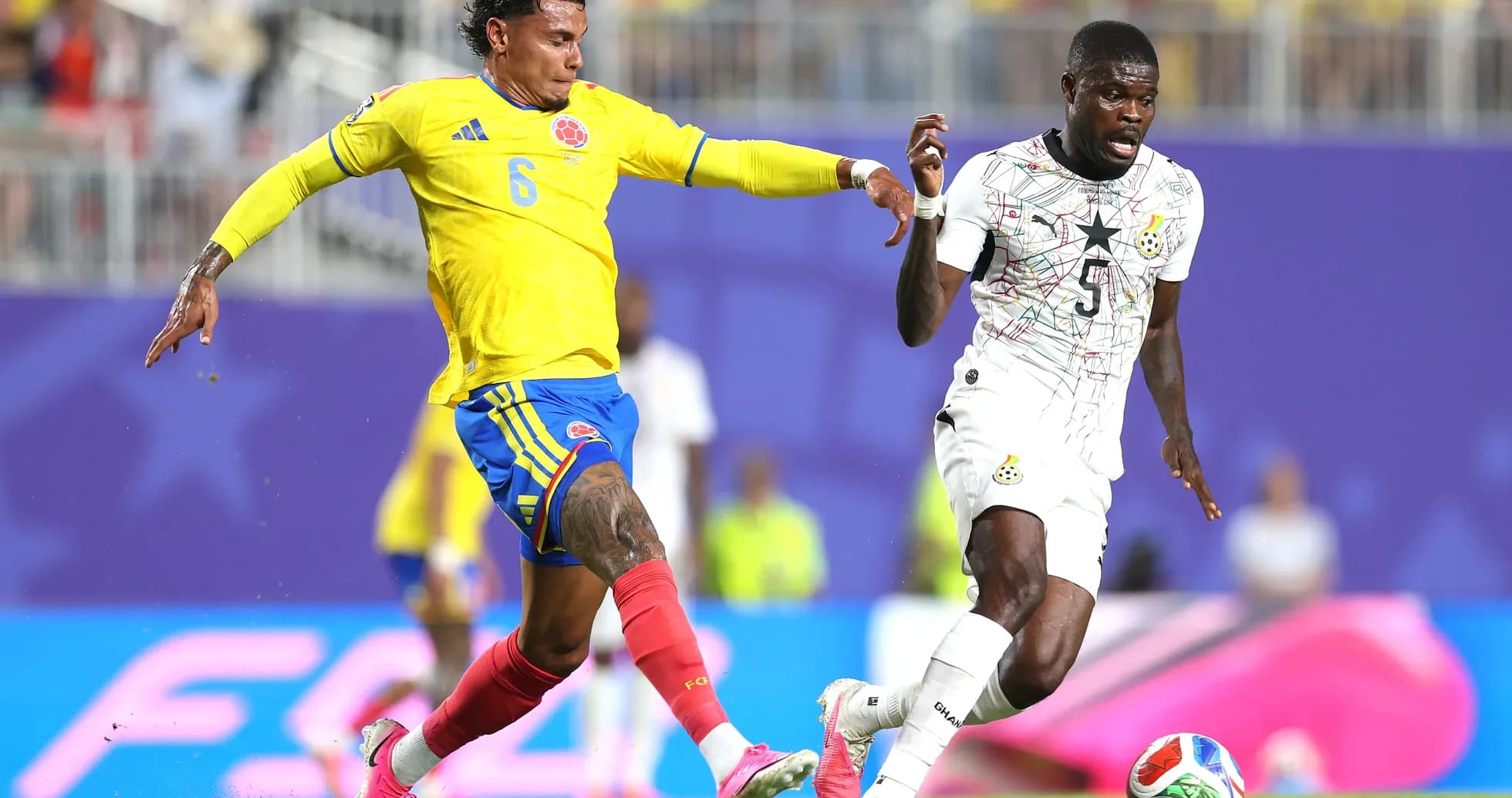
Arrowhead Stadium in Kansas City staged a World Cup Round of 32 tie that always felt like a clash of identities as much as a knockout match: Colombia’s controlled, possession‑driven 4-3-3 against Ghana’s elastic, transitional 4-1-4-1. By the final whistle, Colombia had edged a 1-0 win, a result that felt like the natural extension of their group‑stage profile and a harsh lesson for a Ghana side still searching for a sharper attacking edge.
Colombia's Impressive Record
Heading into this game, Colombia had built a quietly imposing record. Overall this campaign they had played 4 matches, winning 3 and drawing 1, with no defeats. They had scored 5 goals in total and conceded just 1, giving them a goal difference of +4. At home venues they had played 3 times with 2 wins and 1 draw, scoring 2 and conceding 0; on their travels they had played once, scoring 3 and conceding 1. The pattern was clear: at home they grind, away they open up. Ghana arrived with a far more fragile base. Overall they had played 4 matches, winning 1, drawing 1 and losing 2, scoring 2 and conceding 3 for a goal difference of −1. At home they had 1 win from 1, scoring 1 and conceding 0; on their travels they had played 3 times without a win, drawing once and losing twice, with 1 goal scored and 3 conceded.
Team Lineups
Nestor Lorenzo stayed faithful to Colombia’s established structure, naming a pure 4-3-3. C. Vargas in goal sat behind a back four of D. Munoz, D. Sanchez, J. Lucumi and J. Mojica. In front of them, the midfield triangle of G. Puerta, J. Lerma and J. Arias was built to control rhythm and close central channels. Up front, the creative axis revolved around J. Rodriguez as a roaming forward, flanked by the direct running of L. Diaz and the penalty‑box presence of J. Cordoba.
Carlos Queiroz answered with a 4-1-4-1 that hinted at caution first, ambition second. L. Ati Zigi started in goal, shielded by a back line of M. Senaya, D. Luckassen, J. Opoku and G. Mensah. T. Partey anchored as the single pivot, with a line of four ahead: I. Williams and A. Semenyo wide, C. Yirenkyi and K. Sibo inside, all supporting lone striker J. Ayew. On paper it was a system designed to compress the middle third, then spring into space when Colombia’s full‑backs advanced.
Tactical Analysis
The tactical voids in this tie were less about absentees and more about structural risk. Colombia’s season data underlined a side that rarely loses control. Overall they averaged 1.3 goals for per match and only 0.3 against. At home their attack was modest at 0.7 goals per match, but they had not conceded at all at home venues, and they had kept 3 clean sheets in total. That defensive resilience allowed Mojica and Munoz to push high, trusting Sanchez and Lucumi to manage transitions.
Ghana, by contrast, carried a more brittle profile. Overall they averaged just 0.5 goals scored per match and 0.8 conceded. On their travels they averaged only 0.3 goals for and 1.0 against, with 2 away defeats already on the ledger. The 4-1-4-1 therefore needed to be compact and ruthless on the break; any sustained defending would simply invite the kind of pressure their numbers suggested they struggled to withstand.
Disciplinary Patterns
Disciplinary patterns also shaped the emotional temperature of the contest. Colombia’s yellow‑card distribution showed spikes early and late: 33.33% of their yellows came between 0-15 minutes and another 33.33% between 76-90, with 16.67% arriving between 46-60 and 16.67% in the 91-105 window. This is a side that tackles aggressively to set the tone, then again to protect a lead. Ghana’s bookings were more mid‑game: 16.67% between 16-30, 33.33% between 46-60, and 16.67% in each of the 61-75, 76-90 and 91-105 ranges. That pattern suggested a team whose discipline frays as the match opens up rather than at the start.
Key Matchups
Within that framework, the key matchups crystallised into three duels.
- The first was the “Hunter vs Shield” confrontation between Colombia’s forward line and Ghana’s central defensive block. J. Rodriguez’s freedom to drift between the lines asked constant questions of D. Luckassen and J. Opoku. With Colombia averaging 3.0 goals on their travels and 1.3 overall, his task was to find the half‑spaces where Ghana’s 4-1-4-1 can be vulnerable: behind the advanced interior midfielders and to the side of Partey. Ghana’s shield, meanwhile, relied on Partey’s positioning and the timing of pressure from C. Yirenkyi and K. Sibo to deny Rodriguez the time to turn.
- The second duel lay in the engine room. J. Lerma and G. Puerta were tasked with pinning Ghana’s midfield in their own half, using steady recycling rather than constant vertical thrust. On the other side, Partey’s role as enforcer was to break that rhythm and feed the runners. C. Yirenkyi, who had already emerged as a disciplinary focal point for Ghana this tournament with 2 yellow cards across 4 appearances, embodied that edge. His 70 completed passes at 88% accuracy, 2 tackles, 2 blocked shots and 3 interceptions illustrated a midfielder who can both disrupt and progress. But his 7 fouls committed hinted at the risk: press too aggressively and Colombia’s technicians draw contact, push Ghana deeper, and turn every set piece into a territorial gain.
- The third battle played out on the flanks. L. Diaz against M. Senaya promised one‑on‑one drama, with Diaz’s directness essential to stretching Ghana’s back four. On the opposite side, A. Semenyo and I. Williams had to exploit the spaces left by Mojica and Munoz when Colombia attacked. Yet Ghana’s overall attacking return of 2 goals in 4 matches suggested that even when they reached advanced zones, the final action often lacked precision.
Statistical Prognosis
Statistically, the prognosis tilted toward Colombia even before a ball was kicked. They arrived unbeaten overall, with a goal difference of +4 and 3 clean sheets, and had never trailed in the tournament. Ghana, with a −1 goal difference and only 2 goals scored overall, needed an outlier performance in both boxes. Neither side had taken a penalty this campaign, and with both having 0 penalties missed, there was no hidden advantage from the spot to swing the tie.
Conclusion
Following this result, the narrative held true to the numbers. Colombia’s defensive structure, anchored by Vargas, Sanchez and Lucumi, absorbed what Ghana could muster, while their layered possession eventually produced the decisive moment. Ghana’s 4-1-4-1 once again looked more secure than incisive; the lack of a consistent goal threat that had marked their group campaign resurfaced at the worst possible time.
In the end, Colombia’s Round of 32 win felt less like a one‑off and more like a logical continuation of their tournament identity: measured, defensively immaculate, and just sharp enough in the final third to move on, leaving Ghana to reflect on a campaign where organisation outpaced imagination.