.svg&w=384&q=75 "Naijagoal logo")

Canada vs Morocco: Round of 16 Clash at NRG Stadium
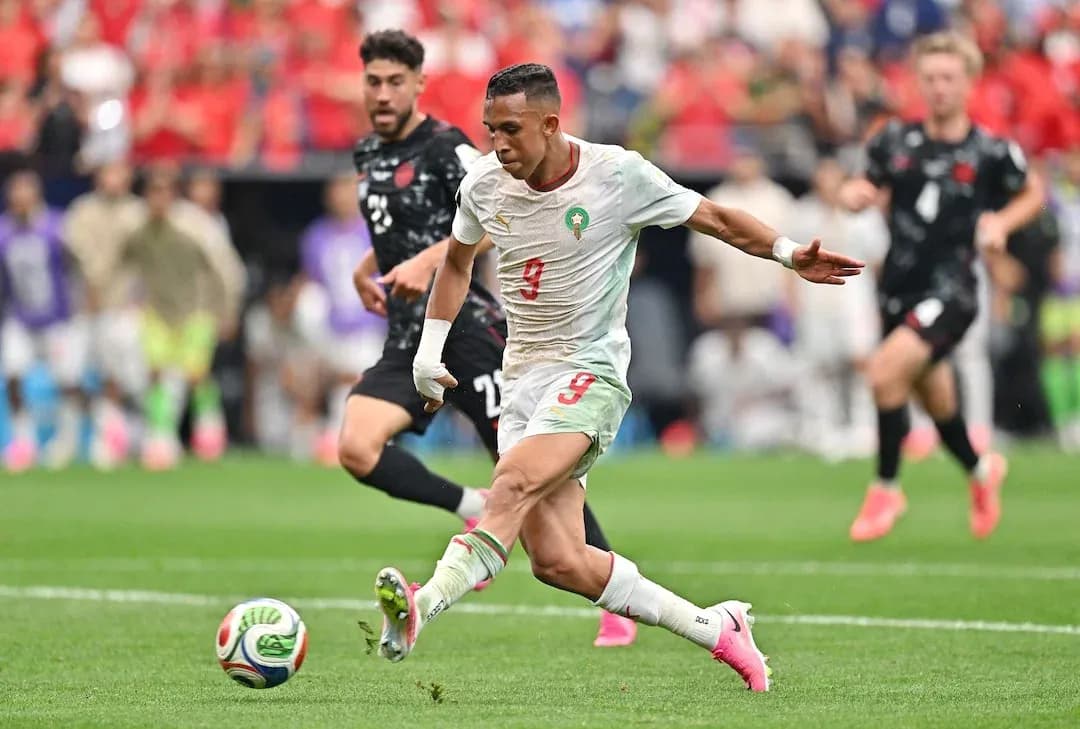
Under the Houston heat at NRG Stadium, this Round of 16 tie brought together two sides whose group‑stage identities could not have been more different. Canada arrived as Group B’s runners‑up, a high‑variance outfit whose campaign had been defined by explosive attacking bursts and defensive looseness. Morocco, second in Group C, came in as a controlled, unbeaten machine, conceding few chances and managing games with a veteran calm.
Heading into this game, Canada’s World Cup story had been one of extremes. Overall they had scored 9 goals in 5 matches, with 7 of those coming at home venues and an overall average of 1.8 goals per match. At home they had averaged 2.3 goals for and 1.3 against, underlining how open Jesse Marsch’s preferred 4‑4‑2 could become. The same pattern held defensively: 6 goals conceded overall at an average of 1.2 per match, with only 2 clean sheets in total. They were capable of blowing teams away, as that 6‑0 home win showed, but also of collapsing, as evidenced by a 0‑3 home defeat.
Morocco, by contrast, were built on control and economy. Across the tournament they had played 5 fixtures, winning 4 and drawing 1, and crucially had not lost. Overall they had scored 11 goals at an average of 2.2 per match, while conceding only 4 at 0.8 per game. On their travels they were even more ruthless: 3 away wins, 7 goals scored and only 2 conceded, with an away defensive average of just 0.5 goals against. Their profile was that of a side comfortable without chaos, one that could absorb pressure and then strike with precision.
The lineups mirrored those identities. Marsch doubled down on his 4‑4‑2, the only formation Canada had used in 5 matches. Maxime Crépeau anchored a back four of Alistair Johnston, Moïse Bombito, Luc De Fougerolles and Richie Laryea. In midfield, Tajon Buchanan and Ali Ahmed provided width, with N. Sigur and Stephen Eustaquio tasked with knitting play through the middle. Up front, Jonathan David and Tani Oluwaseyi formed a direct, aggressive pairing.
Morocco’s Mohamed Ouahbi stayed loyal to his 4‑2‑3‑1, also their single, stable shape across 5 games. Bono started in goal behind a back four of Achraf Hakimi, Issa Diop, R. Halhal and Noussair Mazraoui. In front of them, A. Bouaddi and N. El Aynaoui offered the double pivot, while Brahim Díaz, Azzedine Ounahi and Bilal El Khannouss floated behind lone forward Ismael Saibari.
The absences underscored the tactical stakes. Canada were without I. Koné due to a lower‑leg fracture, depriving Marsch of a dynamic midfield carrier who could have helped them break Morocco’s compact block between the lines. For a team already leaning on a direct 4‑4‑2, that meant even more responsibility on Eustaquio’s distribution and Ahmed’s ability to receive under pressure.
Discipline and game management loomed large before a ball was kicked. Over the tournament, Canada had taken most of their yellow cards between 31‑60 minutes, with 27.27% of bookings in the 31‑45 window and another 27.27% from 46‑60. That mid‑game indiscipline could easily feed Morocco’s strength in controlling tempo once they had a lead. On the Moroccan side, their yellows were clustered between 16‑60 minutes, split evenly at 33.33% across the 16‑30, 31‑45 and 46‑60 ranges. This suggested an aggressive press and tactical fouling in the middle third rather than late‑game panic.
Individually, the “Hunter vs Shield” narrative was compelling. For Canada, David entered as a joint‑top scorer in this World Cup with 3 goals from 5 appearances, backed by 12 shots and 8 on target. He also brought defensive bite, with 4 tackles and 1 blocked shot, underlining how central he is to Canada’s entire out‑of‑possession structure. Alongside him, Cyle Larin—also on 2 goals and a top card collector with 2 yellows—waited on the bench as an impact option, capable of turning the penalty area into a battleground.
Morocco’s shield was collective rather than individual, but Diop stood out. In 4 appearances he had blocked 4 shots and made 5 interceptions, combining aerial dominance with anticipation. His duel numbers—18 contested, 11 won—hinted at a defender who times his engagements rather than diving in. Behind him, Bono’s presence completed a spine that had already delivered 2 clean sheets away from home.
The engine room duel pitted Eustaquio and the emerging Nathan‑Dylan Saliba against Morocco’s double pivot and creative line. Saliba, even from the bench, had become one of Canada’s most efficient contributors: in just 3 appearances and 182 minutes he had 1 goal, 2 assists, 102 completed passes at 83% accuracy and 6 tackles. On the other side, Brahim Díaz arrived as one of the tournament’s premier creators: 4 assists, 8 key passes, 136 completed passes at 90% accuracy, plus 11 dribble attempts with 5 successful. If Morocco could funnel possession through Brahim between Canada’s lines, the back four would be repeatedly exposed to Saibari’s runs and Hakimi’s overlaps.
Out wide, Hakimi was arguably the game’s most complete two‑way force. In 5 appearances he had 1 goal and 2 assists, but his underlying numbers were even more impressive: 343 completed passes at 90% accuracy, 15 key passes, 11 tackles, 1 blocked shot and 5 interceptions. His duel volume—72 contested, 35 won—spoke to a right‑back who lives on the front foot. Up against Buchanan and Laryea, his ability to pin Canada back and then recover defensively was always likely to tilt the flank battle Morocco’s way.
Set‑piece and penalty narratives also shaped expectations. Canada had taken no penalties overall in this World Cup, so there was no sample to lean on. Morocco, however, had earned 5 penalties overall, scoring 3 and missing 2. That 40.00% miss rate meant any spot‑kick was not a foregone conclusion, but it also underlined how often their front line—Saibari, Brahim, Ounahi—forced desperate defending in the box.
From a statistical prognosis, the clash felt asymmetrical. Canada’s overall goal difference of +3 (9 scored, 6 conceded) reflected their openness; Morocco’s overall goal difference of +7 (11 scored, 4 conceded) pointed to a side that married efficiency in attack with a parsimonious defence. With Canada having failed to score only once overall, and Morocco having never failed to score and yet keeping 2 clean sheets, the likeliest pattern was always Canada pushing numbers forward and Morocco punishing the spaces left behind.
In the end, the 3‑0 scoreline to Morocco simply confirmed the trajectories suggested by the numbers. Following this result, Morocco’s unbeaten run and defensive solidity were validated on the biggest stage, while Canada’s brave, expansive football met a ceiling against a side too organised, too clinical and too experienced in the fine details of knockout football.