.svg&w=384&q=75 "Naijagoal logo")
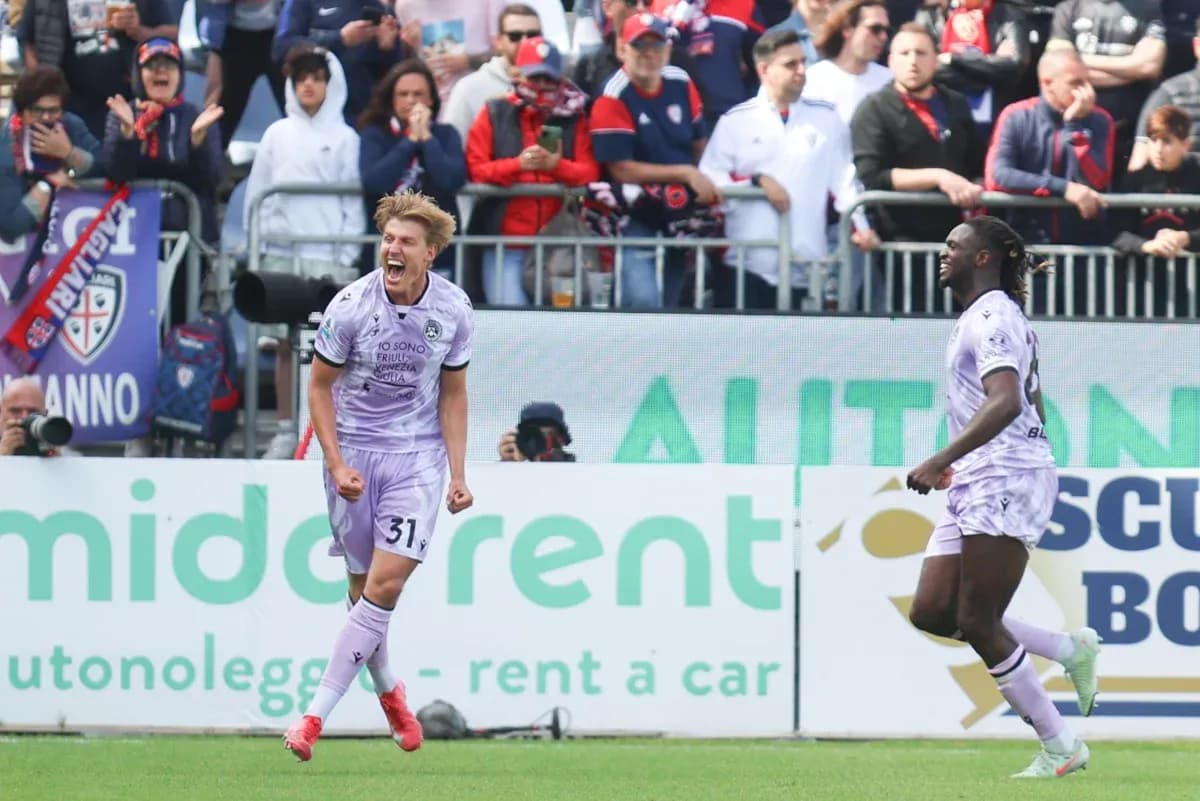
Cagliari vs Udinese: A Tactical Showdown Under the Sardinian Sun
Under the Sardinian sun at the Unipol Domus, this felt less like a routine late‑season fixture and more like a referendum on two contrasting Serie A projects. Cagliari, 16th with 37 points and a goal difference of -15 (36 scored, 51 conceded overall), came in fighting for air. Udinese, 9th on 50 points with a goal difference of -1 (45 for, 46 against overall), arrived with the swagger of a side that has quietly sharpened its edges all year. Following this result, the 0–2 away win underlined exactly why their trajectories are pulling in opposite directions.
I. The Big Picture: Structures and Season DNA
The lineups told the story before a ball was kicked. Fabio Pisacane doubled down on Cagliari’s defensive instincts with a 5‑3‑2: E. Caprile behind a back five of M. Palestra, J. Pedro, A. Dossena, J. Rodriguez and A. Obert. In front of them, M. Adopo, G. Gaetano and M. Folorunsho tried to stitch transitions together, while S. Esposito and P. Mendy formed a mobile but underserviced front two.
It was a structure born from necessity. Heading into this game, Cagliari had only 9 wins from 36 league matches, with their attack sputtering at 1.1 goals per game at home and just 1.0 overall. They had failed to score in 14 league outings and leaned heavily on defensive solidity, evidenced by 8 clean sheets overall. Yet even at the Unipol Domus, they conceded 1.2 goals per match on average, a fragile base for a side that often struggles to turn pressure into goals.
Udinese’s 3‑4‑3 under Kosta Runjaic looked far more progressive. M. Okoye anchored a back three of B. Mlacic, T. Kristensen and O. Solet, with K. Ehizibue and H. Kamara stretching play from the flanks. J. Piotrowski and J. Karlstrom formed the central platform, allowing an attacking trident of N. Zaniolo, A. Buksa and A. Atta to rotate and press aggressively.
This shape mirrored their season identity: compact but ambitious. On their travels, Udinese averaged 1.5 goals scored and 1.4 conceded, part of a broader profile of 14 wins from 36, with 11 clean sheets overall. They were comfortable living in the tension between risk and reward, and this match was a textbook expression of that balance.
II. Tactical Voids: Absences and Discipline
Cagliari arrived depleted in key attacking zones. G. Borrelli (thigh), M. Felici (knee), R. Idrissi (knee), J. Liteta (thigh), L. Mazzitelli and L. Pavoletti (knee) were all ruled out. That stripped Pisacane of alternative reference points up front and creative depth in the half‑spaces. The result: S. Esposito was forced to be both creator and outlet, dropping deep from the front line to link play that too rarely reached the final third with clarity.
Udinese had their own voids. J. Ekkelenkamp (leg injury) and A. Zanoli (knee) removed options for rotation and progression, while C. Kabasele’s suspension for yellow cards took away an experienced defensive leader. Yet their structural continuity and deeper attacking pool allowed them to absorb these losses far more smoothly.
Discipline was another subtle undercurrent. Heading into this game, Cagliari’s yellow card distribution skewed heavily toward chaos in the closing stages: 26.92% of their bookings came between 76–90 minutes, and both of their red cards this season had also arrived in that same late window. Udinese, by contrast, peaked for yellows between 61–75 minutes (26.87%), a sign of a side that raises intensity after the break but generally keeps its head when games fracture late on. That composure was evident as they protected their lead without spiralling into panic.
III. Key Matchups: Hunter vs Shield, and the Engine Room
The most intriguing battle on paper was the one that never quite materialised on the pitch: the looming presence of K. Davis, Udinese’s 10‑goal, 4‑assist striker and one of Serie A’s most efficient attackers this season. Though he started on the bench, his statistical shadow hung over Cagliari’s back line. Across 28 appearances and 1928 minutes, Davis has turned 37 shots into 10 goals, with 24 on target, and added 28 key passes. When he did enter the fray, his duelling profile – 305 duels contested, 143 won – asked exactly the sort of physical questions that test tired defenders.
On the other side, Cagliari’s “shield” was embodied by A. Obert. The Slovak defender, one of the league’s most card‑prone players with 9 yellows and 1 yellow‑red, has also been one of its busiest: 63 tackles, 18 successful shot blocks and 40 interceptions over the campaign. In this match, his role was to compress space between the lines and step out aggressively on Udinese’s forwards, particularly when Zaniolo drifted inside.
In midfield, the “engine room” duel pitted creativity against control. For Cagliari, S. Esposito is not just a forward in name; his season numbers scream playmaker: 5 assists, 65 key passes and 916 total passes at 74% accuracy, plus 49 tackles and 15 interceptions. His ability to drop off the front and connect with G. Gaetano and M. Folorunsho was supposed to be Cagliari’s route out of Udinese’s press.
Udinese’s answer lay in the balance of J. Karlstrom and J. Piotrowski, screening the back three while feeding Zaniolo between the lines. Zaniolo himself, with 6 assists and 53 key passes this season, was the creative fulcrum. His duel volume – 374 duels, 61 fouls drawn – reflects a player who thrives in contact, inviting pressure then releasing runners like Buksa and Atta into the channels.
IV. Statistical Prognosis and What the Scoreline Says
Strip the 0–2 down to its tactical bones and the outcome feels aligned with the numbers. Udinese came in as the more efficient attacking side: 45 goals overall, powered by a 1.5 away goals average, against a Cagliari defence conceding 1.2 at home and 1.4 overall. Cagliari’s reliance on narrow margins and clean sheets was always a fragile plan against a team that carries multiple threats and finishes games strongly without losing structure.
Cagliari’s season‑long habit of late‑game disciplinary spikes hinted at mental and physical fatigue in closing phases. Udinese’s controlled aggression, backed by 11 clean sheets and a perfect penalty record (5 scored from 5, 0 missed), spoke to a side that knows how to manage advantage and convert moments.
Following this result, the table and the performance arc converge: Cagliari remain a team built on resistance more than invention, too often one dimensional when chasing games. Udinese, by contrast, look every inch a modern mid‑table power – tactically flexible, statistically coherent, and armed with enough individual quality in players like Zaniolo and Davis to tilt tight matches decisively in their favour.