.svg&w=384&q=75 "Naijagoal logo")

Burnley vs Wolves: Tactical Analysis of the 1-1 Draw
Burnley’s 1-1 draw with Wolves at Turf Moor unfolded as a classic clash of territorial dominance versus transition threat. Mike Jackson’s side, in a 4-2-3-1, controlled the ball relentlessly, posting 70% possession and 558 passes, while Rob Edwards’ 3-4-2-1 Wolves accepted a deep, compact role and played for direct breaks and penalty-box volume, reflected in their higher xG of 2.05 to Burnley’s 1.06 despite identical totals of 16 shots each.
Tactical Analysis
The first tactical hinge came inside five minutes. Wolves’ back three and double pivot pushed high enough to contest second balls, and a sequence involving Ladislav Krejčí led to a penalty incident checked and “Penalty confirmed” by VAR at 4'. The decision underlined Wolves’ plan: commit numbers quickly into the final third when they did have the ball. Adam Armstrong converted from the spot at 5', giving Wolves a 1-0 platform to sink into their structure.
Out of possession, Wolves’ 3-4-2-1 flattened into a 5-4-1, with wing-backs dropping alongside the three centre-backs and the two advanced forwards screening Burnley’s double pivot. Burnley’s 4-2-3-1, built on Florentino and L. Ugochukwu as a base, sought to overload the half-spaces via L. Tchaouna and J. Anthony drifting infield, while Z. Flemming operated between the lines. The statistical profile is clear: Burnley took more shots from range (9 shots outside the box to Wolves’ 6) as Wolves’ compact block protected the central area of the area, forcing Jackson’s side into longer efforts and crosses.
Despite Burnley’s territorial control, Wolves’ transitions remained dangerous. Their 10 shots inside the box (to Burnley’s 7) show how, when they did attack, they reached high-value zones quickly. The front three – Hwang Hee-Chan, M. Mane and Armstrong – constantly looked to exploit spaces behind full-backs K. Walker and Lucas Pires, particularly when Burnley’s full-backs advanced simultaneously. That dynamic explains why Wolves, with only 223 passes and 30% possession, still generated the better xG and forced 3 saves from M. Weiss (Burnley), while J. Sa (Wolves) had to make 7 stops under sustained pressure.
Equaliser and Substitutions
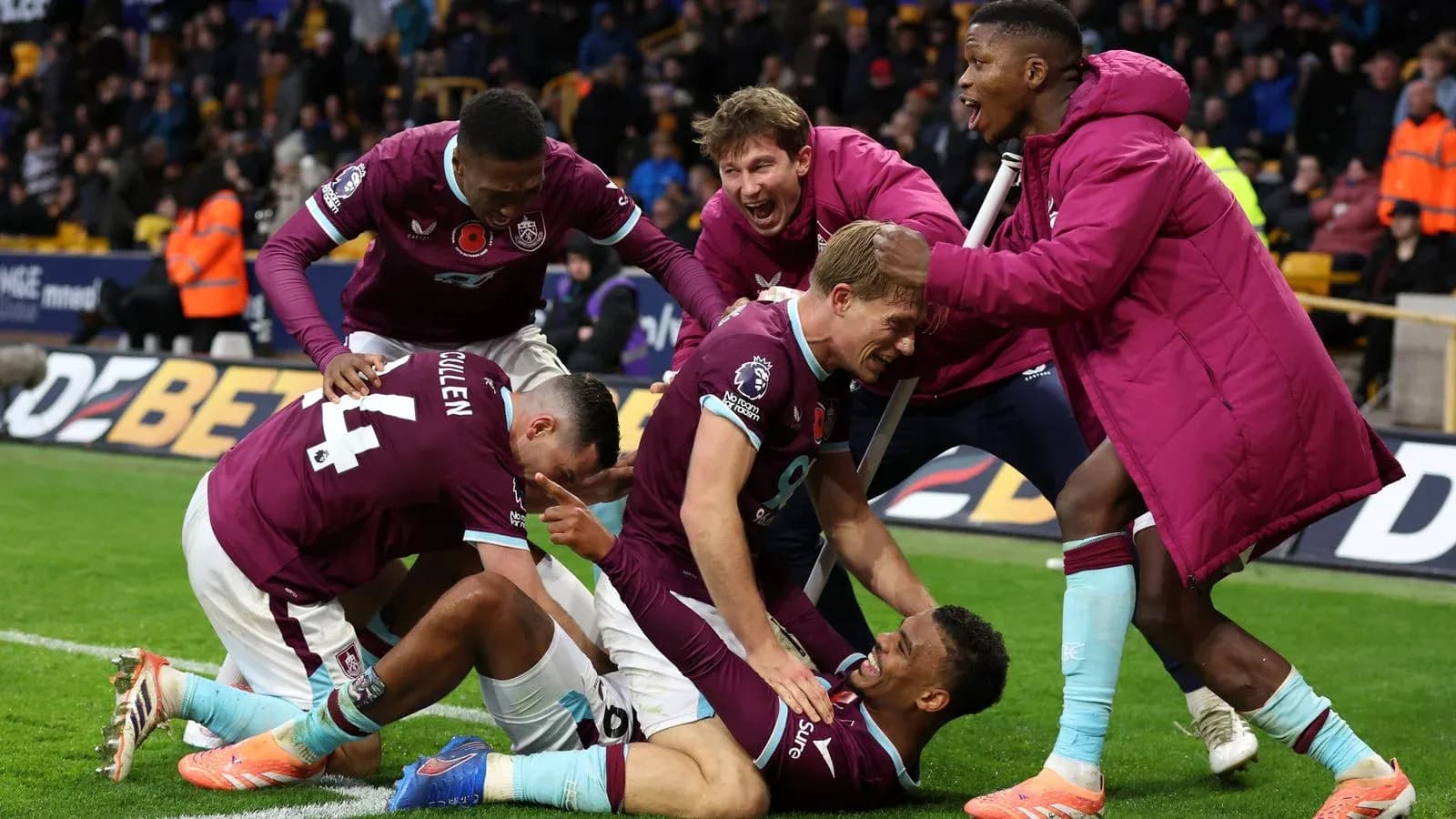
The equaliser at 47' was a product of Burnley’s structural insistence. With Wolves pinned deeper after the break, the 4-2-3-1 morphed into a 2-4-4 in possession: centre-backs A. Tuanzebe and B. Humphreys holding a high line, full-backs pushing on, and both wide midfielders attacking the half-spaces. L. Tchaouna found a pocket and supplied Z. Flemming, whose “Normal Goal” drew Burnley level. The assist underlines Tchaouna’s role as the key connective piece between midfield and attack, rewarded before his withdrawal on 75' for M. Edwards (IN) came on for L. Tchaouna (OUT), a move that injected fresh dribbling threat against tiring wing-backs.
Substitutions from both coaches reflected a late-game tactical chess match. At 66', H. Mejbri (OUT) made way for Z. Amdouni (IN), shifting Burnley towards a more attack-minded central presence, while Wolves simultaneously retooled their structure: A. Gomes (OUT) for T. Arokodare (IN) added a more direct focal point, and L. Krejci (OUT) for Toti (IN) refreshed the back line without altering the 3-4-2-1 shape. Later, D. M. Wolfe (OUT) for H. Bueno (IN) at 74' and Armstrong (OUT) for J. Abbey (IN) rebalanced Wolves between energy in midfield and fresh legs up front, signalling Edwards’ intent to preserve the point while still carrying counter-attacking threat.
Burnley’s bench usage was even more aggressive. After the Mejbri change, J. Ward-Prowse (IN) came on for L. Ugochukwu (OUT) at 75', giving Burnley a more precise passer to exploit Wolves’ compact block with switches and set-piece quality. In the final phase, A. Barnes (IN) came on for Z. Flemming (OUT) and J. Bruun Larsen (IN) came on for J. Anthony (OUT), both at 84', effectively turning the system into a 4-2-4 with a classic target presence in Barnes. This aerial emphasis matched the numbers: Burnley had 7 corners and 6 blocked shots, repeatedly forcing Wolves to defend their box with last-ditch interventions.
Discipline and Statistics
Discipline added another layer to the tactical picture. Hwang Hee-chan’s yellow at 41' for “Off the ball foul” highlighted Wolves’ willingness to disrupt Burnley’s rhythm even without direct ball pressure. For Burnley, Hannibal Mejbri’s booking at 45+9' for “Argument” and Ashley Barnes’ caution at 90+4' also for “Argument” reflected growing frustration as they chased a winner. Yerson Mosquera’s yellow at 90+4' for “Argument” mirrored that emotional edge on the Wolves side, but neither team lost structural discipline enough to concede decisive late chances.
Statistically, Burnley’s passing structure was clean: 558 passes, 488 accurate at 87%, confirming a controlled, methodical approach. Wolves’ 223 passes with 164 accurate (74%) fit a low-possession, vertical plan. Both sides recorded 16 total shots, but their profiles diverged: Burnley’s 8 shots on goal and 2 off goal, plus 6 blocked, show sustained pressure and volume around the box; Wolves’ 4 shots on goal, 5 off goal and 7 blocked illustrate fewer but often clearer openings, frequently shut down by last-ditch defending.
From a defensive perspective, M. Weiss (Burnley) made 3 saves with goals prevented at 0.29, while J. Sa (Wolves) produced 7 saves and also posted 0.29 goals prevented. The identical goals prevented values, despite very different workloads, underline that both goalkeepers performed to a similar shot-quality standard, with Sa simply exposed to more on-target efforts.
Foul counts – Burnley 10, Wolves 11 – and the 2 yellow cards per side show a contest that was competitive but not chaotic. Ultimately, the statistical verdict is that Burnley imposed their positional game and volume, but Wolves’ compact 3-4-2-1 and transition efficiency justified the 1-1 scoreline and even left the visitors feeling they might have edged it on chance quality.