.svg&w=384&q=75 "Naijagoal logo")

Brazil vs Norway: A World Cup Upset at MetLife Stadium
MetLife Stadium in East Rutherford hosted a World Cup 1/8 final that felt like a narrative inversion of everything this Brazil has been building. Over five matches in this tournament, Brazil had constructed a statistical identity of control and balance: in total this campaign they had scored 10 goals and conceded 4, with an overall average of 2.0 goals for and 0.8 against per match. Norway arrived as something wilder, more volatile: in total this campaign they had scored 12 and conceded 9, averaging 2.4 goals for and 1.8 against. On paper, it was Brazil’s structure against Norway’s chaos.
Final Score: Brazil 1 - 2 Norway
I. The Big Picture – Two Different Roads to MetLife
Brazil came into the knockouts as Group C winners, rank 1 in their section with 7 points and a goal difference of 6, built from 7 goals for and 1 against in the group. That defensive parsimony had been underpinned by Carlo Ancelotti’s flexibility: across the tournament Brazil had already used three formations, most often a 4-3-3, but here he turned to a 4-4-2.
Norway, rank 2 in Group I with 6 points and a goal difference of 1 (8 scored, 7 conceded), had leaned into a clearer identity. Stale Solbakken had sent his side out in a 4-3-3 in 4 of their 5 matches, and he stuck with it again, trusting the same structural frame that had allowed them to both thrill and terrify their own supporters.
The contrast was immediate on the teamsheet. Brazil’s 4-4-2 front line of Matheus Cunha and Vinicius Junior suggested a blend of penalty-box presence and wide-channel chaos, while Norway’s trio of A. Nusa, Erling Haaland and A. Sorloth looked designed to stretch and batter a back four that had previously been largely untroubled.
II. Tactical Voids – Brazil’s Missing Links and the Discipline Edge
The absences told their own story before a ball was kicked. Brazil were without Raphinha and Lucas Paquetá, both ruled out with hamstring muscle injuries. In a squad built around fluidity between lines, those were not just missing names but missing functions.
Without Raphinha, Brazil lost a natural wide right outlet who could pin a full-back and provide direct running to complement Vinicius on the opposite flank. Without Paquetá, Ancelotti was deprived of a left-sided playmaker who knits midfield to attack and offers pressing triggers. The result was a flat-band 4-4-2: G. Martinelli and Rayan operating as orthodox wide midfielders, Bruno Guimaraes and Casemiro as a double pivot.
That double pivot carried a disciplinary edge. Across the tournament, Casemiro had already collected 2 yellow cards, leading the competition’s disciplinary charts, and his defensive profile – 14 tackles, 4 blocked shots, 6 interceptions – spoke of a midfielder who lives at the collision point. Danilo, another on 2 yellow cards, started at right-back, adding further risk to any high defensive line.
Norway, by contrast, arrived without notable suspensions and with a relatively clean disciplinary record: their cards had been scattered, with yellow flashes early in halves but no red cards. In a knockout tie likely to be decided in the margins, that relative restraint mattered.
Brazil’s own season-long card distribution hinted at where the emotional spikes might come. In total this campaign, 25.00% of their yellow cards had arrived between 31-45 minutes and another 25.00% between 61-75, with a late-game surge of 12.50% between 76-90 and an additional 12.50% in 91-105. Norway’s yellows were concentrated early, 50.00% in 0-15 and 50.00% in 46-60. The pattern suggested Brazil might grow more ragged as pressure mounted, while Norway tended to flare and then settle.
III. Key Matchups – Hunter vs Shield, and the Engine Room
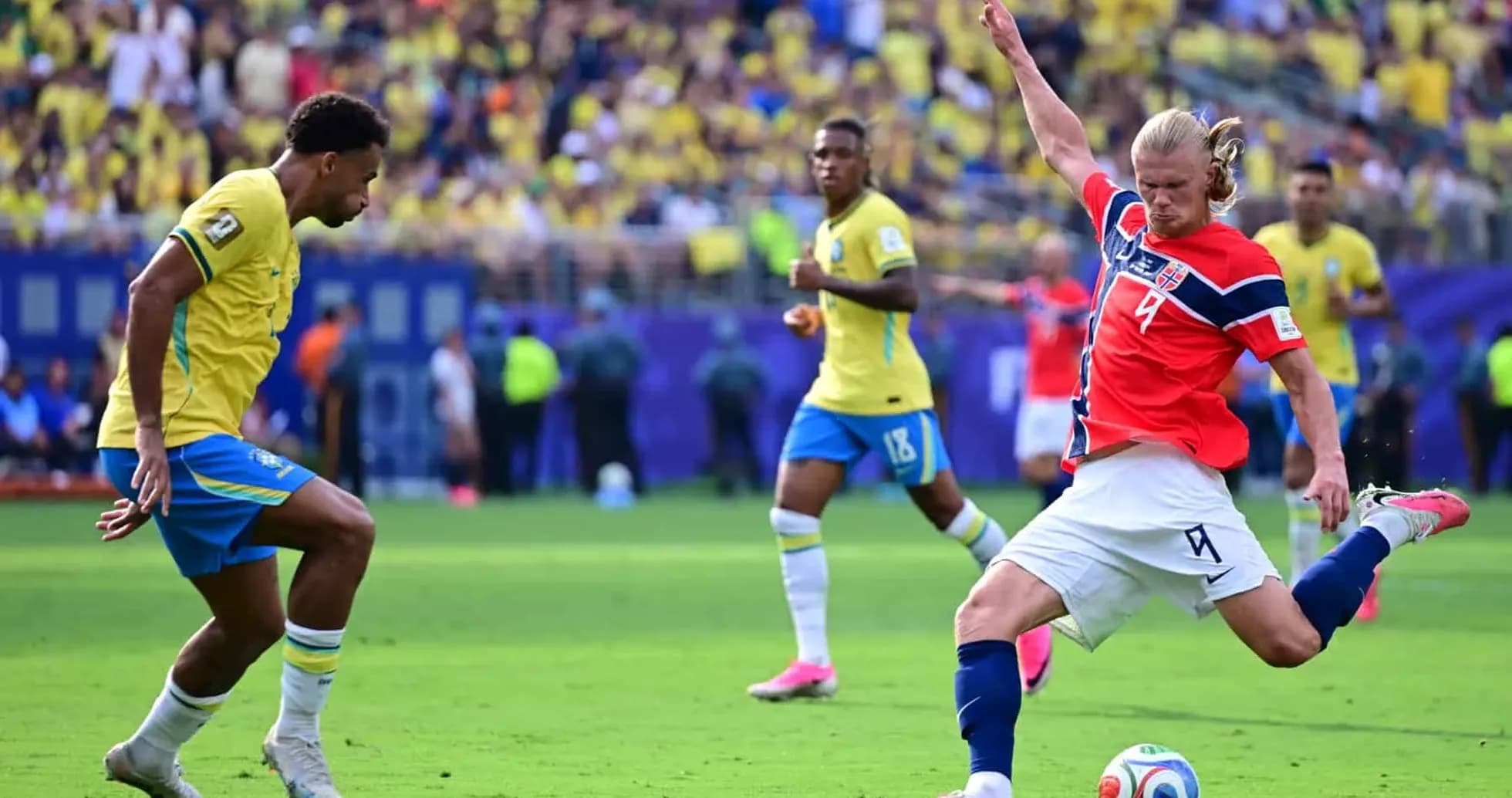
This tie’s headline was always going to be Erling Haaland against Brazil’s defensive structure. Haaland arrived as one of the tournament’s most devastating finishers: 7 goals in 4 appearances, from 15 shots with 12 on target, and an impressive 8.3 average rating. He had won 18 of 37 duels and even chipped in with 1 interception, but his primary weapon was the relentless verticality of his movement.
Brazil’s shield against that was multi-layered. In front of Alisson – the constant in goal – stood a back four of Danilo, Marquinhos, Gabriel and Douglas Santos. Marquinhos and Gabriel were tasked with handling Haaland’s physicality, while Danilo’s job was complicated by A. Nusa’s pace and the threat of Sorloth attacking the far post.
In front of them, Casemiro and Bruno Guimaraes formed the engine. Bruno had quietly become one of the tournament’s most influential midfielders: in total this campaign he had produced 4 assists, 191 passes at 86% accuracy, 10 key passes, 11 tackles and 1 blocked shot. He was Brazil’s metronome and their vertical passer, the man tasked with finding Vinicius Junior and Cunha between Norway’s lines.
Across from him, Martin Ødegaard orchestrated Norway’s attacks. Ødegaard’s 3 assists, 263 completed passes at 90% accuracy and 4 key passes painted the picture of a conductor who dictates tempo and direction. With Sander Berge and P. Berg providing ballast and ball-winning, Ødegaard could drift into pockets between Casemiro and the centre-backs, looking for the angle that released Haaland or Nusa.
On the flanks, G. Martinelli and Rayan against J. Ryerson and D. Wolfe offered a different kind of battle. Martinelli’s direct running from midfield zones and Rayan’s ability to drift inside were meant to overload Norway’s half-spaces. But with no Paquetá to combine and no Raphinha to stretch the opposite side, those overloads often risked becoming isolated dribbles rather than sustained superiority.
IV. Statistical Prognosis – Brazil’s Control vs Norway’s Punch
Heading into this game, Brazil’s numbers painted them as the more controlled side. At home – effectively, in matches where they had been designated as the home team – they had played 4 times, winning 2, drawing 1 and losing 1, scoring 7 and conceding 4. On their travels they had played once, winning it, scoring 3 and conceding none. Their biggest home win was 3-0, their only home defeat 1-2, and in total this campaign they had failed to score in 0 matches. Their penalty record, however, hinted at fragility under pressure: from 2 penalties, they had scored 1 and missed 1, a 50.00% split that underlined the mental strain of the moments that decide knockouts.
Norway’s profile was more extreme. At home they had played 2, winning 1 and losing 1, scoring 4 and conceding 6. On their travels they had been perfect: 3 played, 3 wins, 8 scored, 3 conceded. Their biggest away win, 1-4, and their biggest home defeat, 1-4, encapsulated the volatility. In total this campaign they had not kept a single clean sheet and had not failed to score once. Even from the spot they carried a scar: 1 penalty taken, 1 missed, 0% conversion.
The intersection of these profiles suggested a game-state story. Brazil’s defensive record – 4 conceded in 5 overall – implied they could keep Haaland relatively quiet in phases, but Norway’s refusal to leave a match goalless meant that one moment of transition, one lapse on a second ball, was always likely. Brazil’s yellow-card spikes in the 61-75 and 76-90 ranges hinted at a side that might grow more desperate if the game tilted away from their script.
In the end, the 2-1 scoreline in Norway’s favour felt like the logical extreme of these tendencies. Brazil’s structure, their careful build through Bruno Guimaraes and their reliance on Vinicius Junior and Matheus Cunha – who had combined for 7 goals in total this campaign – could not quite contain the blunt inevitability of Haaland and the subtlety of Ødegaard. Norway’s 4-3-3, imperfect and porous, once again gave up a goal but trusted that their own attacking punch would land harder.
Following this result, the narrative of both teams crystallises. Brazil exit as a side whose numbers promised control but whose key absences and disciplinary edges eroded their margin for error. Norway advance as the tournament’s great disruptors: a team that never keeps things tidy, but almost always makes them decisive.