.svg&w=384&q=75 "Naijagoal logo")

Brazil vs Norway: World Cup Round of 16 Match Analysis
Brazil’s 2-1 defeat to Norway at MetLife Stadium in this World Cup Round of 16 tie was defined by a stark contrast between territorial control and chance quality. Norway dominated the ball with 66% possession and 680 passes, yet Brazil’s direct, transition-heavy approach generated a far higher xG (2.73 to 0.84) and more shots (14 to 9). Ultimately, Norway’s superior efficiency in both boxes, plus Erling Haaland’s ruthless finishing, overturned that underlying balance.
First Half
The first half was tactically cagey but already showed the game’s core pattern. Norway built patiently through Martin Ødegaard, Sander Berge and Patrick Berg, circulating possession and trying to pull Brazil’s compact midfield three of Casemiro, Bruno Guimarães and Rayan out of shape. Brazil, though, were set up to break quickly through Vinícius Júnior and Matheus Cunha, accepting a lower block and only 34% of the ball in exchange for space behind Norway’s back line.
The early VAR intervention at 12 minutes, when a penalty for Brazil was confirmed after Matheus Cunha’s involvement, underlined the danger of Brazil’s verticality. Even though Bruno Guimarães failed to convert the spot kick at 14 minutes, the sequence showed how quickly Brazil could puncture Norway’s structure when they bypassed the midfield and attacked directly into the box. By half-time, despite the 0-0 scoreline, Brazil had already matched Norway’s threat in terms of territory inside the box (10 shots inside the area by full time versus Norway’s 7), reflecting a clear plan to drive attacks into central finishing zones rather than rely on speculative efforts.
Second Half
Norway’s adjustments at the break were significant. Stale Solbakken removed Antonio Nusa and Alexander Sørloth, introducing Andreas Schjelderup and Oscar Bobb. This shifted Norway’s attacking shape: Schjelderup operated more as a connector around Haaland, offering inside pockets between Brazil’s lines, while Bobb’s technical security on the right improved their rest-defense in transition. The result was a more stable attacking structure that limited Brazil’s ability to counter directly through the half-spaces.
Carlo Ancelotti’s response from 58 minutes onward tilted the game further towards chaos. Endrick (IN) came on for Matheus Cunha (OUT), followed by Danilo Santos (IN) for Rayan (OUT) and Neymar (IN) for Gabriel Martinelli (OUT) at 68 minutes, and Éderson (IN) for Bruno Guimarães (OUT) on 79 minutes. These changes pushed Brazil into a more attacking, less balanced configuration: Neymar as a free creator, Endrick offering depth runs, and Casemiro increasingly isolated as the lone true defensive midfielder. Brazil’s shot volume and xG profile benefited, but their defensive cover in front of the centre-backs eroded.
Norway’s opening goal on 80 minutes captured that trade-off. With Brazil stretched and their midfield screen loosened, Schjelderup found space to link play and slipped Haaland through for a “Normal Goal”. It was a classic pattern: Norway’s patient possession finally piercing a Brazil side whose substitutions had skewed heavily towards attack. The second Haaland strike at 90 minutes, again assisted by Schjelderup, was structurally similar – Brazil chasing the game, lines disjointed, and Norway exploiting the gaps with direct vertical service into their centre-forward.
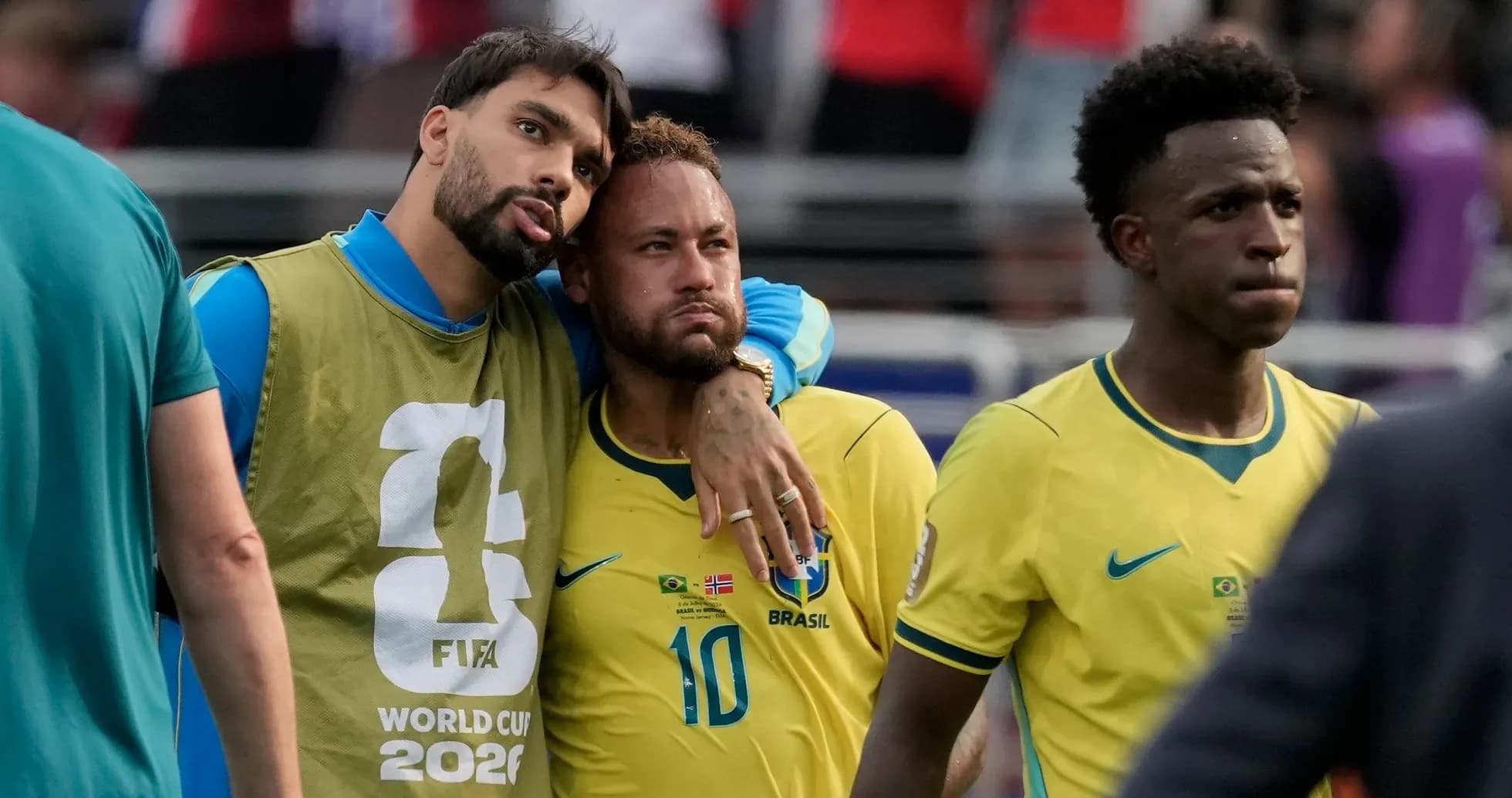
Brazil’s late penalty, converted by Neymar at 90+9 minutes, came after a period of frantic attacking pressure and individual initiative rather than controlled positional play. By then, Ancelotti’s side were effectively in a 4-2-4 or even 3-3-4 in possession, throwing numbers forward. Neymar’s yellow card at 90+6 minutes for “Foul” reflected the emotional and tactical desperation of those closing stages, with Brazil pressing high and making riskier defensive actions to recover the ball quickly.
Defensive Structure
Structurally, Brazil’s back four of Danilo, Marquinhos, Gabriel Magalhães and Douglas Santos were asked to defend long phases without the ball, yet their compactness forced Norway into mostly low-value shots: only 9 attempts and an xG of 0.84. The issue was not volume conceded but the quality of the two decisive moments allowed to Haaland. With Casemiro often dragged into wider or higher zones to support pressing, the space between the lines for Ødegaard and later Schjelderup became the key battleground Norway eventually exploited.
In goal, Alisson (Brazil) made 3 saves and, crucially, his goals prevented figure of 0.76 aligns with the idea that he performed to expectation but could not compensate for the high-quality chances Norway finally manufactured for Haaland. At the other end, Ørjan Nyland (Norway) produced 4 saves and also posted 0.76 goals prevented, matching Alisson’s shot-stopping impact but in a very different context: Norway faced more total shots (14) and a far higher xG against, so his interventions were central to protecting the lead once established.
Passing Data
The passing data underlines the stylistic divide. Norway’s 680 total passes with 617 accurate (91%) depict a side committed to controlled circulation, building through Berge and Berg and using Ødegaard as a rhythm-setter. Brazil, with 329 passes and 279 accurate (85%), were far more vertical and selective in possession, prioritizing progression speed over volume. Both sides took 5 corners and were level on offsides (1 each), suggesting parity in set-piece and line-breaking attempts, but Brazil’s 10 shots inside the box versus Norway’s 7 confirm that Ancelotti’s team did reach the most dangerous zones more often.
Discipline was minimal but revealing: 7 fouls for Brazil, 6 for Norway, and only one card – Neymar’s late yellow for “Foul”. That solitary booking, arriving while Brazil were chasing an equalizer, fits a game where tactical fouls were rare and most defensive work came from positional organization rather than systematic disruption.
Statistically, Brazil can point to the xG (2.73–0.84), shot volume (14–9) and box entries as evidence that their game plan produced enough to win on another day. Norway, however, executed a classic knockout blueprint: dominate the ball, limit opponent passing rhythm, and rely on elite efficiency in the penalty area. The decisive difference lay in Norway’s clinical edge through Haaland and Schjelderup, versus Brazil’s failure to convert an early penalty and fully capitalize on their superior chance quality.