.svg&w=384&q=75 "Naijagoal logo")

Brazil vs Morocco: Tactical Duel Ends in 1-1 Draw
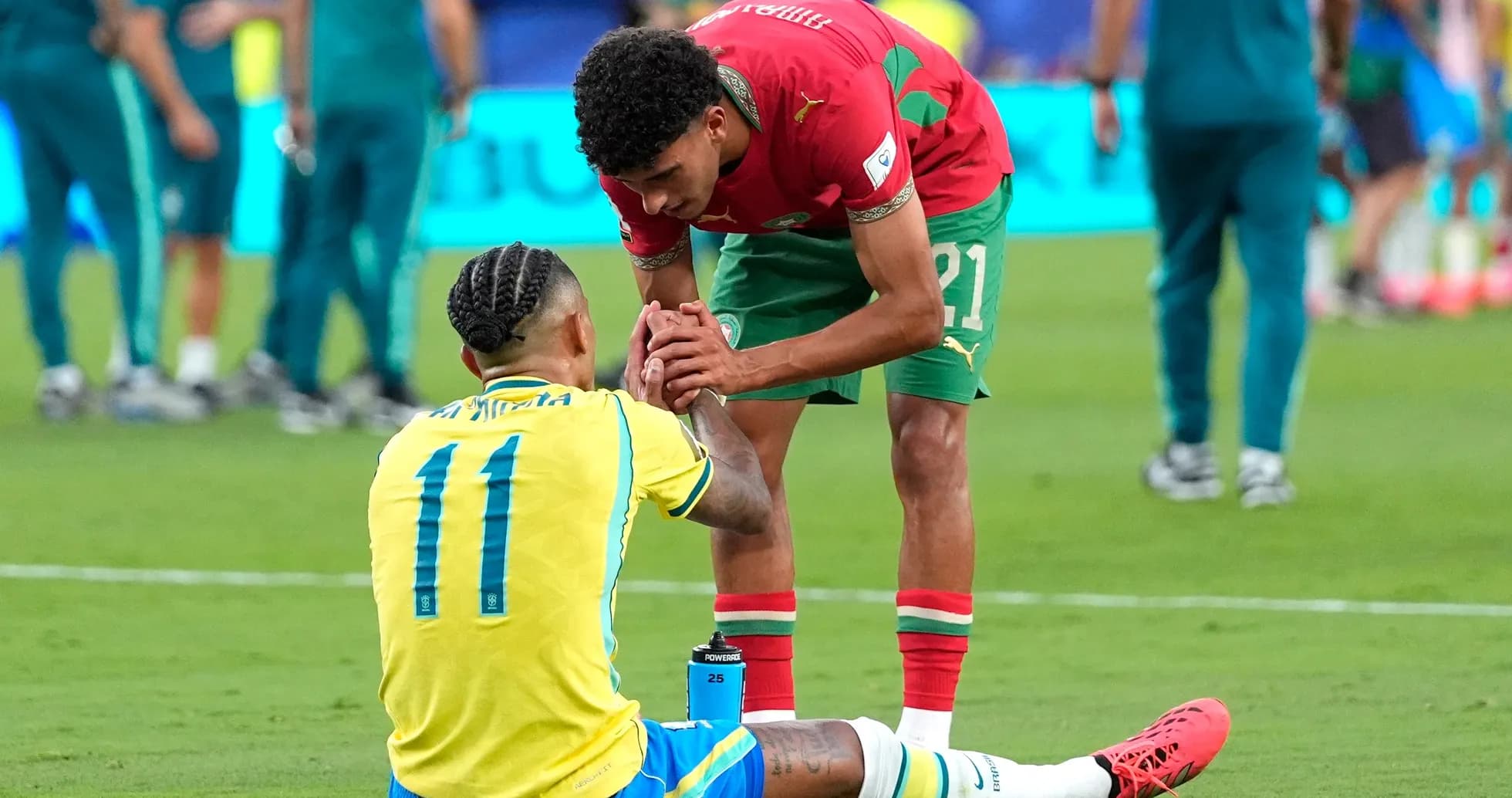
Brazil and Morocco shared a 1-1 draw at MetLife Stadium in a World Cup Group Stage opener that quickly settled into a clear tactical duel between two 4-2-3-1 systems interpreted in very different ways. Brazil, under Carlo Ancelotti, controlled marginally more of the ball (54% possession) and constructed longer passing sequences, but Morocco, coached by Mohamed Ouahbi, were more direct and vertical, using their attacking midfield line to punch through Brazil’s half-spaces. The statistical balance in both total shots (12-12) and xG (Brazil 1.24, Morocco 1.28) underlined a contest where each side had distinct phases of control rather than one dominant protagonist.
The scoring opened in the 21st minute when Ismael Saibari finished a Morocco move, assisted by Brahim Díaz, reflecting Ouahbi’s plan to exploit Brazil between the lines. Brazil’s response on 32 minutes came through Vinícius Júnior, set up by Bruno Guimarães, a goal that encapsulated Brazil’s best attacking pattern: regains in midfield followed by fast progression into the left half-space.
Discipline and Management
Discipline tilted against Brazil and subtly influenced the midfield battle. The card log, in chronological order, was:
- 37' Casemiro (Brazil) — Foul
- 43' Roger Ibañez (Brazil) — Foul
Morocco finished without a booking, which aligned with their compact defensive structure and controlled aggression, while Brazil’s double caution in the first half reflected difficulties in managing Moroccan transitions.
Ancelotti’s in-game management was assertive and structurally significant. At 46', he made a double change that reshaped the back line and the pivot:
- 46' Danilo (IN) came on for Roger Ibañez (OUT)
- 46' Fabinho (IN) came on for Casemiro (OUT)
With Danilo moving into the defensive line and Fabinho anchoring midfield, Brazil sought cleaner first-phase build-up and better protection against Morocco’s counters. The shift effectively turned Brazil’s rest-defense into a more stable three-plus-one when full-backs advanced.
On 61', Brazil altered their attacking reference points:
- 61' Luiz Henrique (IN) came on for Igor Thiago (OUT)
- 61' Matheus Cunha (IN) came on for Lucas Paquetá (OUT)
This reconfiguration tilted Brazil towards a more fluid, mobile front, with fewer classic penalty-box occupations and more rotations between the lines. It aimed to drag Morocco’s centre-backs out of their zone and open lanes for Vinícius Júnior and Raphinha to attack.
Morocco’s substitutions were more about energy maintenance and preserving structure than changing the game’s geometry:
- 64' Samir El Mourabet (IN) came on for Azzedine Ounahi (OUT)
- 64' Chemsdine Talbi (IN) came on for Brahim Díaz (OUT)
- 80' Ayoube Amaimouni Echghouyab (IN) came on for Bilal El Khannouss (OUT)
- 80' Anass Salah-Eddine (IN) came on for Noussair Mazraoui (OUT)
- 89' Soufiane Rahimi (IN) came on for Ismael Saibari (OUT)
Each change kept the 4-2-3-1 intact, refreshing legs in the wide and central channels without sacrificing the compact double pivot that had frustrated Brazil.
Goalkeeper Performances
Both goalkeepers were relatively protected by their structures but had distinct workloads. Alisson (Brazil) faced 2 shots on goal and made 1 save, with Morocco generating 12 total shots but often being forced into less dangerous locations, as reflected by their split between shots inside (6) and outside the box (6). The Brazilian back four, especially Marquinhos and Gabriel Magalhães, were effective at getting bodies in front of attempts, contributing to Brazil’s 4 blocked shots.
Bono (Morocco) saw more on-target volume, with Brazil recording 4 shots on goal. He made 3 saves, supported by a back line that combined strong box protection with proactive full-backs. Morocco’s 6 blocked shots highlight how often their defenders stepped out to close shooting lanes, particularly against Brazil’s attempts from central zones just outside the penalty area.
Possession and Structure
In possession, Brazil’s 4-2-3-1 leaned towards a 2-3-5 in established attacks. Douglas Santos and Roger Ibañez (later Danilo) pushed high and wide, while Casemiro and Bruno Guimarães initially formed the double pivot. Bruno Guimarães’ role was crucial: he connected the centre-backs to the advanced midfield line, enabling Paquetá to occupy the right half-space and Vinícius Júnior to drift inside from the left. Brazil’s passing numbers — 501 passes, 441 accurate (88%) — show a side comfortable circulating the ball, especially across the back line and midfield, but occasionally lacking vertical incision against a set block.
Morocco’s 4-2-3-1 morphed into something closer to a 4-4-1-1 out of possession. Ayyoub Bouaddi and Neil El Aynaoui shielded the defence, while Bilal El Khannouss and Azzedine Ounahi tucked in from wide positions to compress central spaces, leaving Achraf Hakimi and Noussair Mazraoui to manage width. Their 432 passes, 375 accurate (87%), with only 46% possession, point to a team that did not simply clear the ball but tried to build selectively, often triggering attacks through diagonal passes from the full-backs into the feet of the advanced midfielders.
Pressing Dynamics
The pressing dynamics were asymmetrical. Brazil’s fouls (15) and two yellow cards suggest higher and more frequent attempts to counter-press immediately after losing the ball, sometimes arriving late. Morocco committed 14 fouls but with better card management, hinting at more controlled interventions deeper in their own half.
Statistical Balance
Statistically, the match was almost perfectly balanced. Total shots were level at 12-12, and the xG figures — Brazil 1.24, Morocco 1.28 — confirm that neither side consistently generated superior chances. Brazil’s 5 corner kicks to Morocco’s 0 underline their territorial pressure, especially in the second half, but Morocco’s ability to limit Brazil to 4 shots on goal from that platform speaks to their penalty-area organisation.
Defensively, both teams showed strong overall form. Brazil’s defensive index in this match was built on restricting Morocco’s shot quality and volume on target, while Morocco’s rested on a combination of deep block discipline and Bono’s (Morocco) reliability, reflected in his 3 saves and 0.46 goals prevented. The identical goals prevented values (0.46 for each goalkeeper) encapsulate the story: two well-structured sides, two goalkeepers performing to a similar standard, and a 1-1 scoreline that accurately mirrors the underlying balance of the contest.