.svg&w=384&q=75 "Naijagoal logo")
Bologna Stuns Napoli in Tactical Showdown
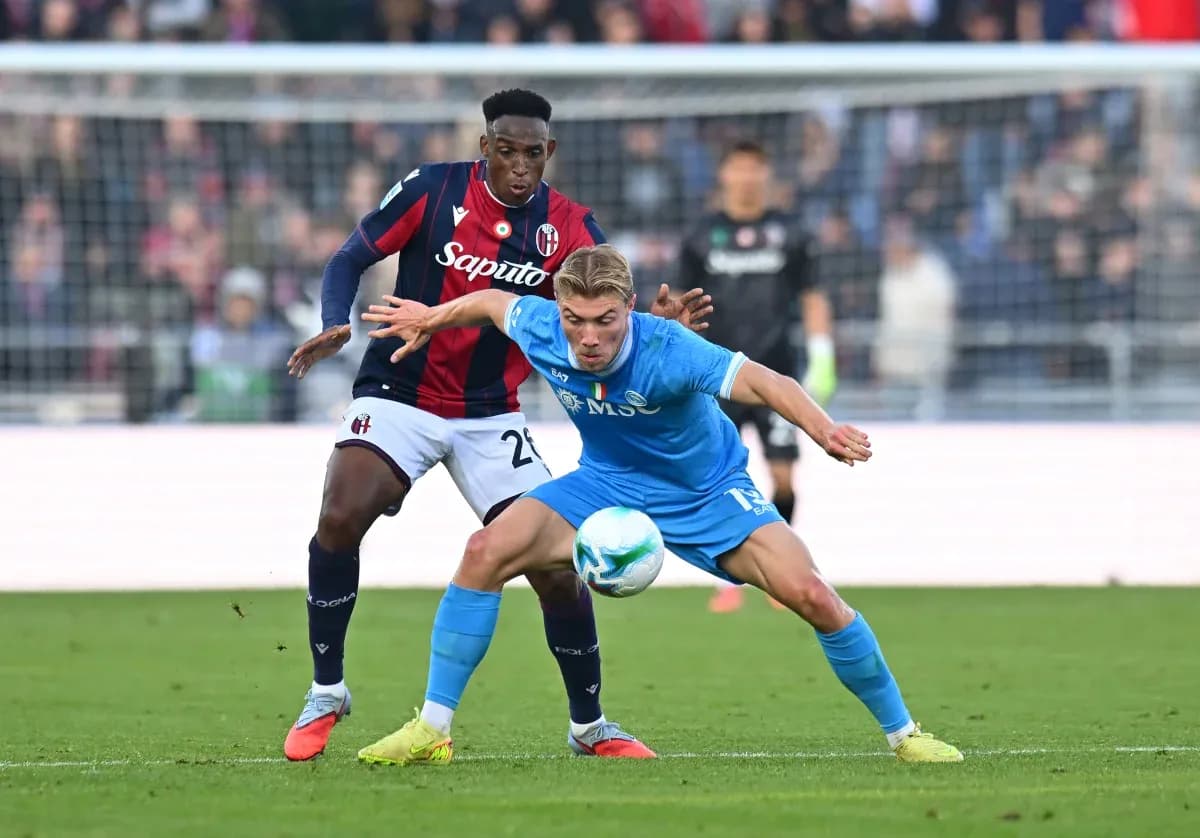
Under the lights of Stadio Diego Armando Maradona, this was billed as a statement game between a title-chasing Napoli and a surging Bologna. Heading into this game, Napoli sat 2nd in Serie A on 70 points, with a goal difference of 18 built on 54 goals scored and 36 conceded overall. Bologna arrived in Naples as the league’s dangerous outsider, 8th with 52 points and a far tighter margin of 45 goals for and 43 against overall. The table said one thing; the 3-2 Bologna win told a more nuanced tactical story.
Tactical Setup
Conte doubled down on Napoli’s seasonal identity, rolling again with the 3-4-2-1 that has been his most-used shape (21 league games). V. Milinkovic-Savic was protected by a back three of G. Di Lorenzo, A. Rrahmani and A. Buongiorno, with width and thrust coming from M. Politano and M. Gutierrez as wing-backs. In the engine room, S. Lobotka and S. McTominay were tasked with both controlling tempo and guarding transitions, while Giovane and Alisson Santos floated behind lone striker R. Hojlund.
Vincenzo Italiano answered with a bold 4-3-3, a system he has leaned on less frequently than his preferred 4-2-3-1 but one that here was clearly tailored to press Napoli’s back three. M. Pessina started in goal behind a flat back four of Joao Mario, E. Fauske Helland, J. Lucumi and J. Miranda. The midfield trio of T. Pobega, R. Freuler and L. Ferguson formed a compact, combative triangle, while the front three of R. Orsolini, S. Castro and F. Bernardeschi were set up to attack the channels and isolate Napoli’s wide centre-backs.
Absentees and Game Management
The absentees gave the game its first layer of tension. Napoli were without David Neres (ankle injury), K. De Bruyne (eye injury) and R. Lukaku (hip injury) – three high-usage, high-impact attackers who would normally deepen Conte’s rotation and offer alternative profiles. Without De Bruyne’s passing range or Lukaku’s hold-up presence, the creative and scoring burden fell heavily on Hojlund, McTominay and Politano. Bologna, for their part, were missing defensive piece K. Bonifazi (inactive) and three more options in N. Cambiaghi (muscle injury), N. Casale (calf injury) and M. Vitik (ankle injury), reducing Italiano’s flexibility in rotating his back line and wide options.
Discipline and game management were always likely to be a sub-plot. Heading into this game, Napoli’s card profile showed a pronounced late-game spike: 31.91% of their yellow cards arriving between 61-75 minutes and 14.89% between 76-90, with both of their league red cards coming in the 76-90 window. Bologna, meanwhile, are serially combative after the break, with 27.27% of yellows between 61-75 and 25.76% from 76-90, plus a scattering of reds across all second-half intervals. In a match that finished 3-2 and stayed on a knife edge, that shared tendency toward late aggression framed every duel in the final quarter of an hour.
Key Duels
The “Hunter vs Shield” duel took centre stage in the form of R. Hojlund against Bologna’s defence. Hojlund came into the night with 10 league goals and 4 assists, having taken 42 shots (22 on target) across 31 appearances. His profile is that of a high-volume runner: 299 duels, 33 dribbles attempted, and 50 fouls drawn. He was attacking a Bologna back line that, overall, concedes 1.2 goals per game (43 against in 36 matches), but is notably more vulnerable on their travels, allowing 23 away goals at an average of 1.3 per away match. Yet Bologna also had a clear attacking hunter of their own: R. Orsolini, with 9 goals and 1 assist, 64 shots (30 on target) and a ruthless record from the spot – 4 penalties scored but with 2 missed that underline his high-risk, high-responsibility role.
Engine Room Battle
Behind the forwards, the “Engine Room” battle set the rhythm. McTominay, with 9 goals and 3 assists and an outstanding 88% passing accuracy from 1202 passes, represents a rare blend of box-arrival threat and midfield security. His 28 tackles, 13 blocks and 20 interceptions show how often he anchors Napoli’s central structure. Opposite him, R. Freuler and L. Ferguson were charged with disrupting that rhythm, while Pobega’s presence at the base allowed Bologna to step out aggressively and still keep a screen in front of the centre-backs.
Flank Operations
On the flanks, Politano’s role was pivotal. With 5 league assists and 36 key passes, he is Napoli’s chief supplier, and his 66 dribbles attempted (33 successful) make him a constant one-v-one outlet. Up against Joao Mario and the right side of Bologna’s defence, Politano’s ability to drag the full-back out and create interior lanes for Giovane and Alisson Santos was a core part of Napoli’s plan to unpick a compact 4-3-3 block.
Statistical Prognosis
From a statistical prognosis standpoint, the pre-match numbers painted Napoli as favourites. Heading into this game, they had scored 32 times at home at an average of 1.8 goals per home match, while conceding only 18 at an average of 1.0. Bologna, by contrast, were more potent away (29 goals, 1.6 per away game) but also more open, conceding 1.3 per away match. In xG terms, that blend usually tilts toward a Napoli win by a narrow margin: superior home attacking output against a visiting side that thrives in transition but lives with defensive risk.
Yet the final 3-2 scoreline to Bologna suggests that Italiano’s plan to exploit Napoli’s structural bravery – a high, aggressive 3-4-2-1 – paid off. The visitors’ ability to turn their away attacking average into real chances, combined with Orsolini’s cutting edge and the front three’s movement, overcame the theoretical edge of Napoli’s defensive solidity and home scoring rate. Following this result, the numbers will shift, but the tactical lesson endures: even a side as well-drilled as Conte’s Napoli can be destabilised when a confident, high-pressing 4-3-3 commits to attacking the spaces behind the wing-backs and between the outer centre-backs.