.svg&w=384&q=75 "Naijagoal logo")

Bafana Bafana and Canada Clash in Historic World Cup Knockout Match
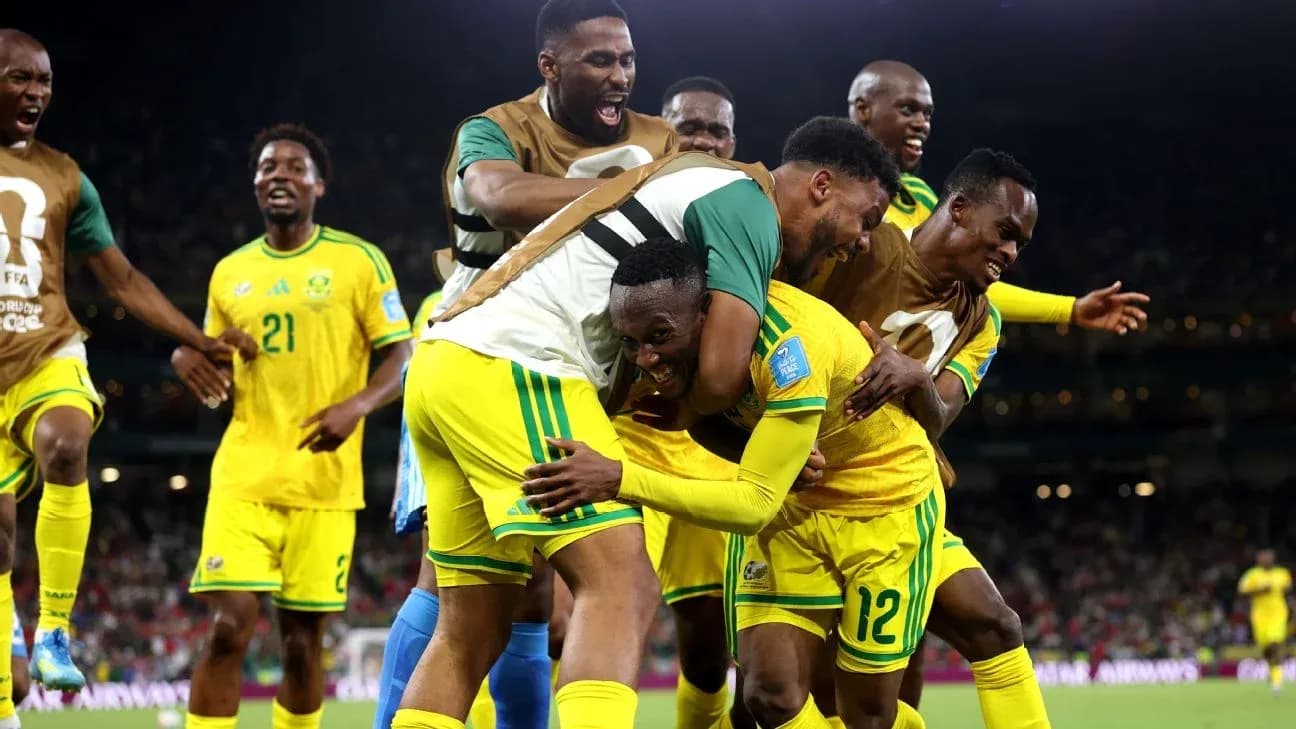
Bafana Bafana and Canada step into the unknown together on Sunday in Los Angeles, each carrying the same burden and the same thrill: a first-ever FIFA World Cup knockout match.
Two nations. Four previous tournaments for South Africa, two for Canada. Six group-stage exits between them. No knockout football. Until now.
Bafana’s slow burn finally catches fire
South Africa arrived at this World Cup with history on their backs and doubt on their shoulders. That weight only grew heavier after a flat 2-0 defeat to co-hosts Mexico in the opener, a performance that looked painfully familiar to anyone who has watched Bafana fade at this level before.
When they fell behind again in their second match, against Czechia, the script seemed written. Another campaign drifting towards another early flight home.
Teboho Mokoena tore it up.
His 83rd-minute equaliser against Czechia did more than rescue a point. It jolted life into a team that had looked stuck in neutral, and it changed the mood around the entire camp. From there, something hardened in this group.
That edge was on full display in the 1-0 win over South Korea, a result that will sit high among South Africa’s greatest World Cup nights. Thapelo Maseko struck in the 63rd minute, and Bafana refused to let go. They protected the lead with a mix of discipline and defiance, sealing second place in Group A and a ticket to Los Angeles.
There were stars in the details, too. Relebohile Mofokeng, still so young, dictated much of South Africa’s attacking play. He led that match in key passes with four, according to FlashScore, and looked every inch the playmaker Bafana have long searched for.
Now, they arrive in California not as tourists, not as hosts, but as genuine competitors with something to prove: that the old talk of a “sleeping giant” in African football finally has substance.
Canada’s co-hosts refuse to play the supporting role
Across the bracket, Canada have been carving out their own story.
Jesse Marsch’s side opened Group B with a 1-1 draw against Bosnia & Herzegovina, a solid if unspectacular start that hinted at organisation but not yet ruthlessness. That changed in brutal fashion against Qatar.
Canada tore the hosts apart in a 6-0 demolition that announced their arrival at this tournament. Goals flowed, confidence surged, and a team often pigeonholed as plucky underdogs suddenly looked like a side capable of dictating terms.
A 2-1 defeat to Switzerland in their final group game checked some of that momentum, but not the outcome. Canada still finished second in Group B and, crucially, showed they could trade blows with a seasoned European side.
All of this has come with key absences. Alphonso Davies, the Bayern Munich star and face of Canadian football, has yet to play a minute as he recovers from a hamstring injury. In midfield, Ismaël Koné’s World Cup ended cruelly with a broken leg against Qatar, a serious blow to Marsch’s plans and to a player whose rise has been one of Canada’s recent success stories.
Even so, Canada stand on the brink of something unprecedented: extending a first knockout run at a World Cup they are co-hosting with Mexico and the USA. They are not just making up the numbers. They are trying to bend the story of Canadian football into a new shape.
Suspensions, returns and what’s left in the tank
Both managers arrive in Los Angeles juggling the usual mix of hope, fatigue, and paperwork.
South Africa suffered a significant setback off the field when their appeal against Themba Zwane’s extended suspension failed. The creative attacker, sent off against Mexico, saw his ban stretched from one game to three. He remains unavailable and leaves a hole in Bafana’s attacking armoury.
Hugo Broos does, however, regain one of his most important pieces. Mokoena, the heartbeat in midfield and the man who sparked the turnaround against Czechia, returns from a one-match suspension after picking up yellow cards in each of South Africa’s first two games. His presence next to Sphephelo Sithole offers balance, bite, and a passing range that allows Mofokeng and the wide players to push higher.
Canada, meanwhile, continue to monitor Davies’ recovery, though he has not yet featured at this tournament. Marsch’s squad has been patched together through a series of niggles and one major loss in Koné, but the core remains intact and competitive.
Where the game could be won
On paper, both lineups offer clarity about how these sides want to play.
For South Africa, Ronwen Williams anchors the side from goal, behind a back four of Aubrey Modiba, Mbekezeli Mbokazi, Ime Okon and Khuliso Mudau. Sithole and Mokoena are set to marshal midfield, freeing a lively attacking trio of Oswin Appollis on the left, Mofokeng through the middle and Maseko on the right, with Evidence Makgopa leading the line.
Canada are expected to respond with Maxime Crepeau in goal and a back line of Richie Laryea, Derek Cornelius, Luc de Fougerolles and Alistair Johnston. Across midfield, Ali Ahmed, Mathieu Choiniere, Nathan Saliba and Tajon Buchanan provide width and energy, while Tani Oluwaseyi partners Jonathan David up front.
The battle between South Africa’s inventive No. 10, Mofokeng, and Canada’s central block will be central to the story. If he finds pockets of space, Bafana’s wide men can isolate full-backs and run at them. If Canada close him down, David and Oluwaseyi will relish transitions the other way.
Set pieces could also tilt the contest. With Mokoena back on the pitch and Canada’s aerial presence at both ends, one dead ball might decide a tight knockout tie.
The stage and the stakes
Los Angeles Stadium in Inglewood will host the occasion, with kick-off at 12 p.m. local time on Sunday (9 p.m. CAT, 8 p.m. BST, 7 p.m. GMT). On the touchline, Portuguese referee João Pinheiro will oversee proceedings. He brings Champions League experience and a reputation that precedes him, not least after criticism of his handling of Bayern Munich’s semi-final against Paris Saint-Germain.
The eyes on this match will be many and varied. In South Africa, fans can follow on SuperSport’s DSTV channels 201, 202 and 235, with SABC offering free-to-air coverage and SportyTV another streaming option. In Canada, TSN, RDS, CTV and Crave carry the broadcast, while US viewers can tune in via FOX, Telemundo or Peacock.
These are the trappings of a big World Cup night. But the real significance lies deeper.
The last and only time these nations met, back in 2007 in Durban, Teko Modise scored twice in a 2-0 South Africa win. That was a friendly. This is something entirely different.
Now, in the glare of a World Cup knockout, one of them will step where they have never been before. The other will walk away knowing that history was within reach and slipped through their fingers.
For Bafana Bafana, it is a chance to show that the giant is not just stirring but standing. For Canada, it is an opportunity to prove that this co-hosting era is not a one-off moment, but the start of a permanent shift in their footballing identity.
Ninety minutes in Los Angeles will not answer every question about these two teams. But it will answer one that has lingered for decades: when the stakes are highest, who truly belongs on this stage?