.svg&w=384&q=75 "Naijagoal logo")
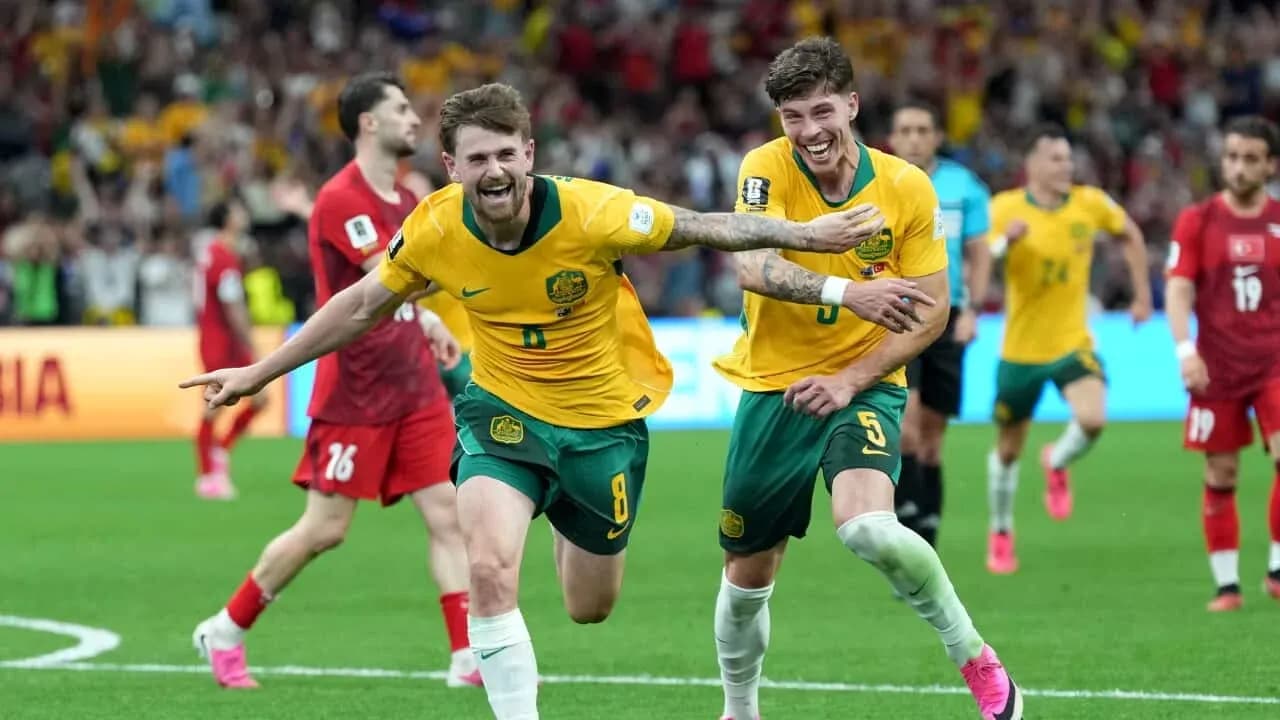

Australia's Tactical Masterclass in 2-0 Win Over Türkiye
Australia’s 2-0 win over Türkiye at BC Place was a classic case of defensive control and ruthless efficiency in transition overturning the raw weight of territory and volume. In a World Cup group opener where Türkiye had 72% possession and 30 shots, Tony Popovic’s side leaned into a compact 5-4-1, protected their box aggressively, and struck with two well-timed surges from midfield to build a lead they then defended with discipline and structure.
The scoring opened on 27 minutes, perfectly illustrating Australia’s plan. Nestory Irankunda drifted from his right-midfield berth into an advanced pocket, timing his run to attack space behind Türkiye’s high line. Paul Okon-Engstler, operating as a central midfielder in the second line of the 5-4-1, provided the key vertical pass and Irankunda finished to make it 1-0. It was Australia’s first real incision after long spells without the ball, and it forced Türkiye to chase into an even more possession-heavy but riskier posture.
The second goal on 75 minutes, scored by Connor Metcalfe, came after Popovic had already begun rotating his front line. By then, Türkiye’s back four had been stretched repeatedly by transitions and overlapping wing-backs. Metcalfe, starting as the right-sided central midfielder, arrived from deep to finish a move that had no recorded assist, again underlining the value of Australia’s midfield runners exploiting the spaces left by Türkiye’s aggressive attacking shape.
Discipline-wise, the match was largely clean, but the one card captured Türkiye’s growing frustration. In the 86th minute, Yunus Akgün (Türkiye) received a yellow card — Roughing — a moment that reflected how the chasing side were forced into more physical interventions as time ran out and Australia continued to disrupt rhythm with clearances, duels and time management.
Defensive Structure
Tactically, Australia’s 5-4-1 was built on a low-to-mid block that narrowed central spaces and invited Türkiye wide. The back three of Alessandro Circati, Harry Souttar and Cameron Burgess were shielded by Aiden O’Neill and Okon-Engstler, with wing-backs Jordan Bos and Jacob Italiano dropping deep to form a line of five. With only 28% possession and 270 total passes (202 accurate, 75%), Australia accepted long spells without the ball, focusing on lane blocking rather than pressing high.
The key was how well Australia protected the penalty area. Türkiye managed 14 shots inside the box but were repeatedly forced into crowded shooting lanes, reflected in their 12 blocked shots. The Socceroos’ defensive index was built on volume defending rather than proactive regains: they conceded 30 total shots but allowed very few clean looks, helping keep Türkiye’s xG to 1.33 despite that volume.
In goal, Patrick Beach (Australia) was decisive. He made 8 saves, significantly outperforming the volume of shots on target he faced relative to the final scoreline. The negative goals prevented figure (-0.95) for Australia’s team block suggests that, on pure shot quality, Türkiye might have been expected to score at least once, but Beach’s interventions and the density of defenders in front of him meant those chances never translated. On the other side, Uğurcan Çakır (Türkiye) had a quieter but more punishing evening: Australia hit 4 shots on target and scored twice, and Çakır made 2 saves, with his team’s own goals prevented metric also at -0.95, indicating that the two goals conceded were in line with, or slightly worse than, the underlying shot quality.
Türkiye’s Tactics
Türkiye’s 4-2-3-1 under Vincenzo Montella was tilted towards dominance of the ball. With 707 total passes and 638 accurate (90%), they built patiently through İsmail Yüksek and Hakan Çalhanoğlu as the double pivot, pushing full-backs Zeki Çelik and Ferdi Kadıoğlu high to pin Australia’s wing-backs. The trio of Arda Güler, Orkun Kökçü and Barış Alper Yılmaz roamed between the lines, with Kerem Aktürkoğlu leading the line and drifting wide to combine.
However, this structure produced sterile control rather than penetration. Australia’s back five compressed the central lane where Güler and Kökçü prefer to operate, forcing Türkiye into long-range efforts (16 shots outside the box) and crosses into a packed area. The introduction of Kenan Yıldız for Barış Alper Yılmaz at 46 minutes and Yunus Akgün for Orkun Kökçü at 62 was an attempt to inject more direct dribbling and one-versus-one threat, but Australia’s deep block continued to win first and second balls.
Popovic’s substitutions were clearly aimed at maintaining defensive intensity and fresh legs in transition. Nishan Velupillay (IN) came on for Irankunda (OUT) at 61', adding energy to the right side. At 74', Tete Yengi (IN) replaced Mohamed Touré (OUT), and Jason Geria (IN) came on for Italiano (OUT), reinforcing the right flank defensively. Later, Aziz Behich (IN) for Bos (OUT) and Jackson Irvine (IN) for Okon-Engstler (OUT) at 84' further solidified the block, adding experience and aerial presence as Türkiye pushed higher with more crosses and numbers.
Statistical Overview
Statistically, the match underlines how game state and structure can distort raw numbers. Türkiye’s 72% possession, 30 total shots and 8 shots on goal would normally correlate with at least one goal, and their xG of 1.33 supports that. Yet their attacks lacked the tempo changes and positional rotations needed to unhinge a settled five-man line. Australia, with only 9 total shots and an xG of 0.77, maximised efficiency: 4 shots on target, 2 goals, and a perfect exploitation of transitional moments.
Foul counts (Australia 12, Türkiye 4) also speak to the tactical dynamics. Australia accepted more defensive duels and interruptions to break rhythm, while Türkiye’s low foul count reflected a side mostly defending in rest-defence positions rather than scrambling. Corner counts (Australia 5, Türkiye 8) again show Türkiye’s territorial advantage but also Australia’s comfort in defending set plays.
In the end, this was a textbook low-possession, high-resilience performance from Australia, whose defensive structure, goalkeeper reliability and well-timed midfield runs allowed them to turn a statistically unfavourable shot profile into a controlled 2-0 World Cup group-stage victory.