.svg&w=384&q=75 "Naijagoal logo")

Aston Villa's Tactical Masterclass Against Manchester City
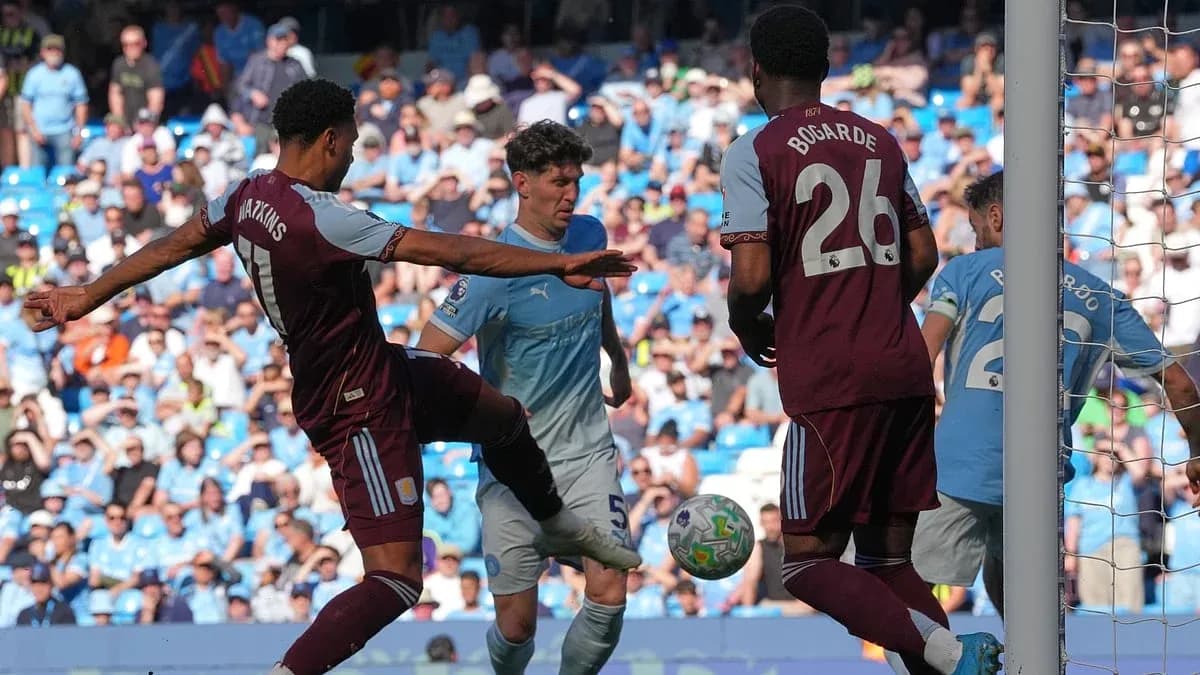
Manchester City’s 1-2 defeat to Aston Villa at Etihad Stadium was defined less by volume of possession and shots, and more by Villa’s clarity of structure and ruthlessness in transition. City’s 4-2-2-2 under Pep Guardiola produced territorial dominance (52% possession, 16 shots, 9 corners) but failed to control the key spaces Villa targeted, especially around Ollie Watkins. Unai Emery’s 4-2-3-1 absorbed pressure, then repeatedly exploited City’s rest defence and wide channels, turning a 1-0 deficit into a controlled, efficient away win.
City’s initial structure was aggressive: J. Trafford in goal behind a back four of Rico Lewis, John Stones, Ruben Dias and Nathan Ake, with Nico and Bernardo Silva as the double pivot and a very attacking line of A. Semenyo, Savinho, Phil Foden and T. Reijnders. The idea was clear: overload central zones with Silva and Nico to feed the narrow front four, while full-backs stepped high to lock Villa in. That plan worked early. City generated 10 shots inside the box and 6 blocked efforts, reflecting sustained pressure around the Villa penalty area.
The opening goal on 23 minutes from A. Semenyo encapsulated City’s early dominance. The 4-2-2-2 created numerical superiority between Villa’s lines, with Semenyo and Savinho operating in the half-spaces, pulling Villa’s double pivot of L. Bogarde and Douglas Luiz into uncomfortable positions. With Villa’s full-backs pinned by Foden and Reijnders, City were able to combine centrally and arrive in the box with runners; Semenyo’s finish rewarded that compact, vertical occupation of the central lane.
Defensively, though, City’s structure had a flaw: the double pivot often stretched horizontally to support wide combinations, leaving large gaps either side of Dias and Stones. With both full-backs advanced, transitions exposed City’s centre-backs in foot races against Watkins. Even though City limited Villa to 12 shots in total, 9 of those came inside the box, a sign that when Villa did break, they reached very high-value zones.
After half-time, Emery’s adjustments flipped the game. The introduction of Matty Cash for A. Garcia at 46’ reshaped Villa’s right flank, adding more direct running and overlap threat. Almost immediately, at 47’, Watkins struck the equaliser. Villa’s 4-2-3-1 morphed into a 4-4-2 in transition, with Emiliano Buendia stepping inside and Leon Bailey driving at the back line, forcing City’s centre-backs to defend wider and opening channels for Watkins to attack.
City’s response in the 58’-61’ window was telling. Guardiola removed Semenyo for Rayan Cherki (58’) and then Bernardo Silva for Mateo Kovacic (59’), moves that shifted the profile of the midfield from dynamic ball-carrying and pressing (Semenyo, Silva) to more controlled circulation (Cherki, Kovacic). While this improved City’s passing stability, it reduced their ability to counter-press Villa’s first pass after turnovers. Villa capitalised: at 61’, Watkins scored again, this time assisted by Ross Barkley, with the goal confirmed by VAR at 63’. The pattern was familiar—Villa breaking quickly into the vacated central channels, with Barkley finding Watkins between and behind City’s centre-backs.
From that point, Emery moved into game-management mode. A triple substitution at 73’—Youri Tielemans for Douglas Luiz, Pau Torres for Victor Lindelof, and A. Onana for L. Bogarde—rebalanced the side. Tielemans added composure in possession, Torres improved aerial and positional security, and Onana offered fresh legs and physical presence in midfield. Villa’s block became more compact, lines closer together, and City’s access into central pockets was significantly reduced.
Guardiola’s late substitutions (J. Doku for Reijnders and R. Ait-Nouri for Ake at 77’, J. Gvardiol for Stones at 78’) pushed City into an even more aggressive attacking posture. Doku provided 1v1 threat wide, Ait-Nouri added another overlapping option, and Gvardiol’s left-footed distribution was aimed at switching play quickly. However, this further compromised rest defence. Villa’s discipline—only 4 fouls and no yellow cards—underlined how rarely they were forced into desperation defending; their structure, rather than last-ditch challenges, did most of the work.
Individually, the goalkeepers’ performances aligned with the underlying numbers. J. Trafford (Manchester City) made 3 saves, while M. Bizot (Aston Villa) recorded 2. The goals prevented metrics (0.28 for each team) suggest neither keeper dramatically overperformed, and that Villa’s win was more about shot quality and defensive organisation than goalkeeping heroics. City’s 1.25 xG versus Villa’s 1.58 xG reinforces that Villa carved out slightly better chances despite having fewer total shots.
Discipline also shaped the closing stages. The only card of the match came on 82’: Rico Lewis (Manchester City) — Foul. It reflected City’s increasing need to break Villa’s counters with tactical infringements as they chased the game. Yet Villa’s substitutions at 86’, with John McGinn replacing Barkley, further solidified the midfield, helping them manage territory and tempo in the final minutes. Even when Phil Foden thought he had rescued something late, a potential goal at 90+2’ was disallowed after VAR intervention, preserving Villa’s 2-1 advantage.
Statistically, City’s 458 passes to Villa’s 436, with 405 accurate for City (88%) and 394 for Villa (90%), show a contest of two technically secure sides. But Villa’s slightly higher pass accuracy, combined with more efficient shot selection (12 shots, 5 on target, 9 inside the box), points to a game plan that prioritised quality over volume. City’s 9 corners and territorial control produced pressure but not enough clear chances, while Villa’s compact 4-2-3-1 and incisive transitions maximised the impact of every attack.
In tactical terms, the match underlined a recurring theme: Manchester City can dominate the ball without fully controlling transition spaces, and a well-drilled Aston Villa under Unai Emery are capable of turning limited possession into decisive, high-value attacking moments.