.svg&w=384&q=75 "Naijagoal logo")
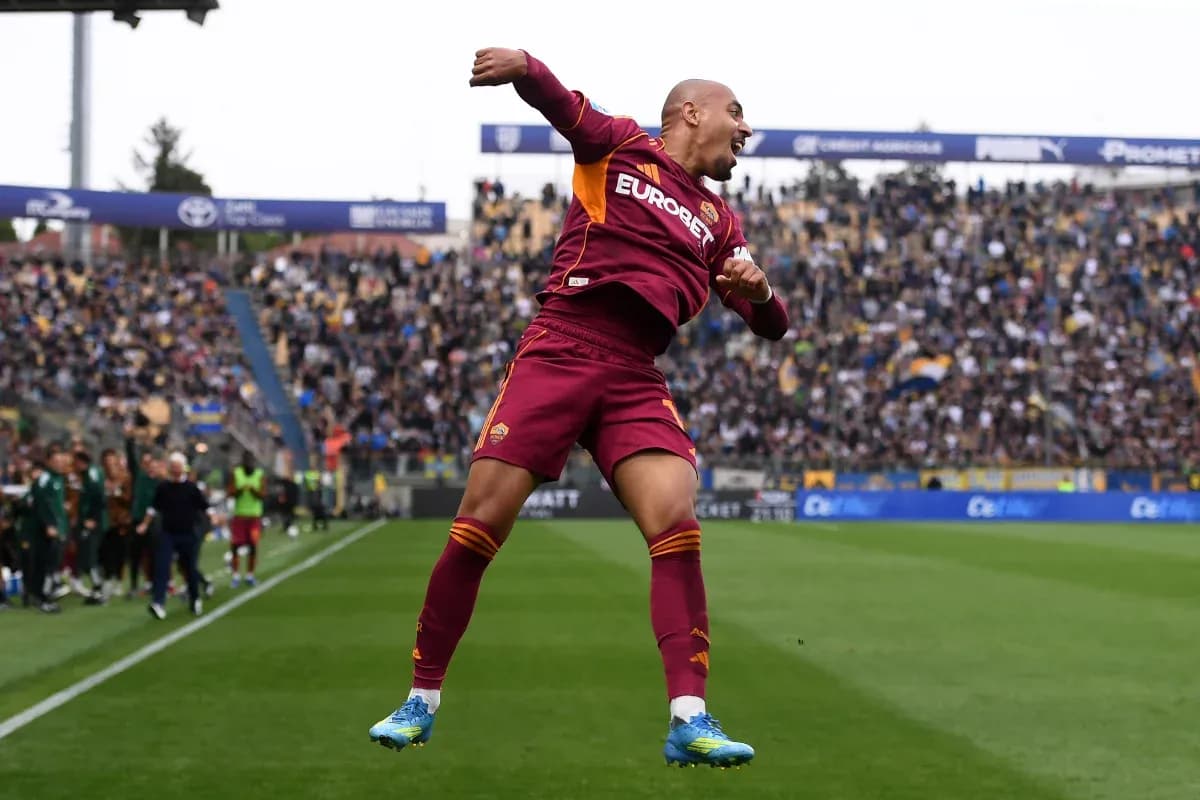
AS Roma Edges Parma 3-2 in Tactical Showdown
Under the late-afternoon light at Stadio Ennio Tardini, a 3-2 scoreline to AS Roma told only part of the story. Following this result, it felt like a meeting between two clubs whose seasonal identities were already etched into the Serie A table: Parma sitting 13th on 42 points, Roma in 5th with 67, one side still learning how to suffer, the other refining the art of winning tight games.
I. The Big Picture – Structures and Seasonal DNA
The tactical shapes mirrored each club’s broader campaign. Parma returned to their most-used 3-5-2, a structure they have employed in 17 league matches, leaning into density in midfield and wing-back width to compensate for a modest attack. Overall this season, Parma have scored 27 goals and conceded 45; the goal difference of -18 underlines a side that often has to overachieve in moments rather than dominate games.
At home, that identity is even starker. Heading into this game, Parma had played 18 home matches, winning 4, drawing 6 and losing 8. They had scored 15 goals at home (an average of 0.8) and conceded 25 (1.4 on average). This is a team that lives on tight margins at Ennio Tardini, frequently failing to score – 7 home blanks – but occasionally grinding out results through organisation and set phases.
Roma arrived with a more assertive profile and a 3-4-2-1 that has become their calling card, used 28 times this season. Overall they had 21 wins from 36, with 55 goals for and 31 against, a goal difference of +24 that reflects a side both dangerous and largely secure. On their travels, Roma’s numbers were more human: 9 away wins, 1 draw and 8 defeats, with 24 goals scored (1.3 on average) and 21 conceded (1.2). They are not invulnerable away from home, but their attacking ceiling is higher than Parma’s home ceiling.
The final 3-2 in Roma’s favour felt like the meeting point of these trends: Parma, usually low-scoring but combative, punching above their weight in front of their fans; Roma, a top-five side with enough offensive quality to edge a chaotic contest.
II. Tactical Voids – Absences and Discipline
Both coaches were forced to navigate significant absences that reshaped their options and, subtly, their game plans.
Carlos Cuesta’s Parma were without A. Bernabe (muscle injury), B. Cremaschi, M. Frigan and G. Oristanio (all knee injuries). That stripped away creative and rotational depth between the lines, pushing Parma towards a more functional midfield trio of H. Nicolussi Caviglia, C. Ordonez and M. Keita, with E. Valeri and E. Delprato tasked to provide width. The bench carried forwards like M. Pellegrino and D. Mikolajewski, but the lack of an in-form secondary creator meant Parma’s 3-5-2 was always going to lean on transitions, crosses and set pieces rather than intricate central play.
Roma’s voids were arguably even more high-profile. A. Dovbyk (groin), E. Ferguson (ankle), L. Pellegrini (thigh) and B. Zaragoza (knee) all missed out. That removed a traditional reference striker, a box-arriving midfielder and a major creative hub in Pellegrini. In response, Piero Gasperini Gian doubled down on mobility and interchanges in the final third: D. Malen as the spearhead, with P. Dybala and M. Soule floating behind him.
Disciplinary profiles added another layer of tension. Parma’s season-long card data reveals a combustible side: yellow cards peak between 46-60 minutes and 76-90 minutes (both at 21.88%), with red cards clustered around 31-45 minutes (40.00%) and then spread across the second half. This is a team that tends to fray emotionally as intensity rises.
Roma, by contrast, are more controlled but still aggressive. Their yellow cards are heavily concentrated from 46-60, 61-75 and 76-90 minutes (each 23.08%), suggesting a side that presses and duels hard after half-time. Red cards for Roma are rare but arrive in the 46-60 and 61-75 windows. In a match that finished 3-2, that shared tendency for late, hard challenges was always likely to fuel a stretched, volatile second half.
III. Key Matchups – Hunter vs Shield, Engine Room Battles
The “Hunter vs Shield” narrative was embodied by D. Malen leading Roma’s line against a Parma defence anchored by M. Troilo, A. Circati and L. Valenti.
Malen entered as one of Serie A’s most efficient forwards: 13 goals and 2 assists in 16 appearances, with 45 shots and 28 on target. He is not just a finisher but a multi-phase threat, capable of running channels, attacking the box and linking with Dybala and Soule. His penalty record this season is spotless, with 3 scored from 3 and no misses, adding a clinical edge in high-leverage moments.
Parma’s back line, however, is not passive. Troilo, in particular, is a high-impact defender. Across the season he has made 15 successful blocked shots, a notable figure that underlines his willingness to step into the line of fire. Yet his disciplinary record – 7 yellow cards, 1 yellow-red and 1 straight red – hints at the cost of that aggression. Against a forward like Malen, whose dribbling (36 attempts, 14 successful) and duel volume (128 duels, 43 won) constantly test timing and composure, that matchup always threatened to tilt the game.
In the “Engine Room”, Roma’s control hinged on B. Cristante and M. Kone against Parma’s central trio. Cristante’s role as a metronome and screen allowed Roma’s wide players, Z. Celik and Wesley Franca, to push high. Celik himself is a fascinating hybrid: 59 tackles, 6 blocked shots and 17 interceptions across the season, but also 25 key passes and 2 assists. He is both shield and auxiliary playmaker from the right.
For Parma, H. Nicolussi Caviglia and M. Keita were tasked with compressing Roma’s passing lanes while feeding the front two. Without Bernabe, the burden of progression fell more on their ability to break lines with the first or second pass after regaining the ball, and on the vertical movements of forwards like G. Strefezza and N. Elphege.
Higher up, M. Soule embodied Roma’s creative nerve. With 5 assists and 6 goals, plus 43 key passes and 91 dribble attempts (33 successful), he is the bridge between midfield structure and final-third chaos. His capacity to drift into half-spaces, combine with Dybala and slip Malen into channels gave Roma a layered threat Parma struggled to fully contain.
IV. Statistical Prognosis – xG Shape and Defensive Solidity
While explicit xG numbers are not provided, the season-long profiles of both sides sketch the underlying expected goals story behind a 3-2.
Parma, with only 27 goals in total and an overall scoring average of 0.8 per match, typically generate low-volume, low-probability chances. Their 12 clean sheets overall (4 at home, 8 away) show they can defend compactly, but the 45 goals conceded and 1.3 goals-against average underline that when their block is broken, they struggle to fully suppress quality opportunities.
Roma, by contrast, project as a side whose xG for consistently outstrips opponents. With 55 goals at an overall rate of 1.5 per match and only 31 conceded (0.9 per match), they combine sustained attacking pressure with a disciplined defensive line. Ten home clean sheets and 6 away clean sheets speak to their structural solidity, even if their away record (21 goals conceded on their travels) shows occasional vulnerability when the game becomes transitional.
In a match that finished 3-2, the pattern is almost archetypal: Roma’s higher attacking ceiling and sharper individual quality – Malen’s finishing, Soule’s creativity, Dybala’s craft – produced enough high-value chances to outstrip Parma’s more sporadic threat. Parma, buoyed by the home crowd and the emotional charge of their 3-5-2, found ways to punch through, but their season-long averages suggest that scoring twice was them pushing above their usual offensive baseline.
Following this result, the tactical verdict is clear. Roma’s 3-4-2-1, even without key names like L. Pellegrini and A. Dovbyk, remains a system that can manufacture goals through movement and overloads rather than relying solely on a classic number nine. Parma’s 3-5-2 can compete and disrupt, especially when defenders like Troilo step up and when the wing-backs hit their marks, but the underlying numbers still paint them as a side walking a thin line between resilience and fragility.
On this afternoon at Ennio Tardini, that thin line produced a spectacle – and, fittingly, tilted towards the side whose season-long metrics had always suggested they would find one more decisive moment.