.svg&w=384&q=75 "Naijagoal logo")

AC Milan vs Atalanta: Tactical Breakdown of a 2-3 Defeat
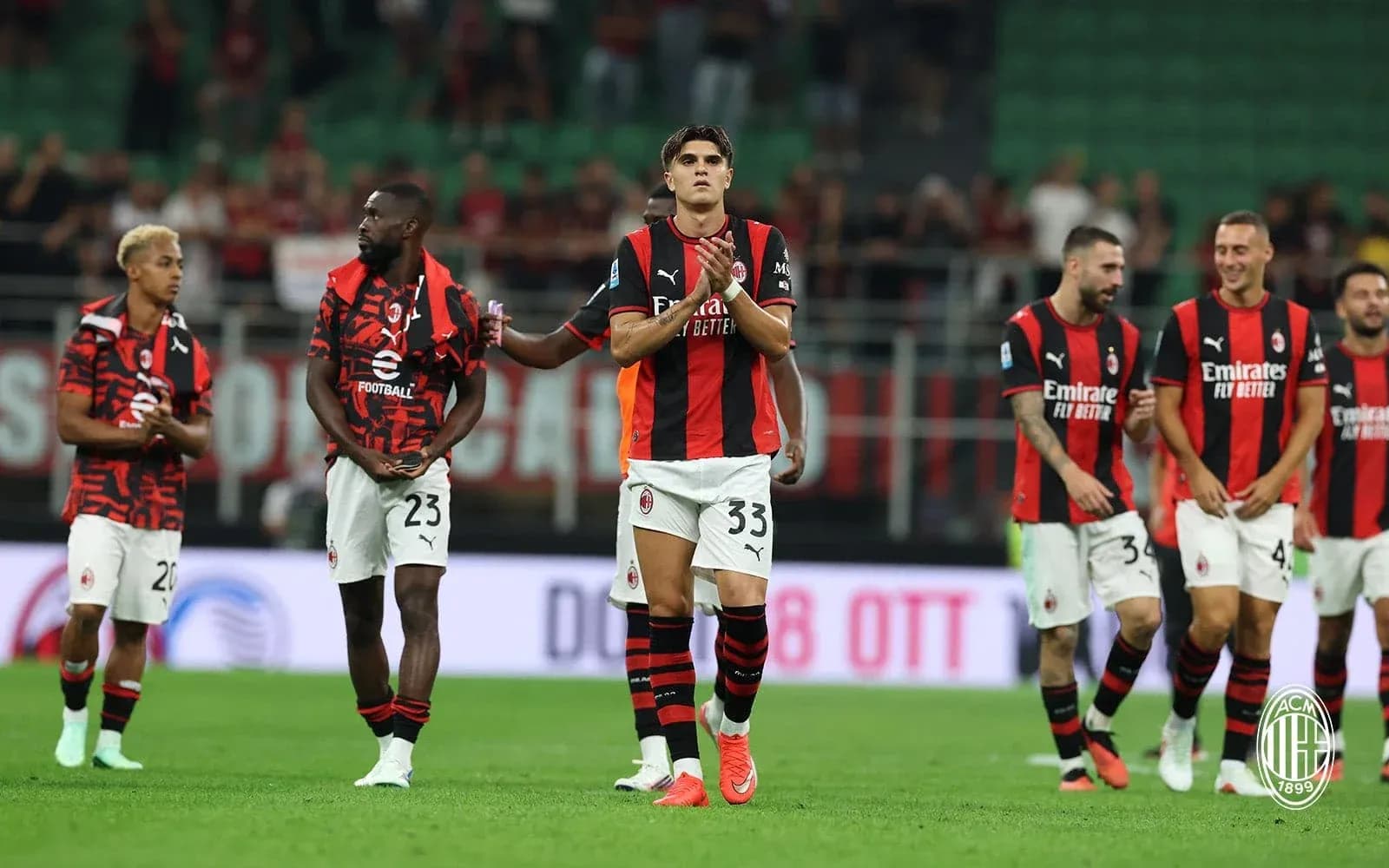
AC Milan’s 2-3 defeat to Atalanta at Stadio Giuseppe Meazza unfolded as a tactical paradox: territorial and chance creation control for the hosts, but a ruthlessly efficient visiting side whose early vertical punches proved decisive. Across 90 minutes, Milan’s 57% possession, 20 total shots and 1.94 xG contrasted sharply with Atalanta’s 43% possession, 9 shots and 1.08 xG, yet the scoreboard reflected Atalanta’s superior structure in transition and penalty-box clarity.
I. Executive Summary
In a high-stakes Serie A Round 36 clash, Massimiliano Allegri’s 3-5-2 attempted to dominate through controlled circulation and wing occupation, while Raffaele Palladino’s 3-4-2-1 prioritised compactness, quick vertical access to the front three and ruthless exploitation of Milan’s back line. Atalanta raced into a 0-2 lead by half-time and extended it to 0-3 before a late Milan surge, but the visitors’ early tactical execution and defensive resilience—underpinned by Marco Carnesecchi’s eight saves and 1.1 goals prevented—ultimately secured the 2-3 away win.
II. Scoring Sequence & Disciplinary Log
Goals (chronological, all included):
- 7' Ederson (Atalanta) — (no assist). Atalanta’s early pressure paid off as Ederson attacked the space in front of Milan’s back three, punishing a loose defensive structure with a clean finish for 0-1.
- 29' Davide Zappacosta (Atalanta) — assisted by Nikola Krstovic. A classic Atalanta pattern: wide overload on the right, Krstovic supplying Zappacosta’s underlapping run, and a composed finish for 0-2. This set the 0-2 half-time score.
- 51' Giacomo Raspadori (Atalanta) — assisted by Ederson. A vertical transition from midfield, with Ederson breaking lines and releasing Raspadori, who made it 0-3, seemingly killing the contest.
- 88' Strahinja Pavlovic (AC Milan) — assisted by Samuele Ricci. From sustained pressure, Ricci’s delivery found Pavlovic attacking the box to reduce the deficit to 1-3.
- 90' Christopher Nkunku (AC Milan) — Penalty, no assist. Nkunku converted from the spot in the 90th minute to bring Milan back to 2-3, setting up a frantic finale but not altering the outcome.
Card verification (totals locked):
- AC Milan: 4 yellow cards
- Atalanta: 3 yellow cards
- Total: 7 yellow cards
All cards in strict chronological order, with exact reasons:
- 34' Rafael Leão (AC Milan) — Foul
- 70' Isak Hien (Atalanta) — Argument
- 89' Adrien Rabiot (AC Milan) — Argument
- 89' Pervis Estupiñán (AC Milan) — Foul
- 90' Alexis Saelemaekers (AC Milan) — Argument
- 90+5' Nikola Krstović (Atalanta) — Time wasting
- 90+6' Raoul Bellanova (Atalanta) — Foul
III. Tactical Breakdown & Personnel
Allegri’s 3-5-2: Milan started with Mike Maignan behind a back three of Koni De Winter, Matteo Gabbia and Strahinja Pavlovic. The wing zones were entrusted to Alexis Saelemaekers on the right and Davide Bartesaghi on the left, with a central midfield of Samuele Ricci as the pivot, Adrien Rabiot as a left-sided carrier and Ruben Loftus-Cheek as the right-sided interior. Santiago Gimenez and Rafael Leão formed a dynamic but initially disconnected front two.
The structure aimed at controlled build-up: 541 total passes, 478 accurate (88%), reflecting a clear intention to progress through short combinations. Milan’s 8 fouls underline that they were rarely forced into desperate defending, but the issue was the fragility of their rest defence. In early phases, the back three often spread too wide in possession, leaving Ederson and Raspadori space to receive between lines. The first goal at 7' epitomised this: Ederson advanced into an unprotected central lane, with Ricci and Rabiot caught ahead of the ball and Gabbia isolated.
Atalanta’s 3-4-2-1, with Carnesecchi behind Giorgio Scalvini, Isak Hien and Sead Kolasinac, was compact and horizontally tight. Davide Zappacosta and Nicola Zalewski provided width, while Marten De Roon and Ederson formed a double pivot that alternated between screening and springing transitions. Charles De Ketelaere and Giacomo Raspadori operated as hybrid 10s behind Nikola Krstovic, constantly seeking pockets behind Ricci. Atalanta’s 411 passes, 330 accurate (80%), show a more direct, risk-accepting approach: fewer passes, more verticality.
The second goal at 29' came from Atalanta’s right-sided pattern: Zappacosta advanced from a deeper starting position, exploiting the space behind Bartesaghi. Krstovic’s assist underlined how Palladino’s front three coordinated: the central striker drifting to combine wide, the wing-back attacking the half-space. Milan’s wing-back line was too flat, with Pavlovic drawn out and Gabbia unable to cover the channel.
At 0-2 down, Allegri’s adjustments were aggressive. At 46', Christopher Nkunku (IN) came on for Ruben Loftus-Cheek (OUT), adding a third forward profile between the lines. Later, at 58', Z. Athekame (IN) came on for Koni De Winter (OUT), N. Fullkrug (IN) came on for S. Gimenez (OUT), and Y. Fofana (IN) came on for R. Leao (OUT), turning Milan into a more direct, front-loaded side. The late switch at 80', with P. Estupinan (IN) for D. Bartesaghi (OUT), further increased thrust on the left.
Palladino responded promptly: O. Kossounou (IN) for Scalvini at 48', R. Bellanova (IN) for Zappacosta at 55', and M. Pasalic (IN) for De Ketelaere at 63', plus H. Ahanor (IN) entering the pitch at 63', all aimed at refreshing the defensive block and maintaining transition threat. These changes preserved the 3-4-2-1’s compactness while adding legs to deal with Milan’s increased tempo.
Defensively, Milan’s Maignan registered 2 saves with 1.1 goals prevented, suggesting that while he limited damage, the shots he faced were of high quality and often from central zones. Conversely, Carnesecchi’s 8 saves and identical 1.1 goals prevented underline Atalanta’s dependence on their goalkeeper once the game tilted territorially in Milan’s favour. Milan’s late goals, especially Pavlovic’s from a Ricci assist and Nkunku’s penalty, reflected the cumulative pressure and numerical occupation of Atalanta’s box, but came too late to compensate for earlier structural flaws.
IV. The Statistical Verdict
From a statistical standpoint, the match is a textbook case of efficiency versus volume. Milan outshot Atalanta 20-9, with 9 shots on goal to Atalanta’s 5, and led xG 1.94 to 1.08. Their 57% possession and superior passing accuracy (88% vs 80%) reflect territorial control and sustained pressure, particularly after the hour mark. Yet Atalanta translated their 7 shots inside the box (to Milan’s 8) into three goals, maximising the quality of their chances rather than their quantity.
Discipline tilted against Milan: 4 yellow cards to Atalanta’s 3, with multiple late cautions for Argument and Foul signalling frustration as the hosts chased the game. Atalanta’s 17 fouls to Milan’s 8 illustrate a deliberate tactical aggression, breaking rhythm and protecting their lead. The goalkeeper metrics are decisive: Carnesecchi’s 1.1 goals prevented matched Maignan’s figure but under far greater shot volume, effectively preserving the away win. In pure tactical and statistical synthesis, Milan’s structure produced enough to avoid defeat, but Atalanta’s early exploitation of Milan’s rest defence and superior penalty-box clarity delivered a 2-3 result that the numbers, though close on xG, just about justify.