.svg&w=384&q=75 "Naijagoal logo")
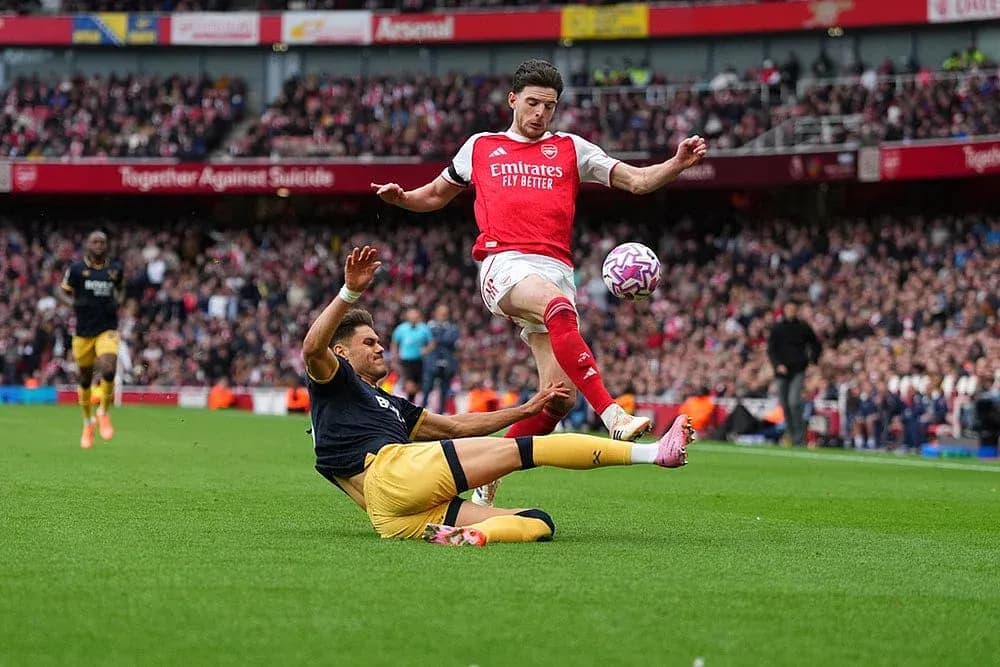
West Ham vs Arsenal: Premier League Showdown on 10 May 2026
London Stadium stages a match of huge contrasts on 10 May 2026, as 18th‑placed West Ham host league leaders Arsenal in Premier League Round 36. With West Ham sitting in the relegation zone on 36 points and Arsenal top on 76, the stakes are stark: survival versus the title.
Context and stakes
In the league, West Ham’s position is precarious. They are 18th with 9 wins, 9 draws and 17 defeats from 35 matches, a goal difference of -19 and 42 goals scored against 61 conceded. Their recent league form reads “LWDWL”, underlining inconsistency at the worst possible time.
Arsenal arrive as the benchmark side in England. They top the table with 23 wins, 7 draws and only 5 losses, scoring 67 and conceding just 26. Their form line “WWLLW” shows a minor wobble recently, but overall they remain the division’s most complete outfit, with the best defence and one of the most potent attacks.
For West Ham, any result could be decisive in the relegation battle. For Arsenal, three points are vital to keep control of the title race heading into the final two rounds.
Tactical outlook: West Ham
West Ham’s season statistics paint the picture of a team constantly firefighting. Across all phases they concede an average of 1.7 goals per game (61 in 35), with 29 of those at home (1.7 per home match). They score 1.2 per game overall, 1.4 at London Stadium, which suggests they can threaten going forward but rarely control matches defensively.
Their lineup data reveals a tactical search for balance. The most used shape is 4‑2‑3‑1 (9 matches), followed closely by 4‑4‑1‑1 (8). There have also been experiments with 4‑3‑3, 3‑4‑1‑2, 4‑1‑4‑1, 3‑4‑3 and others. That level of variation hints at a manager still looking for a stable defensive structure and the right attacking blend.
West Ham’s “biggest wins” and “biggest losses” also highlight volatility. Their best home win is 4‑0, but they have also suffered a 1‑5 home defeat and a 5‑2 away loss. Clean sheets are rare: just 6 in 35 matches (2 at home). They have failed to score 12 times in the league, including 5 at London Stadium, so if they fall behind early, the data suggests a real struggle to respond.
Discipline is another concern. The yellow card distribution is heavily weighted towards the middle and late phases of games, with 31‑45 and 91‑105 minutes particularly busy. They have also collected red cards between 46‑60, 76‑90 and 91‑105 minutes. Against a possession‑dominant Arsenal, late fouls and potential dismissals could be costly.
In terms of personnel, the absence of Lukasz Fabianski (back injury, listed as “Missing Fixture”) removes an experienced goalkeeping option from the bench or rotation. While he has not been the undisputed starter in recent years, his leadership and shot‑stopping depth are a loss in a high‑pressure fixture.
Tactical outlook: Arsenal
Arsenal’s statistical profile is that of a title contender in full flow. Across all phases they average 1.9 goals scored per game (67 in 35) and only 0.7 conceded. Away from home they still maintain 1.6 scored and 0.9 conceded per match, underlining how well their approach travels.
They are tactically stable: 4‑3‑3 has been used 23 times, with 4‑2‑3‑1 deployed in 12 matches. That continuity has underpinned both their defensive solidity and attacking fluency. Seventeen clean sheets in 35 league games (10 at home, 7 away) is an elite return, and they have failed to score only 3 times all season.
Their “biggest wins” include 5‑0 at home and 0‑4 away, showing they are capable of running away with games, particularly if they score first. Even their heaviest defeats (2‑3 at home, 2‑1 away) have been narrow, which suggests they rarely collapse.
Up front, Viktor Gyökeres is a central figure. The Swedish striker has 14 league goals and 1 assist in 33 appearances, with 22 of his 39 shots on target. He has also scored 3 penalties without a miss, making him a reliable option from the spot. His physical profile (189 cm, 90 kg) and duel numbers (219 duels, 67 won) fit Arsenal’s preference for a centre‑forward who can both stretch defences and occupy centre‑backs.
Arsenal’s discipline is generally controlled. Yellow cards rise in the final quarter of games, but they have not recorded a red card in the distribution provided. That composure could be crucial in a tense away environment.
Team news does offer a note of caution: Mikel Merino (foot injury) and Jurrien Timber (ankle injury) are both listed as “Missing Fixture”. Merino’s absence affects midfield rotation and control, while Timber’s injury removes a versatile defensive option. However, given Arsenal’s depth and consistent shape, the underlying structure should remain intact.
Head‑to‑head: recent history
The last five competitive meetings between these sides (all in the Premier League) show Arsenal with a clear edge, but West Ham have had their moments:
- 4 October 2025, Emirates Stadium: Arsenal 2‑0 West Ham – Arsenal win.
- 22 February 2025, Emirates Stadium: Arsenal 0‑1 West Ham – West Ham win.
- 30 November 2024, London Stadium: West Ham 2‑5 Arsenal – Arsenal win.
- 11 February 2024, London Stadium: West Ham 0‑6 Arsenal – Arsenal win.
- 28 December 2023, Emirates Stadium: Arsenal 0‑2 West Ham – West Ham win.
Across these five, Arsenal have 3 wins, West Ham 2, and there have been 0 draws. Notably, the three Arsenal victories at London Stadium and Emirates have been by heavy margins (2‑5 and 0‑6 away, 2‑0 at home), while West Ham’s two wins have come via clean sheets away at the Emirates (0‑1 and 0‑2).
The pattern suggests that when Arsenal click, the scoreline can be emphatic, but West Ham have shown they can execute a low‑block, counter‑attacking plan effectively enough to shut Arsenal out.
Key tactical battles
- West Ham’s defensive block vs Arsenal’s structured attack: With West Ham conceding 1.7 goals per game and Arsenal scoring 1.9, the home side are likely to adopt a compact 4‑2‑3‑1 or 4‑4‑1‑1, hoping to restrict central spaces. Arsenal’s 4‑3‑3 will look to create overloads in the half‑spaces and isolate Gyökeres against the centre‑backs.
- Set pieces and discipline: West Ham’s card profile and occasional red cards, especially after the interval, are a risk against an Arsenal side that sustain pressure and draw fouls. Any lapse could hand Gyökeres a penalty opportunity, where his 3/3 record is strong.
- Psychology at London Stadium: Arsenal’s last two visits here in the league ended 0‑6 and 2‑5 in their favour. That history could weigh on West Ham’s defenders, while also giving Arsenal confidence that their approach works on this pitch. However, West Ham’s two recent away wins at the Emirates show they can frustrate this opponent when their game plan is executed cleanly.
The verdict
On form, numbers and tactical cohesion, Arsenal are clear favourites. They have the league’s best defence, a reliable attack led by a double‑figure scorer in Gyökeres, and a settled 4‑3‑3 structure that has produced 23 wins and 17 clean sheets.
West Ham’s hope lies in the volatility of single matches and their proven capacity to deliver shock results against Arsenal, as shown by the 0‑1 and 0‑2 wins at the Emirates. At London Stadium, they do score more frequently than away, and in a desperate relegation fight, intensity and atmosphere could narrow the gap.
Yet the underlying data points strongly towards an Arsenal side that concedes under a goal per game and rarely fail to score, facing a defence that leaks 1.7 per match. If Arsenal manage the occasion and avoid early errors, they have the tools to control territory, create chances and, over 90 minutes, impose their quality.
Everything suggests a match where West Ham must be near perfect defensively to take something, while Arsenal, even slightly below their best, should still generate enough to keep their title push on track.