.svg&w=384&q=75 "Naijagoal logo")
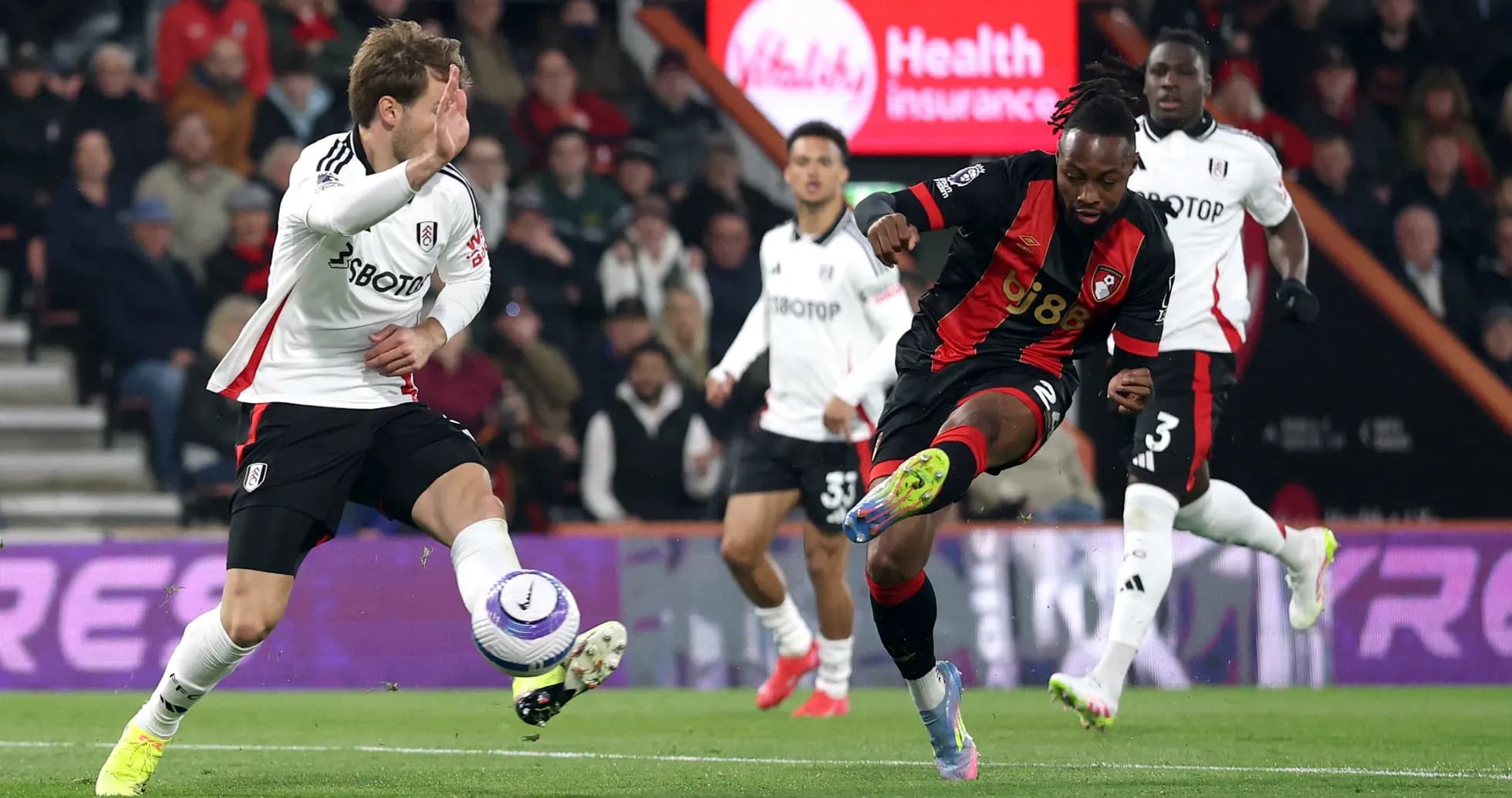
Fulham vs Bournemouth Tactical Analysis: Red Cards Shape the Game
Fulham’s 1–0 home defeat to Bournemouth at Craven Cottage in Round 36 was defined less by the scoreline than by the way game state and discipline reshaped the tactical landscape. A match that began with Fulham in territorial control was flipped by two red cards and a single clean transition attack, allowing Andoni Iraola’s side to defend deep, manage the tempo, and extract maximum value from limited possession.
I. Executive Summary
Fulham dominated the ball (60% possession, 520 passes at 88% accuracy) and produced the higher xG (1.33 to Bournemouth’s 0.82), but Bournemouth’s structural discipline and ruthless exploitation of their best transition moment decided the contest. Playing with ten men from 41’ after Ryan Christie’s dismissal, and then facing ten-man Fulham from 45+7’ following Joachim Andersen’s red, Bournemouth accepted a low-block, low-volume attacking approach, scoring through Rayan on 53’ and then compressing the pitch. The away side’s ability to turn a chaotic, card-heavy game into a controlled defensive exercise was the central tactical story.
II. Scoring Sequence & Disciplinary Log
Card verification:
- Fulham: 4 yellow, 1 red
- Bournemouth: 1 yellow, 1 red
- Total: 6 cards
Disciplinary log (chronological, all cards):
- -5' Marcus Tavernier (Bournemouth) — Argument
- 41' Ryan Christie (Bournemouth) — Foul (Red Card)
- 45+7' Joachim Andersen (Fulham) — Foul (Red Card)
- 50' Rodrigo Muniz (Fulham) — Foul (Yellow Card)
- 59' Saša Lukić (Fulham) — Argument (Yellow Card)
- 65' Alex Scott (Bournemouth) — Time wasting (Yellow Card)
- 77' Antonee Robinson (Fulham) — Foul (Yellow Card)
- 82' Joshua King (Fulham) — Foul (Yellow Card)
The pre-kickoff booking for Marcus Tavernier at -5' for “Argument” set an early tone of tension. Bournemouth’s first major tactical rupture came at 41', when Ryan Christie saw red for “Foul” after a VAR “Card upgrade” review at 40'. Reduced to ten, Iraola immediately adjusted, withdrawing Evanilson (OUT) for Tyler Adams (IN) at 43', prioritising midfield stability over a focal point up front.
Fulham’s numerical advantage lasted only a few minutes of effective play. In first-half stoppage time, VAR again intervened at 45+6' with a “Card upgrade” on Joachim Andersen, culminating in a straight red at 45+7' for “Foul”. The interval thus arrived with both teams down to ten and the score 0–0.
After the break, Rodrigo Muniz’s 50' yellow (“Foul”) reflected Fulham’s aggressive push from a higher block. Bournemouth then struck with the game’s only goal at 53': Rayan finished a “Normal Goal” after a right-sided combination, assisted by Adam Smith, exploiting the open spaces left by Fulham’s front-foot approach. From that point, Bournemouth shifted decisively into game-management mode. Saša Lukić’s 59' yellow (“Argument”) captured Fulham’s growing frustration, while Alex Scott’s 65' booking for “Time wasting” underlined Bournemouth’s tactical decision to slow the rhythm. Late yellows for Antonee Robinson (77', “Foul”) and substitute Joshua King (82', “Foul”) reflected Fulham’s increasingly desperate attempts to recover the ball and attack quickly.
III. Tactical Breakdown & Personnel
With both formations listed as null in the data, structure must be inferred from roles and behaviour. Fulham’s selection under Marco Silva was clearly possession-oriented: Bernd Leno in goal behind a back four of Timothy Castagne, Joachim Andersen, Calvin Bassey, and Antonee Robinson; a midfield axis of Saša Lukić and Tom Cairney; and a fluid band of Harry Wilson, Emile Smith Rowe, and Samuel Chukwueze supporting central striker Rodrigo Muniz.
Their 60% possession, 520 passes and 11 shots inside the box show a clear plan: use full-backs Castagne and Robinson to create width, invert at least one of the advanced midfielders into half-spaces, and attack with volume rather than isolation. The 11 corner kicks underline sustained territorial pressure. However, only 2 shots on target from 14 total attempts reveal a structural flaw: Fulham reached good zones but struggled to generate clean, high-quality final actions against Bournemouth’s compact block.
Bournemouth, with Đorđe Petrović in goal and a back four of Adam Smith, James Hill, Marcos Senesi, and Adrien Truffert, leaned into a more direct, transition-focused model. Alex Scott and Ryan Christie provided central energy, with Rayan, Eli Junior Kroupi, and Marcus Tavernier supporting Evanilson. Their 40% possession and 359 passes (86% accuracy) show a willingness to concede the ball, but their 5 shots on target from 10 attempts suggest a much more efficient shot profile.
Goalkeeper reality was finely balanced. Leno made 3 saves, Petrović 2, with both posting the same “goals prevented” value of 0.16. Given Fulham’s higher xG (1.33), Leno’s work was more about preventing Bournemouth from overperforming their modest 0.82 xG, while Petrović’s interventions came at higher leverage moments, especially once Bournemouth were ahead and increasingly deep.
The red cards reshaped the match’s geometry. After Christie’s dismissal, Bournemouth collapsed into a 4-4-1, with Adams shoring up the central zone and Evanilson sacrificed. This invited Fulham onto them, but also primed Bournemouth for the decisive transition that produced Rayan’s 53' goal. When Andersen was sent off, Fulham’s back line lost its main distributor and organiser. Bassey had to step into a more expansive passing role, while Lukić dropped deeper to initiate build-up, slightly blunting Fulham’s ability to overload the final third.
Silva’s substitutions were all attack-tilted: Issa Diop (IN) for Emile Smith Rowe (OUT) at 46' rebalanced the defence after Andersen’s dismissal; Oscar Bobb (IN) for Harry Wilson (OUT) and Kevin (IN) for Samuel Chukwueze (OUT) at 62' injected fresh dribbling and vertical runs; Joshua King (IN) for Tom Cairney (OUT) at 76' added a more direct, box-crashing presence from midfield; and Jonah Kusi-Asare (IN) for Timothy Castagne (OUT) at 83' effectively turned the shape into a back three with extra forwards. The cumulative effect was more bodies in attacking zones but less structure behind the ball, exposing Fulham to counters and forcing tactical fouls that fed into their card count.
Iraola’s changes were more about energy and game management. After Adams stabilised midfield, Amine Adli (IN) for Marcus Tavernier (OUT) at 78', Enes Ünal (IN) for Eli Junior Kroupi (OUT) and David Brooks (IN) for Rayan (OUT) at 79', and Alex Tóth (IN) for Alex Scott (OUT) at 90' all served to refresh the block and maintain pressing triggers on the flanks and in the half-spaces. Bournemouth’s foul count (21 to Fulham’s 12) and Scott’s “Time wasting” yellow were not indiscipline but deliberate tactical tools to disrupt Fulham’s rhythm.
IV. The Statistical Verdict
The statistical profile reinforces the tactical reading. Fulham’s higher xG (1.33 vs 0.82), more shots (14 vs 10), and overwhelming corner advantage (11 vs 2) indicate territorial and chance-volume superiority. Yet Bournemouth’s 5 shots on target to Fulham’s 2, combined with identical “goals prevented” values for both goalkeepers, show that the away side created fewer but clearer opportunities and defended their box with greater clarity.
Fulham’s Overall Form in this match was that of a possession-dominant side lacking penalty-box efficiency and defensive composure under transition. Their Defensive Index, reflected in conceding a goal from a modest xG against and accumulating 1 red and 4 yellows, suffered from structural exposure once they chased the game with ten men.
Bournemouth’s Overall Form was pragmatic and opportunistic: accept low possession, maximise transition value, and lean into tactical fouling and time management when ahead. Defensively, their index was strong: 1.33 xG conceded but only 2 shots on target allowed, 2 yellow cards and 1 red overall, and a compact block that forced Fulham into low-quality finishing. In a match where both sides lost a man, Bournemouth’s clearer identity and more coherent reaction to game state delivered a narrow but tactically deserved 1–0 away win.