.svg&w=384&q=75 "Naijagoal logo")
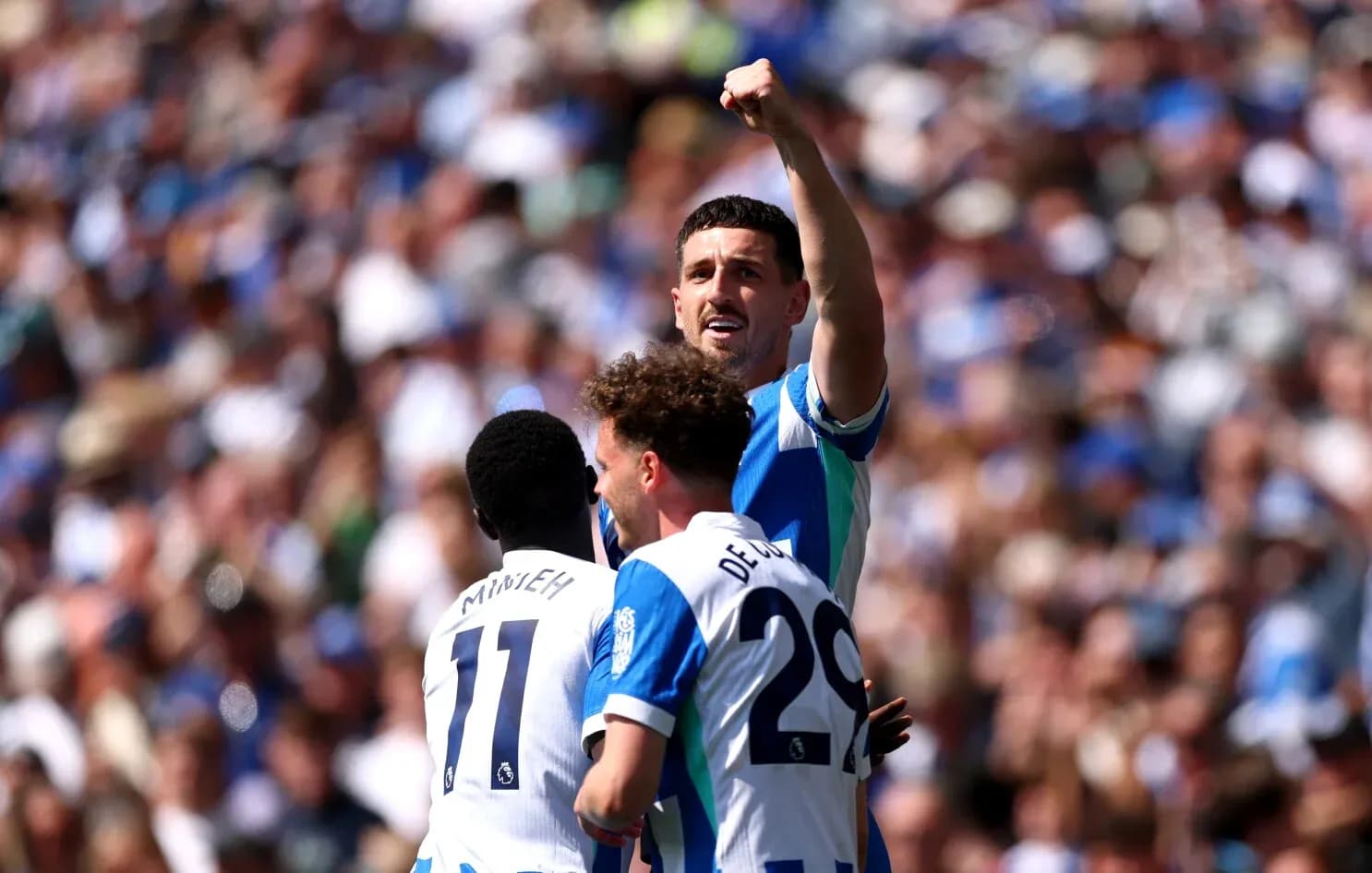
Brighton Dominates Wolves 3–0 at Amex Stadium
Brighton’s 3–0 win over Wolves at the Amex Stadium was a controlled dismantling built on early set‑pattern efficiency and total territorial dominance. In this Premier League Round 36 fixture, Fabian Hurzeler’s side raced into a 2–0 lead inside five minutes and never relinquished control, finishing with 72% possession and a 14–5 shot advantage. Wolves, under Rob Edwards, were pinned back for long stretches, unable to convert sporadic transitions into sustained pressure, and ultimately conceded a late third as Brighton’s structure and energy held from first whistle to last.
First Half
The scoring opened almost immediately. At 1', Jack Hinshelwood arrived from midfield to finish a move created down the left, assisted by Maxim De Cuyper. Just four minutes later, Brighton doubled their lead from another left‑sided pattern: De Cuyper again delivered, this time for Lewis Dunk at 5', whose presence in the box underlined Brighton’s aggressive use of centre-backs in attacking phases. By 24', the game had its first disciplinary note: 24' Kaoru Mitoma (Brighton) — Foul. That yellow card, however, did little to alter the flow; Brighton went into halftime 2–0 up, fully in control and largely unthreatened.
Second Half
The second half began with Rob Edwards trying to adjust Wolves’ left flank: at 46', David Møller Wolfe (IN) came on for Hugo Bueno (OUT), a like-for-like switch aimed at freshening the wing-back lane. Discipline then turned against Wolves. 49' Hwang Hee-chan (Wolves) — Foul, a sign of their increasing desperation in duels as Brighton circulated the ball. Hurzeler responded on 58' with a structural tweak: Joël Veltman (IN) came on for Kaoru Mitoma (OUT), allowing Ferdi Kadıoğlu to push or tuck as needed while Veltman stabilized the right.
Edwards doubled down on changes at 67', rotating his wide and forward lines: Rodrigo Gomes (IN) came on for Pedro Lima (OUT) and Jean-Ricner Bellegarde (IN) came on for Mateus Mané (OUT). Wolves’ midfield aggression then crossed the line again: 68' André (Wolves) — Foul. Brighton, still in command, used the 76' window to manage legs and profiles: Yasin Ayari (IN) came on for Carlos Baleba (OUT), and Georginio Rutter (IN) came on for Danny Welbeck (OUT), injecting fresh pressing energy and ball-carrying.
The final phase brought both game management and a killer third goal. At 86', Yankuba Minteh struck to make it 3–0, finishing unassisted and capping his industrious wide performance. Hurzeler immediately rotated his young scorers and key left-sider: at 88', Charalampos Kostoulas (IN) came on for Jack Hinshelwood (OUT), and Solly March (IN) came on for Maxim De Cuyper (OUT). Edwards’ last throw at 89' saw Angel Gomes (IN) come on for Hwang Hee-chan (OUT) and Tolu Arokodare (IN) come on for João Gomes (OUT), but by then the structure of the match was fixed. Across the 90 minutes, the disciplinary balance ended: Brighton 1 yellow, Wolves 2 yellows, total 3 cards.
Tactical Overview
Tactically, Brighton’s dominance was rooted in their build-up and rest-defence. With 578 total passes at 86% accuracy versus Wolves’ 225 at 68%, Hurzeler’s side consistently created 3v2 and 4v3 overloads in the first and second phases. Lewis Dunk and Jan Paul van Hecke were comfortable stepping high, with Carlos Baleba often dropping to form a situational back three. This allowed the full-backs, particularly Maxim De Cuyper, to push very high, which directly produced the first two goals.
De Cuyper’s dual-assist output reflected Brighton’s left-sided bias. With Kaoru Mitoma starting as a nominal midfielder but attacking as a wide winger, Brighton repeatedly stretched Wolves’ right side, forcing Santiago Bueno and Pedro Lima into difficult, wide defensive positions. The early Dunk goal at 5' exemplified this: centre-back arriving into the box while Wolves’ defensive line was still collapsing from the wide overload.
Jack Hinshelwood’s role was pivotal between the lines. Nominally a midfielder, he consistently attacked the right half-space, linking with Yankuba Minteh and offering third-man runs beyond Danny Welbeck. His 1' goal came from precisely this pattern: Brighton using short combinations to drag Wolves’ midfield narrow, then releasing Hinshelwood into a seam. Later, as fatigue set in, Hurzeler protected him with the introduction of Charalampos Kostoulas, but by then Hinshelwood had already shaped the game.
Out wide, Minteh gave Brighton vertical threat and 1v1 chaos. Even before his 86' goal, his positioning pinned Wolves’ left, limiting Hugo Bueno and later David Møller Wolfe from joining attacks. On the opposite flank, Mitoma’s early booking for a foul did not materially reduce his aggression, but Hurzeler’s decision to introduce Joël Veltman at 58' signaled a shift toward greater defensive stability, trusting the 2–0 platform and the team’s control of territory.
Wolves' Struggles
For Wolves, the front three of Adam Armstrong, Mateus Mané, and Hwang Hee-chan were starved of service. With only 5 total shots and a single shot on target, their attacks were largely hopeful transitions rather than constructed sequences. João Gomes and André fought to disrupt Brighton’s rhythm, but the two yellow cards for Wolves — both for “Foul” — highlighted how often they arrived late into duels. Rob Edwards’ multiple second-half changes altered personnel but not the underlying issue: Brighton’s superior structure in possession and counter-pressing.
Goalkeeping Performance
In goal, Bart Verbruggen’s reality was one of concentration rather than heroics: he faced only 1 shot on target and made 1 save, with an expected goals against of 0.49 and 0.25 goals prevented, underscoring how well-protected he was by the block in front of him. At the other end, Daniel Bentley made 3 saves, and despite conceding three times, the underlying numbers are revealing: Brighton’s xG of 1.62 versus Wolves’ 0.49 suggests Hurzeler’s side finished slightly above expectation, while Wolves created little of true quality.
Statistically, Brighton’s 72% possession and 7–1 corner advantage illustrate their territorial lock on the match. The foul count (Brighton 9, Wolves 11) and card split (Brighton 1, Wolves 2, total 3) confirm that while Wolves tried to increase physicality, it did not translate into control. With both sides’ keepers posting 0.25 goals prevented, the decisive edge came from Brighton’s attacking patterns and execution rather than shot-stopping. In sum, this was a structurally dominant home performance, with early scripted movements and wide overloads setting a platform that Wolves never seriously threatened.