.svg&w=384&q=75 "Naijagoal logo")

U.S. Men's National Team Falls to Turkey in Stoppage Time
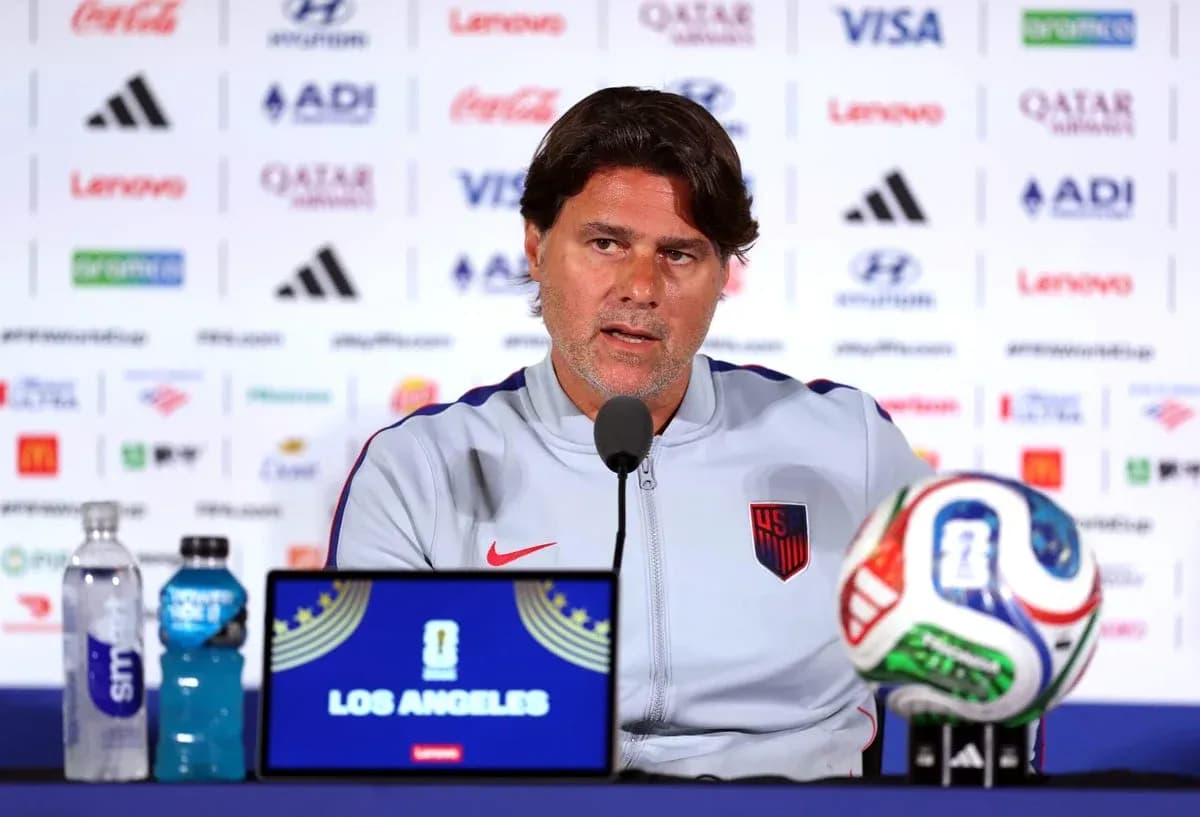
INGLEWOOD, Calif. — Mauricio Pochettino walked out before anyone in the room could soften the blow.
The U.S. men’s national team had just lost 3-2 to Turkey at SoFi Stadium, conceding with the final kick of the game. The questions came fast: about momentum, about warning signs, about whether this defeat had punctured the optimism of the first week.
Pochettino bristled.
“It cannot be possible that Turkey celebrates three points, Australia celebrates getting through, Paraguay celebrates getting through… for you to not say congratulations for winning the group, it’s a little bit sad,” he snapped, reminding everyone — several times — that the USMNT had already secured top spot in Group D.
“I need to remind everyone we won the group, sorry guys, we won,” he added, then stood up and left, the press conference ending as abruptly as the match had.
A dead-rubber thriller, a live-wire manager
The irony was hard to miss. This was, on paper, the most inconsequential of nights. First place had been locked up after two games. Pochettino responded by rotating almost his entire lineup, protecting legs and yellow-card records with the round of 32 already looming.
Only Ricardo Pepi and Weston McKennie survived from the win over Australia. Tyler Adams, Folarin Balogun, Chris Richards and Antonee Robinson — all walking the disciplinary tightrope — never got off the bench. The risk, in Pochettino’s eyes, lay not in losing a game that didn’t change the standings, but in jeopardizing the spine of his team for when it really matters.
So when the conversation turned to “momentum,” his patience snapped.
“Explain what you mean in momentum — I don’t understand,” he said. “To play with the same team we played against Australia to take a risk? To receive a yellow card (suspension)? To risk players who maybe have problems? I don’t understand. Germany lost momentum too and they played with (mostly) the same team (in their loss to Ecuador on Thursday).”
The coach who built his reputation on intensity and detail was in no mood to entertain narratives. To him, this was a controlled gamble, not a wobble.
Trusty strikes, Guler takes over
On the field, the game refused to behave like a formality.
Auston Trusty, one of those handed a chance, opened the scoring and briefly turned the night into an audition success story. Turkey responded, then tilted the contest around the brilliance of Arda Guler. The young star scored, glided between lines and dictated Turkey’s best attacking moments with the swagger of a player who knows the stage suits him.
Sebastian Berhalter dragged the U.S. level early in the second half, another squad player seizing a rare start. The match became stretched, chaotic, the kind of end-to-end contest that neutral fans adore and coaches secretly hate.
Then came the sting. Deep into stoppage time, with the last kick of the game, Turkey found the winner. The U.S. defenders sank. The Turkish bench exploded. On the touchline, Pochettino knew the table wouldn’t move an inch.
He made sure everyone else remembered that, too.
Pulisic returns, and reassures
For the U.S., the most important sight of the night didn’t come on the scoreboard. It came in the 58th minute.
Christian Pulisic, who had limped out at halftime against Paraguay with a calf issue, stepped onto the field. No strapping that restricted him. No visible limp. Just the familiar urgency with and without the ball.
He replaced Tim Weah on the left and immediately looked like the most dangerous American attacker, driving at defenders, demanding the ball, stretching Turkey’s back line. The one blot: he was nutmegged by Guler in the buildup to Turkey’s late winner, a detail that will sting on video review but won’t change the bigger picture.
“The objective was not just to win, but to get Christian 30-40 minutes,” Pochettino said. “He finished well and he made an impact on the pitch.”
For a team built around his ability to tilt games, that impact mattered far more than a stoppage-time punch to the ego.
Best-ever group stage, little appetite for praise
Strip away the drama of the night, and the numbers are clear. With six points, this U.S. team has matched its best-ever group-stage haul, equaling the 1930 side — only now wins are worth three points, not two.
That context barely surfaced in the room. Pochettino noticed.
“No one congratulated us for finishing first in a very difficult group,” he said in another pointed exchange. “I congratulate the players, staff and fans. Now I’ll answer your question. You always learn when you are in a World Cup.”
His tone carried a message: this was not a camp in crisis, whatever the late goal or the scoreline suggested. In his mind, the group has grown, the rotation has broadened his options, and the key men are preserved and, in Pulisic’s case, back on the grass.
“We’re a much better team now than we were before,” Pochettino said. “That will be put to the test next game.”
Bosnia and Herzegovina await
That test comes against Bosnia and Herzegovina in Santa Clara next Wednesday, a round-of-32 tie that will define whether this carefully managed group stage was a platform or a missed chance to build something more imposing.
There will be no room for rotation then, no safety net of “already qualified.” Adams, Balogun, Richards, Robinson — all those protected in Inglewood — will be back in the firing line. Pulisic, if his 30-plus minutes against Turkey are any guide, will be ready to carry the fight again.
The U.S. leaves Los Angeles with a last-second defeat, a bristling manager and a first-place finish. The debate over momentum will rage on the outside.
Inside the camp, Pochettino has already drawn his line. Now Bosnia and Herzegovina will decide whether he was right.