.svg&w=384&q=75 "Naijagoal logo")

USA's Tactical Mastery in 2-0 Victory Over Bosnia & Herzegovina
USA’s 2-0 win over Bosnia & Herzegovina at Levi's Stadium in this World Cup Round of 32 tie was defined by structural clarity and superior penalty-box efficiency rather than territorial dominance. Despite trailing 48–52 in possession and 8–10 in total shots, USA controlled the key spaces better, struck in pivotal moments through Folarin Balogun and Malik Tillman, and then managed the game intelligently after going down to ten men on 64 minutes. Bosnia & Herzegovina saw more of the ball and completed more passes, but their 5-3-2 lacked incision between the lines, while USA’s 4-3-3, built on a compact midfield triangle and aggressive full-backs, repeatedly turned defensive stability into direct, decisive attacks.
I. Executive Summary of Tactical Shapes and Game State
Mauricio Pochettino set USA up in a 4-3-3 with Matthew Freese in goal, a back four of Sergiño Dest, Chris Richards, Tim Ream, and Antonee Robinson, and a midfield trio of Tyler Adams anchoring behind Weston McKennie and Malik Tillman. Christian Pulišić and Folarin Balogun flanked Dest in a narrow, fluid front line, with Dest listed as a forward but functioning as an advanced right-sided outlet.
Sergej Barbarez responded with a 5-3-2 for Bosnia & Herzegovina: Nikola Vasilj in goal behind a back five of Amar Dedić, Nikola Katić, Tarik Muharemović, Stjepan Radeljić, and Sead Kolašinac. The midfield three of Armin Gigović, Ivan Šunjić, and Kerim Alajbegović supported a front two of Edin Džeko and Ermedin Demirović. The structure was clearly designed to absorb USA’s wide pressure and protect central zones, then spring Džeko and Demirović in transition.
The match pivoted around three key phases: USA’s control and breakthrough before half-time, the red card to Balogun that forced a structural recalibration, and the late-game period where Bosnia & Herzegovina pushed with more possession but remained largely sterile against a disciplined USA block.
II. Scoring Sequence & Disciplinary Log in Tactical Context
The first half was relatively balanced in volume but not in quality. USA generated 6 of their 8 total shots from inside the box, reflecting their ability to work the ball into high-value zones despite only 48% possession. Bosnia & Herzegovina, with 5 of their 10 shots inside the box, often shot from less advantageous positions or under pressure.
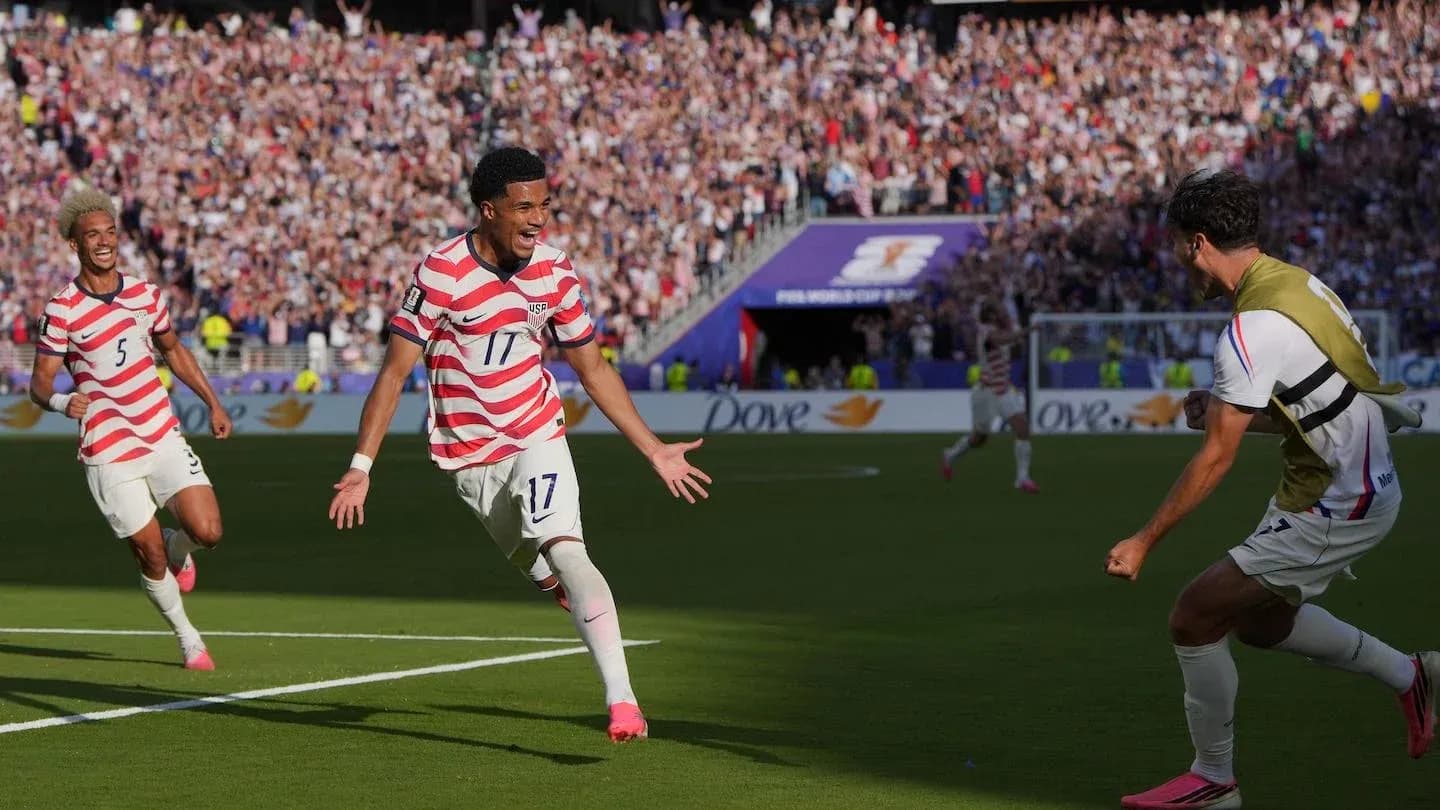
On 45', Folarin Balogun (USA) broke the deadlock with a normal goal, capitalizing on USA’s sustained territorial pressure. The lack of an assist in the data suggests a sequence where USA’s front line, supported by Tillman and McKennie, created enough chaos for Balogun to finish from close range. That strike made it 1-0 at half-time, perfectly aligning with the half-time scoreline.
The second half opened with a triple substitution wave for Bosnia & Herzegovina at 51'. Armin Gigović (OUT) made way for Esmir Bajraktarević (IN), Ivan Šunjić (OUT) was replaced by Benjamin Tahirović (IN), and Edin Džeko (OUT) came off for Ermin Mahmić (IN). These moves collectively shifted the away side toward fresher legs and more mobility, hinting at a desire to raise pressing intensity and ball progression from midfield.
The game’s major disciplinary turning point came at 64', when Folarin Balogun (USA) received a red card — “Serious foul”. This forced USA to reconfigure their 4-3-3 into a more conservative, compact shape, with the remaining forwards tasked with deeper defensive work and counter-attacking rather than sustained pressure.
Bosnia & Herzegovina continued to adjust, with Sead Kolašinac (OUT) replaced by Haris Tabaković (IN) at 75', and Nikola Katić (OUT) substituted for Amar Memić (IN) at the same minute. These changes tilted the structure away from a pure back five toward a more aggressive posture, sacrificing some defensive width for additional attacking threat.
Discipline further shaped the closing stages. At 80', there were two yellow-card events for Bosnia & Herzegovina. First, a Yellow Card was shown to S. Barbarez (Bosnia & Herzegovina) with no additional info listed, indicating a touchline incident rather than on-pitch play. Moments later at 80', Stjepan Radeljić (Bosnia & Herzegovina) was booked — “Holding”, directly linked to USA’s attempts to break through or counter.
Crucially, USA struck again at 82'. Malik Tillman (USA) scored a normal goal, again with no assist recorded, to make it 2-0. This second goal, coming after the red card and amid Bosnia & Herzegovina’s more open structure, underlined USA’s capacity to exploit transitional moments and individual quality even when numerically inferior.
Late substitutions from USA were about energy management and game control: at 87', Sergiño Dest (OUT) was replaced by Sebastian Berhalter (IN); at 88', Christian Pulišić (OUT) came off for Ricardo Pepi (IN); and at 90+5', Weston McKennie (OUT) was substituted by Giovanni Reyna (IN). Each move nudged USA further toward a compact, possession-denying shape to protect the 2-0 lead.
Card Totals (locked):
- USA: 1 red card (Folarin Balogun — “Serious foul”)
- Bosnia & Herzegovina: 2 yellow cards (S. Barbarez, Stjepan Radeljić — “Holding”)
- Total cards: 3
III. Tactical Breakdown & Personnel
USA’s 4-3-3 was built around Tyler Adams’ screening role in front of Chris Richards and Tim Ream. With 415 total passes and 346 accurate (83%), the hosts were not dominant in volume but highly efficient in circulation. The midfield triangle staggered its positioning: Adams held the central lane, McKennie pushed higher into half-spaces, and Tillman oscillated between an advanced No.8 and a support 10. This created vertical lanes for Dest and Robinson to advance, pinning Bosnia & Herzegovina’s wing-backs.
In possession, USA often formed a 2-3-5: Richards and Ream as the base two, Adams between lines, with full-backs high and inside, and the front three narrowing to attack the box. The 6 shots inside the box from just 8 total attempts show a clear emphasis on creating clean, central chances rather than speculative efforts.
Bosnia & Herzegovina’s 5-3-2, by contrast, was structurally sound but conservative. With 446 total passes and 364 accurate (82%), they marginally out-passed USA but lacked verticality. The midfield trio of Gigović, Šunjić, and Alajbegović often received in front of USA’s block without the support of overlapping wing-backs, leaving Džeko and Demirović isolated. Even after the triple substitution at 51', the pattern remained: more ball, limited penetration.
Defensively, USA’s back four managed Bosnia & Herzegovina’s 10 total shots effectively, allowing just 3 on target. Matthew Freese (USA) made 3 goalkeeper saves, a solid return that, combined with the defensive line’s positioning, underpinned the clean sheet. USA’s “goals prevented” figure of -1.73 suggests that, relative to the quality of chances conceded, the model expected fewer goals against than the zero actually conceded, indicating some overperformance or conservative shot quality from Bosnia & Herzegovina.
On the other side, Nikola Vasilj (Bosnia & Herzegovina) recorded 0 goalkeeper saves. Given USA’s 2 shots on goal and 2 goals scored, this points to extremely clinical finishing from Balogun and Tillman and possibly defensive breakdowns before the shot, rather than goalkeeping heroics. Bosnia & Herzegovina’s “goals prevented” metric of -1.73 further underlines that the goals conceded were within a range the model might expect to be partially saved.
The red card to Balogun at 64' was the game’s key tactical inflection point. With one forward fewer, USA compressed into a 4-4-1/4-5-0 out of possession, with wide players dropping deeper and the remaining attackers focused on pressing triggers rather than constant high positioning. Bosnia & Herzegovina responded by pushing more players forward, as reflected in their slight possession edge (52%) and additional shots (10 total), but USA’s compactness and disciplined horizontal shifting denied them clear central routes.
Set plays and restarts were another subtle battleground. USA earned 4 corner kicks to Bosnia & Herzegovina’s 3, a small edge that reflects their ability to sustain pressure phases, especially in the first half. Offside numbers (USA 3, Bosnia & Herzegovina 0) show the hosts’ willingness to run beyond the last line, particularly through Balogun and Pulišić, testing Bosnia & Herzegovina’s back five with depth runs.
Discipline-wise, USA committed 7 fouls to Bosnia & Herzegovina’s 13, illustrating a more controlled defensive approach versus Bosnia & Herzegovina’s increasingly stretched and reactive defending as they chased the game. Radeljić’s yellow card for “Holding” at 80' epitomized this: a last-resort intervention to halt a USA transition.
IV. The Statistical Verdict
The underlying numbers reinforce the tactical story. USA’s xG of 0.92 versus Bosnia & Herzegovina’s 0.25 highlights that, despite a narrow shot count (8 vs 10), USA created significantly better-quality chances. Converting both shots on target into goals underscores a clinical edge in the final third.
Possession (48–52) and passes (415 vs 446) suggest Bosnia & Herzegovina enjoyed marginal control of the ball, but their low xG and 3 shots on target reveal that much of this possession was sterile, circulating in front of USA’s well-organized block. USA’s structure, both in the initial 4-3-3 and the post-red-card compact shape, effectively funneled Bosnia & Herzegovina into low-probability attempts.
Defensively, the contrast in goalkeeper involvement is stark: Matthew Freese (USA) with 3 saves versus Nikola Vasilj (Bosnia & Herzegovina) with 0. USA’s block and pressing limited Bosnia & Herzegovina to low-quality shots, while the visitors’ defensive line allowed USA’s two clean looks to be finished ruthlessly.
In the end, the combination of a clear positional plan, superior box occupation, and efficient finishing made USA’s 2-0 victory a tactically coherent and statistically justified progression from the Round of 32.