.svg&w=384&q=75 "Naijagoal logo")

France vs Sweden: A Clash of Styles in the Round of 32
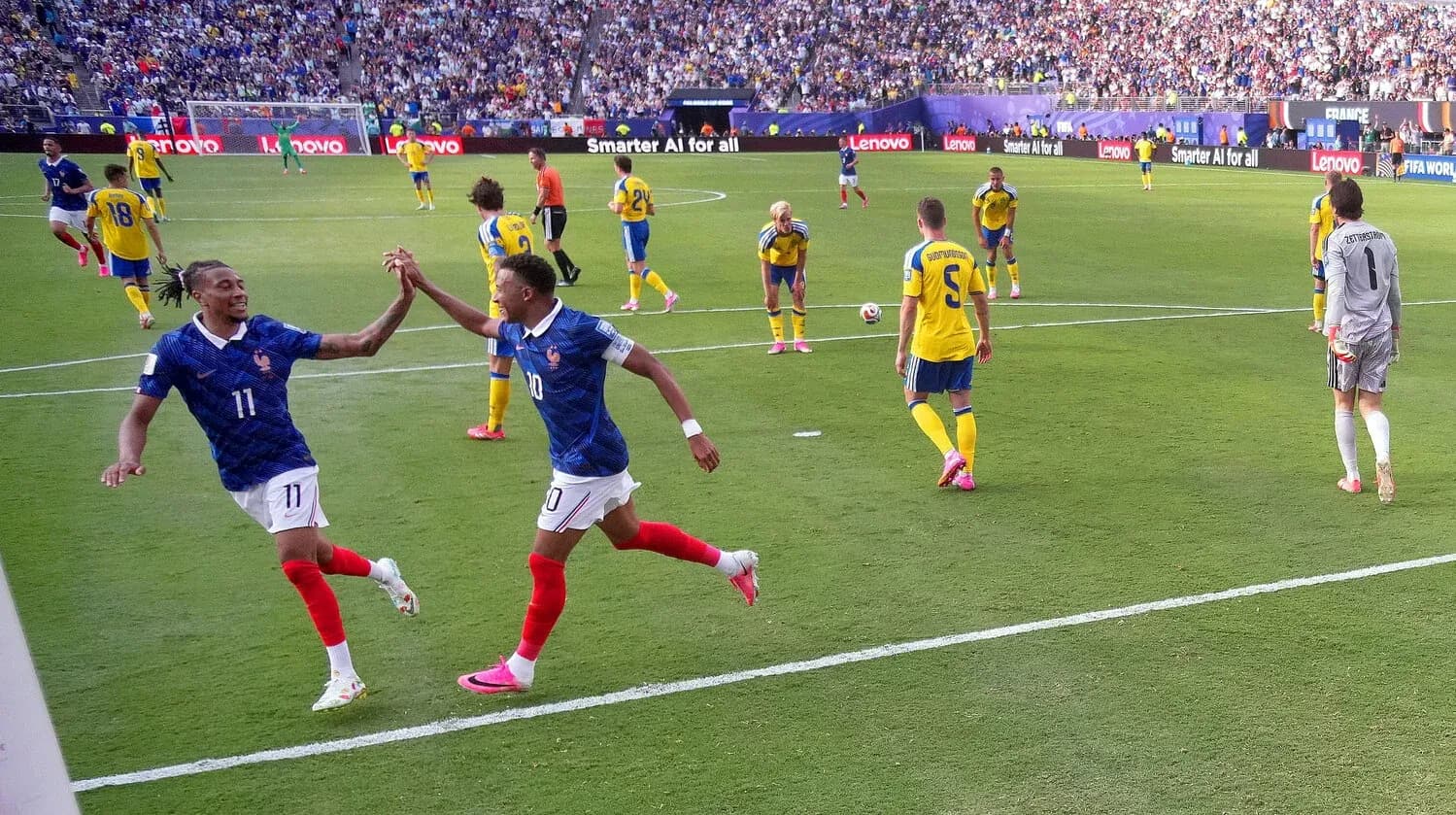
MetLife Stadium in New York hosted a Round of 32 tie that looked, on paper, like a clash of identities as much as of nations. France arrived as the most ruthless machine of the group phase, top of Group I with 9 points, 10 goals for and 2 against overall, their goal difference of 8 the mark of a side already in knockout rhythm. Sweden, second in their group with 4 points and a neutral overall goal difference of 0 (7 scored, 7 conceded), came in as a dangerous but inconsistent outsider. Over 90 minutes, the contrast hardened into a narrative: France’s fully formed collective against Sweden’s still‑shifting project.
Didier Deschamps doubled down on continuity. His side lined up again in the familiar 4‑2‑3‑1, a structure that has underpinned all 4 of their matches in this World Cup. The back four in front of M. Maignan was stable and balanced: J. Kounde and L. Digne as full‑backs, D. Upamecano and W. Saliba as the central pairing. In midfield, A. Tchouameni and A. Rabiot formed a double pivot designed less to dazzle than to control, freeing the advanced line of O. Dembele, M. Olise and B. Barcola to orbit around K. Mbappe.
The numbers coming into this tie told you why Deschamps trusted that blueprint. Heading into this game, France had played 3 home fixtures and 1 away, winning all 4. At home they averaged 3.0 goals scored and only 0.3 conceded; on their travels they were even more explosive, with 4.0 goals scored and 1.0 conceded. Overall, that meant 13 goals for and 2 against, an average of 3.3 scored and 0.5 conceded per match. Two clean sheets at home underlined how rarely opponents were allowed a foothold.
Graham Potter’s Sweden, by contrast, arrived in flux. Their season statistics showed a team still searching for the right shape: 4 matches, split across three systems – 3‑1‑4‑2 (2 times), 3‑4‑3 (once) and 4‑4‑2 (once). For this knockout tie, Potter chose the more conservative 4‑4‑2, perhaps acknowledging the need for extra protection against France’s wide threats. J. Widell Zetterstrom started in goal behind a back four of D. Svensson, G. Lagerbielke, V. Lindelof and G. Gudmundsson. Across midfield, A. Elanga and E. Stroud provided width, with L. Bergvall and Y. Ayari central, while V. Gyökeres and A. Isak formed a physically imposing front two.
The risk for Sweden was clear in the data. Heading into this game, they had played 1 home and 3 away fixtures. At home, they were devastating going forward, with 5.0 goals scored and 1.0 conceded on average. But on their travels the picture darkened: just 0.7 goals scored away per match and a bruising 3.0 conceded. Overall, 7 goals for and 10 against gave them an average of 1.8 scored and 2.5 conceded per game, and not a single clean sheet in any venue. The defensive fragility of their away profile was always likely to be exposed by the most prolific attack in the competition.
Layered on top of those team trends were the individual storylines that shaped this tie. Kylian Mbappé arrived as the tournament’s leading scorer: 6 goals and 2 assists in 4 appearances, with an outstanding rating of 8.65, 19 shots (13 on target) and 10 key passes. O. Dembele, fifth in the scoring charts, had 4 goals and 2 assists with an 8.28 rating, while M. Olise led the entire World Cup in assists with 5, combining 211 completed passes at 87% accuracy with 9 key passes and 8 successful dribbles. France’s front four were not just finishing chances; they were manufacturing them in waves.
Sweden’s threat was more concentrated but still potent. A. Isak, third in the assist rankings, had 1 goal and 3 assists from 4 starts, offering link play and penalty‑box intelligence. Alongside him, V. Gyökeres had 1 goal and 2 assists, 9 shots with 6 on target, and a willingness to fight every duel – 40 contested, 16 won. Between them they were capable of turning long clearances into meaningful transitions, a vital outlet for a side likely to spend long spells without the ball.
Yet the tactical voids were just as revealing. France’s discipline profile was almost spotless heading into this match: only one yellow card all tournament, and that solitary booking coming between minutes 61 and 75, a late‑game blip rather than a chronic issue. Sweden, by contrast, showed a pattern of mounting stress. Their yellow cards were distributed across the match but peaked late: 20.00% in each of the 31‑45, 46‑60 and 61‑75 minute windows, and a striking 40.00% between 76 and 90 minutes. L. Bergvall, already on the yellow‑card leaderboard with 1 booking, 7 fouls committed and 4 drawn, embodied that edge. Against a France side that tends to accelerate as spaces open, that late‑game indiscipline was always likely to be punished.
The “Hunter vs Shield” duel naturally centred on Mbappe and the Swedish back line. Sweden’s overall record of 10 goals conceded in 4 matches – with 9 of those shipped away from home – suggested that the pairing of Lagerbielke and Lindelof would be under siege. Dembele’s 8 dribbles completed and Olise’s 9 key passes hinted at how France would pull that defence apart horizontally before Mbappe attacked the vertical channels. With France having failed to score in none of their matches and Sweden having failed to keep a single clean sheet, the balance of probability leaned heavily blue.
In the engine room, Tchouameni and Rabiot were set against Bergvall and Ayari. Bergvall’s 84 passes at 88% accuracy and 2 interceptions made him Sweden’s most reliable conduit through midfield, but his tendency to foul under pressure risked handing France cheap set‑pieces in dangerous zones. For France, the double pivot’s primary task was to suffocate Swedish transitions, preventing Gyökeres and Isak from ever facing Maignan with space to attack.
Statistically and tactically, the prognosis before a ball was kicked was stark. France’s overall scoring rate of 3.3 per game against Sweden’s overall concession rate of 2.5, combined with France’s defensive parsimony (0.5 conceded overall) and Sweden’s limited away punch (0.7 scored away), pointed towards a one‑sided expected‑goals landscape. The 3‑0 full‑time scoreline at MetLife Stadium did not feel like an outlier; it felt like the logical conclusion of two trajectories crossing – a fully realised contender in France, and a Sweden side still learning its limits on the biggest stage.