.svg&w=384&q=75 "Naijagoal logo")

Mexico Dominates Ecuador in World Cup Round of 32
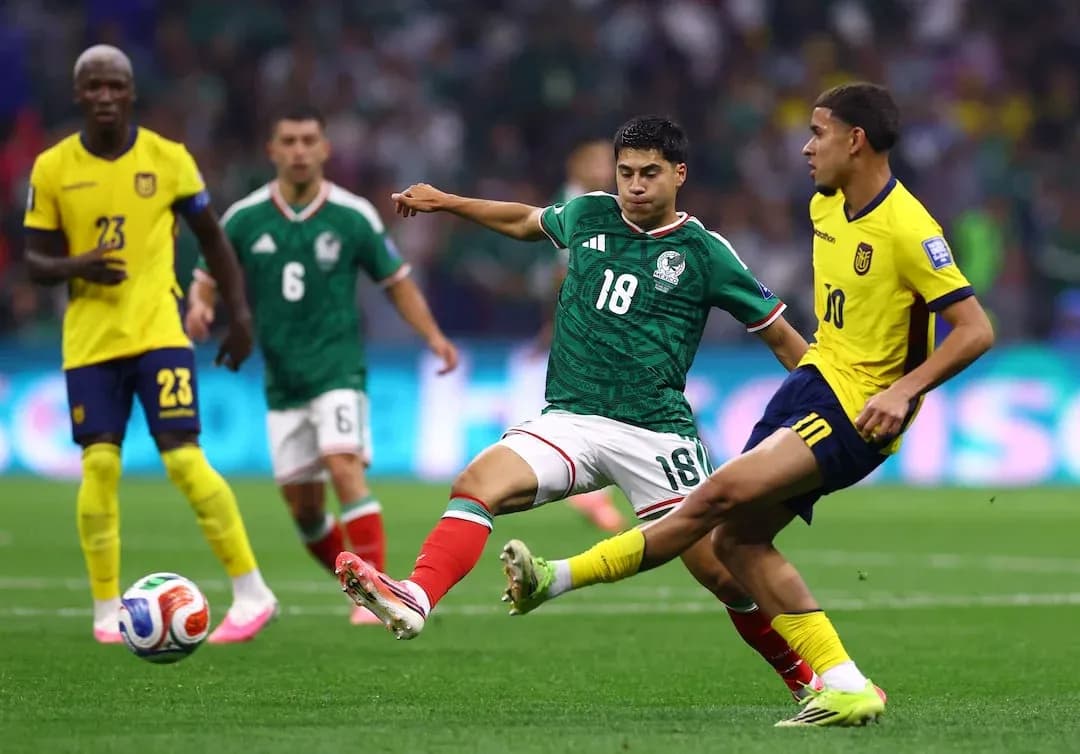
Under the lights of Estadio Banorte in Mexico City, Mexico’s Round of 32 meeting with Ecuador felt less like a tentative first knockout step and more like a statement of intent. The 2–0 scoreline, built by a ruthless first half and managed with mature control thereafter, extended Mexico’s perfect World Cup campaign and underlined the contrast between a side with a clear, coherent identity and one still searching for balance.
Coming into this tie, Mexico had already authored a flawless group stage: three wins from three, six goals scored and none conceded, for a total goal difference of +6. Their season numbers painted the picture of a team built on control and efficiency. Overall this campaign, they had played 4 matches, winning all 4, with 8 goals for and 0 against. At home, they had played 3, winning all 3, scoring 5 and conceding none; on their travels, they had played 1, winning it with 3 goals scored and 0 conceded. An overall scoring rate of 2.0 goals per game, married to a total defensive average of 0.0 goals conceded, is the statistical profile of a contender, not just a survivor.
Javier Aguirre doubled down on that identity with his team selection and shape. Mexico’s 4-3-3 was not just a formation but a script. In goal, R. Rangel stood behind a back four of J. Gallardo, J. Vasquez, C. Montes and J. Sanchez. Ahead of them, the midfield triangle of L. Romo, E. Lira and G. Mora was configured to suffocate transitions and keep Mexico’s tempo high. Up front, R. Alvarado and J. Quiñones flanked R. Jimenez in a line that blended creativity, power and penalty-box presence.
The squad architecture behind that XI matters. Mexico’s season data shows they have used a 4-3-3 in 3 matches and a 4-1-4-1 once, underlining a clear preference for a three-man midfield that can either press high or drop into a compact block. The clean sheet record is remarkable: 3 at home, 1 away, 4 in total. They have yet to fail to score in any match. This is a side that rarely allows chaos at either end.
On the other bench, Sebastian Beccacece sent Ecuador out in a 4-4-2 that tried to stretch Mexico laterally while keeping two forwards high to threaten in transition. H. Galindez anchored the side in goal, with a back line of P. Hincapié and W. Pacho in the middle, flanked by A. Franco and J. Ordonez. Across midfield, N. Angulo and J. Yeboah worked the flanks, with M. Caicedo and P. Vite trying to wrestle control in the central lanes. Up front, G. Plata and E. Valencia formed a classic big threat–mobile runner pairing.
But Ecuador’s broader campaign context hinted at fragility. Overall, they had played 4 matches, with 1 win, 1 draw and 2 defeats. At home, they had played 2, winning 1, drawing 1 and losing none, scoring 2 and conceding 1. Away, however, they had played 2 and lost both, failing to score and conceding 3. That left them with 2 goals for and 4 against overall, an overall scoring rate of just 0.5 per game and a defensive average of 1.0 conceded. On their travels, the attacking average dropped to 0.0 and the defensive average rose to 1.5 conceded per away match. The Round of 32 demanded that they overturn a pattern of bluntness away from home.
Discipline and temperament were always going to be subplots. Mexico’s card profile showed a controlled aggression: yellow cards concentrated between 16–30 minutes and 61–75 minutes, each band accounting for 50.00% of their total yellows, and a single red card arriving deep into added time between 91–105 minutes. That suggests a side that occasionally oversteps when the press is at its most intense or when closing out a result, but not one prone to reckless early chaos.
Ecuador’s numbers told a more combustible story. Their yellow cards were spread across the middle and late phases: 31–45 minutes and 46–60 minutes each accounted for 25.00% of their yellows, with further spikes at 61–75 and 76–90 minutes (12.50% each), and another 25.00% between 91–105 minutes. Crucially, they also had a red card in the 91–105 minute band, underlining how emotional their endings can become. Individually, A. Franco and P. Hincapié embodied that edge. Franco, the league’s top yellow-carded player, had 2 yellows and 7 fouls committed across his 4 appearances, while Hincapié combined 1 yellow with 1 red, 12 tackles, 2 blocked shots and 4 interceptions. They are both enforcers and potential liabilities.
The “Hunter vs Shield” duel of this tie was written in bold. For Mexico, J. Quiñones arrived as one of the World Cup’s most dangerous attacking outlets. Across the tournament, he had 3 goals and 1 assist in 4 appearances, with 9 shots (5 on target), 106 passes at 80% accuracy, 7 key passes and 6 successful dribbles from 8 attempts. Officially listed as a midfielder in the season data but deployed high on the left here, he is the hybrid weapon that bends defensive lines out of shape. Opposite him stood Ecuador’s defensive structure led by Hincapié and Pacho, supported by the combative Franco on the right. Hincapié’s 47 duels (24 won), 12 tackles and 2 blocked shots underline his capacity to step out and engage, but the red card in his record is a warning: if stretched repeatedly by Quiñones’ direct running and Mexico’s rotations, his aggression can tip into risk.
In the “Engine Room” battle, the contrast was just as sharp. Mexico’s midfield trio of Romo, Lira and Mora was tasked with controlling rhythm and denying space between the lines. Romo’s role as a shuttling connector, Lira’s deeper distribution and Mora’s ability to step into advanced pockets created a three-layered screen in front of Montes and Vasquez. Ecuador leaned heavily on M. Caicedo’s range and bite, with P. Vite offering the more creative angles. But with Ecuador’s overall scoring average stuck at 0.5 goals per game and 3 failures to score in 4 matches, the burden on that central pair to both protect and create was always going to be immense.
The tactical void that ultimately decided the tie lay between Ecuador’s lack of away attacking threat and Mexico’s suffocating defensive record. Mexico came in having conceded 0 goals overall, with 4 clean sheets from 4 and no failures to score. Ecuador, by contrast, had failed to score in 3 of their 4 matches, including both away fixtures. When a side that never concedes meets one that rarely scores, the margins are brutal.
Even without explicit xG figures, the season profiles point to a clear statistical prognosis. Mexico’s consistent chance creation, reflected in Quiñones’ and Alvarado’s output, suggests a team that regularly generates high-quality opportunities. Alvarado, the competition’s leading assister, had 3 assists, 10 key passes and 140 total passes at 82% accuracy from midfield, giving Mexico a second creative axis on the right. With R. Jimenez as the central reference point, Mexico could vary between crosses, cut-backs and through balls, constantly probing Ecuador’s back line.
Ecuador’s defensive averages show they are more solid at home than away. At home they conceded 0.5 per game; away, that rose to 1.5, and their biggest away defeat was 2–0. That is precisely the scoreline that unfolded in Mexico City, a numerical echo of their vulnerability on their travels. Their clean sheet record – 1 at home, 0 away, 1 in total – underlines how rare it is for them to keep the door fully shut outside their comfort zone.
Following this result, Mexico’s World Cup journey remains immaculate: 5 wins from 5, still without conceding, their defensive aura only growing. The squad’s spine – Rangel, Montes, Vasquez, the Romo–Lira–Mora triangle, and the Alvarado–Jimenez–Quiñones trident – looks settled, complementary and battle-hardened. Ecuador exit at the Round of 32 with a sense of what might have been: a back line capable of heroic resistance, but an attack that never quite escaped its own restraints, especially away from home.
In the end, this was a match that confirmed the numbers rather than defied them. Mexico, relentless and controlled, played to their season’s script. Ecuador, brave but blunt, were once again undone by the same structural flaws their statistics had been hinting at all along.