.svg&w=384&q=75 "Naijagoal logo")

Egypt Advances to World Cup Round of 16 After Penalty Shootout Win Over Australia
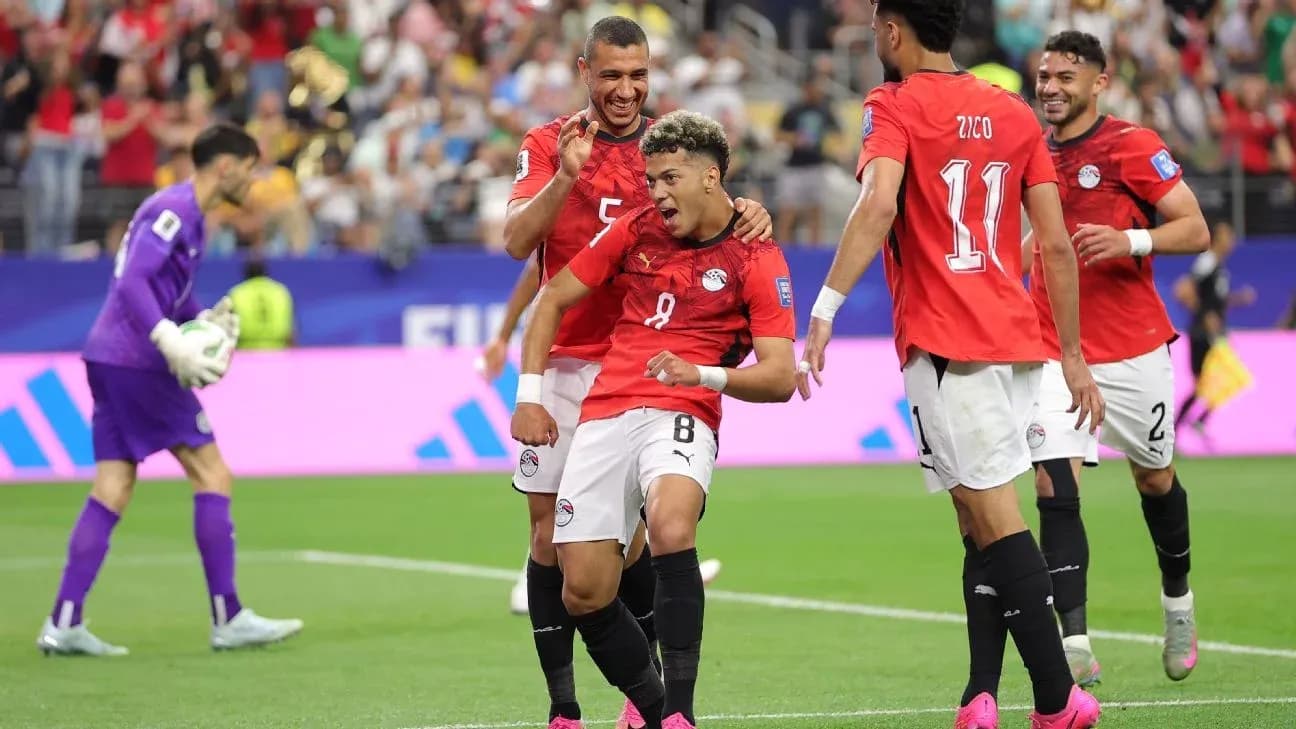
Australia 1-1 Egypt (Egypt win 4-2 on penalties) at AT&T Stadium sends the North Africans into the World Cup Round of 16 after a tense Round of 32 tie. Australia’s campaign ends despite dragging the game through 120 minutes, while Egypt convert their technical and territorial edge into progression after holding their nerve in the shootout.
Match Report
At 13' Egypt struck first: Egypt goal — E. Ashour (assisted by K. Hafez) finished a well-constructed move from the left to make it 0-1 and give Hossam Hassan’s side early control.
Australia adjusted at the break. At 46' K. Trewin replaced J. Bos (Australia), a like-for-like defensive change that hinted at tightening the back line while keeping wing-back energy.
The Socceroos levelled on 55' in fortuitous fashion: Australia goal — M. Hany (own goal, unassisted) diverted the ball into his own net, bringing the score to 1-1 and radically altering the game state despite Australia’s limited attacking output.
Egypt responded with a double change on 67' to refresh their front line and midfield balance. At 67' H. Hassan replaced M. Ziko (Egypt), adding fresh legs in attack, and simultaneously at 67' H. Abdelmaguid replaced H. Fathy (Egypt), bringing extra height and defensive cover.
Australia then injected creativity and pace. At 74' A. Hrustic replaced C. Volpato (Australia), and at the same 74' minute M. Toure replaced N. Irankunda (Australia), signalling a push for more incision between the lines and in transition.
Egypt made another attacking adjustment on 80' as Trezeguet replaced K. Hafez (Egypt), moving a more direct wide threat into the game after Hafez’s earlier assist.
As the match moved into added time, Australia continued to cycle legs in midfield. At 91' P. Okon-Engstler replaced A. O'Neill (Australia), and also at 91' A. Mabil replaced C. Metcalfe (Australia), adding dribbling and set-piece quality for the closing stages.
Extra time brought the first disciplinary note. At 105' H. Hassan (Egypt) — yellow card (Holding) was booked for a cynical stop on an Australian transition, reflecting Egypt’s increasing need to manage space rather than chase a winner.
Egypt turned again to their bench at 106' as H. Abdelkarim replaced O. Marmoush (Egypt), a move aimed at preserving energy and maintaining pressing intensity in the wide channels.
With penalties looming, Australia made a specialist goalkeeper switch. At 119' M. Ryan replaced P. Beach (Australia), a clear indication Tony Popovic was betting on Ryan’s experience and penalty pedigree for the shootout.
On 120' Y. Ibrahim (Egypt) — yellow card (Roughing) was cautioned after a robust challenge, underlining the physical toll of a stretched extra time.
Egypt’s final substitution came at 120+1' as M. Saber replaced M. Attia (Egypt), a late tweak that also set up Saber as a penalty taker.
The penalty shootout then decided the tie. At 120+1' H. Souttar (Australia) — missed penalty saw the defender fail to convert Australia’s first kick, immediately tilting the shootout in Egypt’s favour. At 120+1' M. Saber (Egypt) — penalty restored calm for Egypt with a composed finish, putting them 0-1 up in the shootout.
Australia responded at 120+2' when J. Irvine (Australia) — penalty converted confidently, but Egypt matched at 120+2' as R. Rabia (Egypt) — penalty scored, maintaining Egypt’s advantage.
The pattern continued at 120+3'. A. Mabil (Australia) — penalty kept the Socceroos in touch, yet M. Salah (Egypt) — penalty at 120+3' answered immediately, the captain dispatching his kick with trademark composure.
The decisive moment arrived at 120+4' when L. Herrington (Australia) — missed penalty failed to find the net, leaving Australia trailing and under immense pressure. Egypt seized the opportunity at 120+4' as H. Abdelmaguid (Egypt) — penalty scored the clinching kick, sealing a 4-2 shootout win after a 1-1 draw over 120 minutes.
Fixture Statistics & Tactical Audit
- xG: Australia 0.87 vs Egypt 1.36
- Possession: Australia 42% vs Egypt 58%
- Shots on Target: Australia 1 vs Egypt 4
- Goalkeeper Saves: Australia 3 vs Egypt 1
- Blocked Shots: Australia 9 vs Egypt 6
The numbers support the notion that Egypt were the more controlled and territorially dominant side (58% possession, 4 shots on target to 1, higher xG at 1.36 vs 0.87), but not overwhelmingly so. Egypt’s greater shot quality and volume in dangerous zones suggested a marginally fairer claim to victory, yet Australia’s defensive structure — reflected in 9 blocked shots — repeatedly narrowed shooting lanes and forced Egypt into less optimal efforts. Australia’s attack was notably blunt (only 1 shot on target across 120 minutes), underlining how much their equaliser owed to an own goal rather than sustained chance creation. Conversely, Egypt’s inability to translate their superiority into more than a single open-play goal kept the contest alive, leaving the outcome to be decided by the higher technical ceiling and composure of their penalty takers.
Standings Update & Seasonal Impact
Australia entered the knockout phase having taken 4 points with a neutral goal difference (2 goals scored, 2 conceded) in Group D. The 1-1 draw in regulation and extra time adds one goal for and one against, moving them to 3 goals scored and 3 conceded in the tournament proper, maintaining a goal difference of 0. However, elimination on penalties means they do not add to their 4-point group-stage tally; their World Cup ends here despite a broadly balanced goals record.
Egypt came into the Round of 32 from Group G with 5 points and a positive goal difference of +2 (5 scored, 3 conceded). This 1-1 draw across 120 minutes lifts their tournament totals to 6 goals scored and 4 conceded, keeping their goal difference at +2. While knockout matches are not reflected in a traditional league table, Egypt carry forward the confidence of remaining unbeaten in open play and now progress to the Round of 16 with a profile of a side that combines defensive resilience with enough attacking threat to trouble higher-ranked opponents.
Lineups & Personnel
Australia Starting XI
- GK: Patrick Beach
- DF: Alessandro Circati, Harry Souttar, Lucas Herrington
- MF: Jordan Bos, Jackson Irvine, Aiden O'Neill, Aziz Behich
- FW: Cristian Volpato, Connor Metcalfe, Nestory Irankunda
Egypt Starting XI
- GK: Mostafa Shobeir
- DF: Mohamed Hany, Yasser Ibrahim, Rami Rabia, Karim Hafez
- MF: Emam Ashour, Hamdy Fathy, Marwan Attia, Omar Marmoush
- FW: Mohamed Salah, Mostafa Ziko
Post-Match Verdict
Egypt’s progression was built on a controlled, possession-based performance (58% of the ball, 723 passes at 85% accuracy) that consistently pushed Australia back and generated the better chances (xG 1.36 vs 0.87, 4 shots on target to 1). Their structure in a 4-4-2 allowed Emam Ashour and Mohamed Salah to find pockets between the lines, while full-backs Hany and Hafez advanced to pin Australia’s wing-backs. The downside was a lack of ruthlessness in the final third, with only Ashour’s early strike to show from open play despite this platform.
Australia, by contrast, delivered a defensively committed but attackingly limited display. Their back three and double pivot absorbed sustained pressure, evidenced by 9 blocked shots and 3 saves, but the price was an almost total sacrifice of threat going the other way (just 1 shot on target from 16 attempts). The equaliser via Mohamed Hany’s own goal masked their struggle to construct clear chances from open play. Popovic’s multiple second-half and extra-time substitutions, including the late switch to Mathew Ryan for the shootout, were logical attempts to tilt fine margins, yet the side’s lack of incision in possession — despite 507 passes at a decent 80% accuracy — ultimately left the tie to be decided from the spot.
In the shootout, Egypt’s technical superiority and composure told. Converting all four of their penalties, with Salah and Abdelmaguid closing it out, contrasted sharply with Australia’s two misses from Souttar and Herrington. Over 120 minutes, Egypt were the more proactive and structurally sound team; the penalties merely confirmed an advantage that the open-play scoreline had kept in doubt.