.svg&w=384&q=75 "Naijagoal logo")

U.S. Men's Soccer Shines in World Cup Opener with Record Win
LOS ANGELES — The noise around this World Cup was deafening before a ball was kicked. Politics. Ticket prices. Immigration headaches. Transit chaos.
Now the tournament is here, spread across Mexico, Canada and the United States, and most of that has been pushed to the edges. The football has taken over. And in Los Angeles, the U.S. men delivered a statement they’ve rarely come close to on this stage.
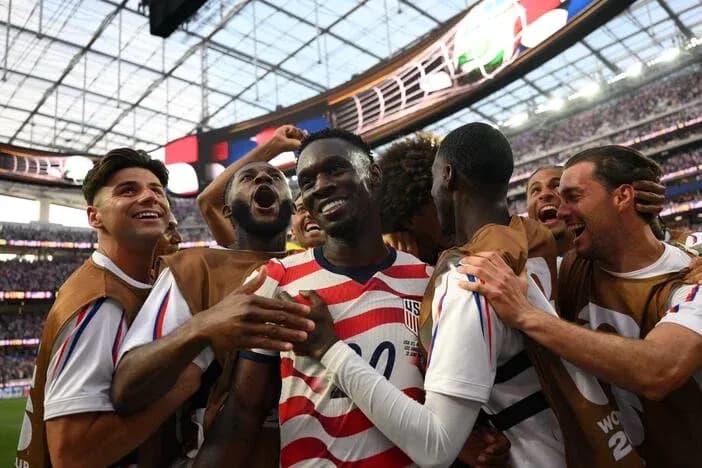
U.S. explode into World Cup with record win
For a country still learning how to live with big expectations in men’s soccer, Friday night at Los Angeles Stadium felt different. A 4-1 win over Paraguay wasn’t just comfortable. It was ruthless, expressive, and statistically historic.
- Four goals — the most the U.S. men have ever scored in a World Cup match.
- A brace from Folarin Balogun — the first multi-goal game by an American man at a World Cup since the inaugural tournament in 1930.
Balogun’s movement and finishing gave the attack a cutting edge that’s so often been missing. Every time he peeled off a defender, Paraguay looked nervous. Twice, they paid for it.
Behind him, Chris Richards quietly put together a performance that would stand out in any era. Back from the injury that kept him out of both pre-World Cup warm-ups, the defender completed all 83 of his passes — the most by any player in a World Cup match since 1966. Not just tidy recycling, either. He dictated tempo, broke lines, and turned defense into attack with assurance that radiated through the team.
There was one cloud. Christian Pulisic, the team’s star forward and emotional barometer, did not emerge for the second half after a calf issue. He walked gingerly to the bus afterward, his status still uncertain. For a side that finally looks ready to punch with the heavyweights, that’s a concern they can’t ignore.
From top to bottom, though, the U.S. sparkled. The pressing had bite. The passing had purpose. The finishing had conviction.
It was a statement.
It was also only one game.
Australia rip up the script in Group D
On Saturday, the rest of Group D offered an early reminder of how fragile any plan can be at a World Cup.
Turkey arrived with the pedigree. Players from Europe’s elite leagues. A-list talent in Arda Güler of Real Madrid and Kenan Yildiz of Juventus. On paper, they looked like the group’s glamour side.
Australia tore up that script.
The underdogs stunned Turkey 2-0, a result that jolted the group and instantly raised the stakes for Friday’s clash between the U.S. and the Socceroos. If the Americans beat Australia, they seize control of Group D and step firmly toward a favorable path in the knockout rounds. Drop points, and the group turns into a knife-edge scrap.
One dominant performance has given the U.S. momentum. Australia’s shock has given the group danger.
Scotland crash the party in Brazil’s group
Elsewhere, the tournament’s early days delivered another jolt from an unexpected corner.
Scotland, back at a World Cup for the first time in 28 years, sit on top of Group C after beating Haiti. On its own, that’s a feel-good story. In this group, it’s something more.
Sharing the stage with Brazil — the five-time champions and global standard-bearers — and a powerful Morocco side, Scotland were expected to fight for scraps. Instead, they’ve grabbed the early lead while Brazil and Morocco cancelled each other out in a 1-1 draw.
The giants are still favored to advance. They have the depth, the pedigree, the history. But for now, the table says something else: Scotland look down on royalty.
For now.
Qatar’s first point, Curaçao’s fleeting dream
The undercard matches have had their own history-making touches.
Qatar, in just its second World Cup, earned its first-ever point with a 1-1 draw against Switzerland on Saturday. The 2022 hosts lost all three games on home soil. This time, they leave the field with something tangible.
On Sunday, Group F produced a heavyweight duel as the Netherlands and Japan traded blows in a 2-2 draw. Neither side blinked, neither side backed down. For a group-stage opener, it felt like a game with knockout-round intensity.
Then came Curaçao.
The smallest nation ever to play at a World Cup, with a population of just 158,000, walked onto the pitch against Germany and, for 17 unforgettable minutes, stood level with one of the sport’s giants. Germany struck first. Curaçao answered. At 1-1, the impossible hovered in the air.
Then Germany did what Germany so often does at this tournament. They accelerated. They overwhelmed. They ran away 7-1 winners — a scoreline etched in their World Cup history for very different reasons — and the dream dissolved into a harsh reality. Still, for that brief spell, the Caribbean debutants had the football world’s attention.
Iran arrive under a cloud, France and Argentina prepare to launch
The next wave of group openers brings a different kind of tension.
On Monday, Iran face New Zealand at Los Angeles Stadium, a match played under the long shadow of geopolitics. After the U.S. and Israel attacked Iran in February, questions swirled about whether Iran would even take part in this World Cup.
The team had originally planned to base its training camp in Tucson, Arizona. Instead, citing security concerns and the ongoing hostilities, Iran shifted its camp to Tijuana, Mexico. U.S. authorities are only allowing the squad into the country the day before each of its three group matches. It’s an extraordinary backdrop for a team trying to focus on 90 minutes of football at a time.
On Tuesday, the spotlight swings to two of the sport’s modern superpowers.
France, with Kylian Mbappé at the peak of his powers, open their Group I campaign against Senegal. Every touch from Mbappé will be dissected, every sprint measured against the towering expectations that now follow him into every major tournament.
Also on Tuesday, Argentina and Lionel Messi begin their defense of the title in Group J against Algeria. The mission is clear and historic: join Italy (1938) and Brazil (1962) as the only nations to win back-to-back World Cups. Argentina know the weight of that challenge. Messi has carried heavier.
The noise will return. The debates, the politics, the questions about hosting and cost and logistics will keep swirling around this North American World Cup.
But this week, as the U.S. chase authority in Group D, as Scotland dare to dream, as France and Argentina stride onto the stage, one question cuts through it all:
Who will still be standing when the chaos of these opening days gives way to the cold clarity of the knockout rounds?