.svg&w=384&q=75 "Naijagoal logo")

Universitatea Craiova vs Ararat-Armenia: Tactical Analysis of 1-1 Draw
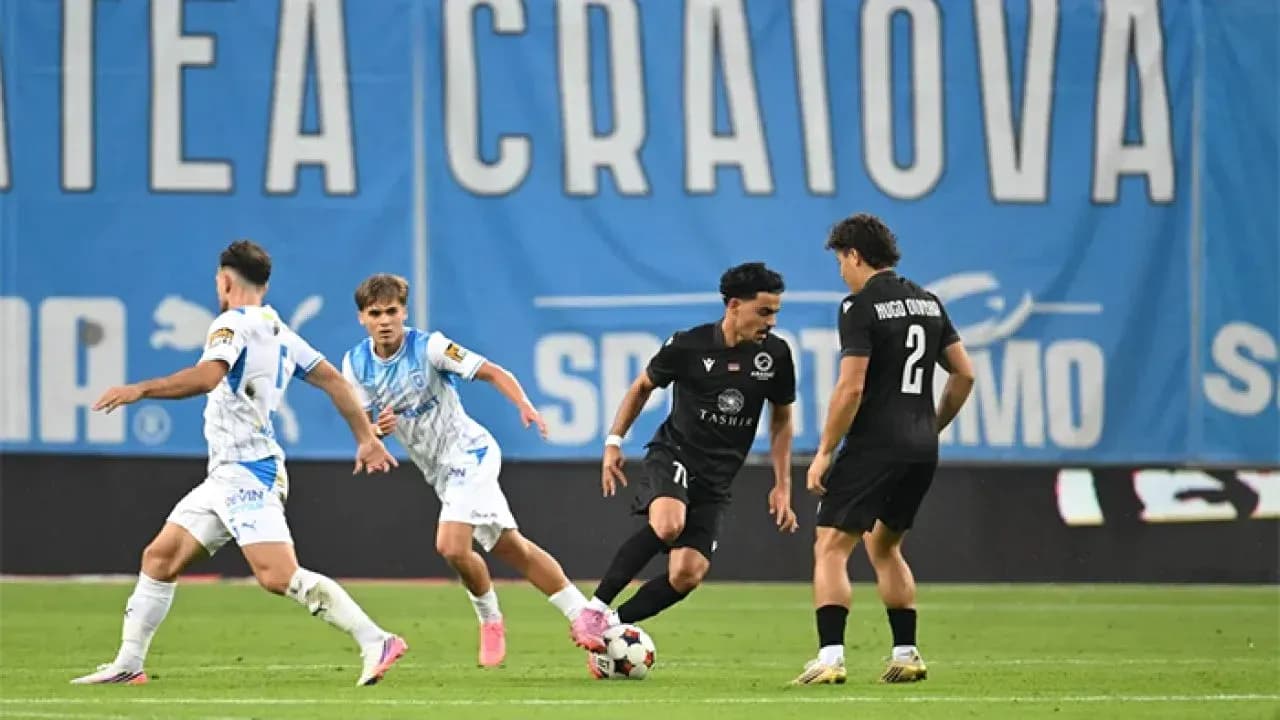
Universitatea Craiova’s 3-4-3 against Ararat-Armenia’s 4-3-3 produced a territorially dominant but ultimately frustrated home performance at Stadionul Ion Oblemenco, ending 1-1 in this UEFA Europa League Play-offs tie. The hosts generated far more finishing volume – 7 shots on goal to 2 and 8 corners to 4 – yet could not convert that pressure into a decisive second goal.
Structurally, Filipe Coelho set Craiova up with a back three of V. Screciu, A. Rus and O. Romanchuk behind a four-man midfield line. N. Bancu and C. Mora worked as advanced wing-backs/outer midfielders, with A. Mekvabishvili and A. Cicaldau forming the central axis. Ahead of them, D. Matei operated as a high midfielder between the lines, supporting the front two of A. Al Hamlawi and S. Baiaram.
This 3-4-3 gave Craiova natural width and allowed Bancu and Mora to pin back Ararat-Armenia’s full-backs, reflected in the 8-4 corner advantage and the 7-2 edge in shots on goal. The back three could hold a high line, compressing the pitch and keeping the visitors’ 4-3-3 mostly in their own half. However, with “Ball Possession” recorded at “0%” for both teams in the data, we cannot quantify the exact share of the ball, only infer from the shooting and corner patterns that Craiova spent longer in attacking phases.
Ararat-Armenia, under Tulipa, lined up in a 4-3-3 with Joao Bravim in goal behind a back four of E. Grigoryan, A. Malis, B. R. Wilson Valdez and Junior Julio. In midfield, H. Oliveira, Benny and K. Muradyan (later on) formed a compact trio, with A. Serobyan and Z. Banjaqui supporting central forward Sandro Lima from wide starting positions. The visitors’ plan was clearly to be efficient rather than expansive: only 6 total recorded shots (2 on goal, 4 off goal) but one converted, plus a low foul count of 5 suggesting a controlled, positionally disciplined block rather than constant emergency defending.
Tactical Hinge
The game’s tactical hinge came early. At 20', A. Malis stepped forward from the back line to finish for Ararat-Armenia, assisted by H. Oliveira. That sequence encapsulated the visitors’ approach: selective forward surges from defenders and midfielders to exploit Craiova’s aggressive shape. With Craiova’s wing-backs high and the back three spread, Ararat-Armenia could target the half-spaces and the channels either side of Screciu and Rus.
Craiova’s response was to further increase their territorial squeeze. Bancu, who equalised at 33' assisted by C. Cicaldau, consistently attacked the left channel, acting almost as an auxiliary forward. His goal underlined the value of the 3-4-3: overloads on the flank, a midfield runner (Cicaldau) supplying the final ball, and Bancu arriving from a deeper lane that was hard for Ararat-Armenia’s back four to track.
Discipline
Discipline-wise, the home side’s intensity came at a cost. Universitatea Craiova accumulated 4 yellow cards, all without specified reasons in the data: to David Matei at 39', Oleksandr Romanchuk at 47', Adrian Rus at 69' and Monday Etim at 78'. This rising card count hints at a defensive line occasionally exposed in transition and forced into interventions to stop counters, especially as Ararat-Armenia sought to break through Sandro Lima and the fresh legs of substitutes like Z. Shaghoyan and J. A. Balanta. In contrast, Ararat-Armenia finished without a single booking, consistent with their lower foul total (5 to Craiova’s 15) and a more passive, line-protecting defensive style.
Substitution Pattern
The substitution pattern further reveals the tactical story. At 62', Coelho doubled down on attacking thrust: S. Nsimba (IN) came on for A. Al Hamlawi (OUT), adding fresh movement up front, while M. Etim (IN) replaced D. Matei (OUT), injecting verticality from midfield. At 69', Teles (IN) came on for A. Cicaldau (OUT), maintaining central energy as the hosts pushed for a winner. Later, at 85', T. Baluta (IN) replaced A. Mekvabishvili (OUT) and L. Basceanu (IN) came on for S. Baiaram (OUT), suggesting a late attempt to vary the attacking profiles between the lines and on the last line.
Tulipa’s response was more about preserving structure and legs than changing the game’s geometry. At 69', Franca Carlos (IN) replaced Benny (OUT) in midfield, followed at 75' by J. A. Balanta (IN) for H. Oliveira (OUT), keeping the central block fresh. Then, in a triple change at 80', Z. Shaghoyan (IN) for Z. Banjaqui (OUT), M. Carlier (IN) for K. Muradyan (OUT), and A. Tera (IN) for A. Serobyan (OUT) effectively reset the midfield and wide roles to maintain defensive concentration and offer counter-attacking outlets without sacrificing the 4-3-3’s shape.
Without goalkeeper save data or passing figures, we cannot quantify build-up efficiency or shot-stopping performance. However, the contrast in shooting volume (7 shots on goal for Craiova versus 2 for Ararat-Armenia) and corners (8-4) indicates that the home side’s 3-4-3 successfully generated territory and chances, while the visitors’ 4-3-3 prioritised compactness and selectivity. The 1-1 scoreline, with Universitatea Craiova’s higher foul and card counts, suggests a match where the hosts carried the initiative but had to manage transitional risk, and Ararat-Armenia executed a pragmatic, low-event away strategy that leaves the tie finely balanced heading into the return leg.