.svg&w=384&q=75 "Naijagoal logo")

Lech Poznań Dominates FC Thun 7-0: Tactical Breakdown
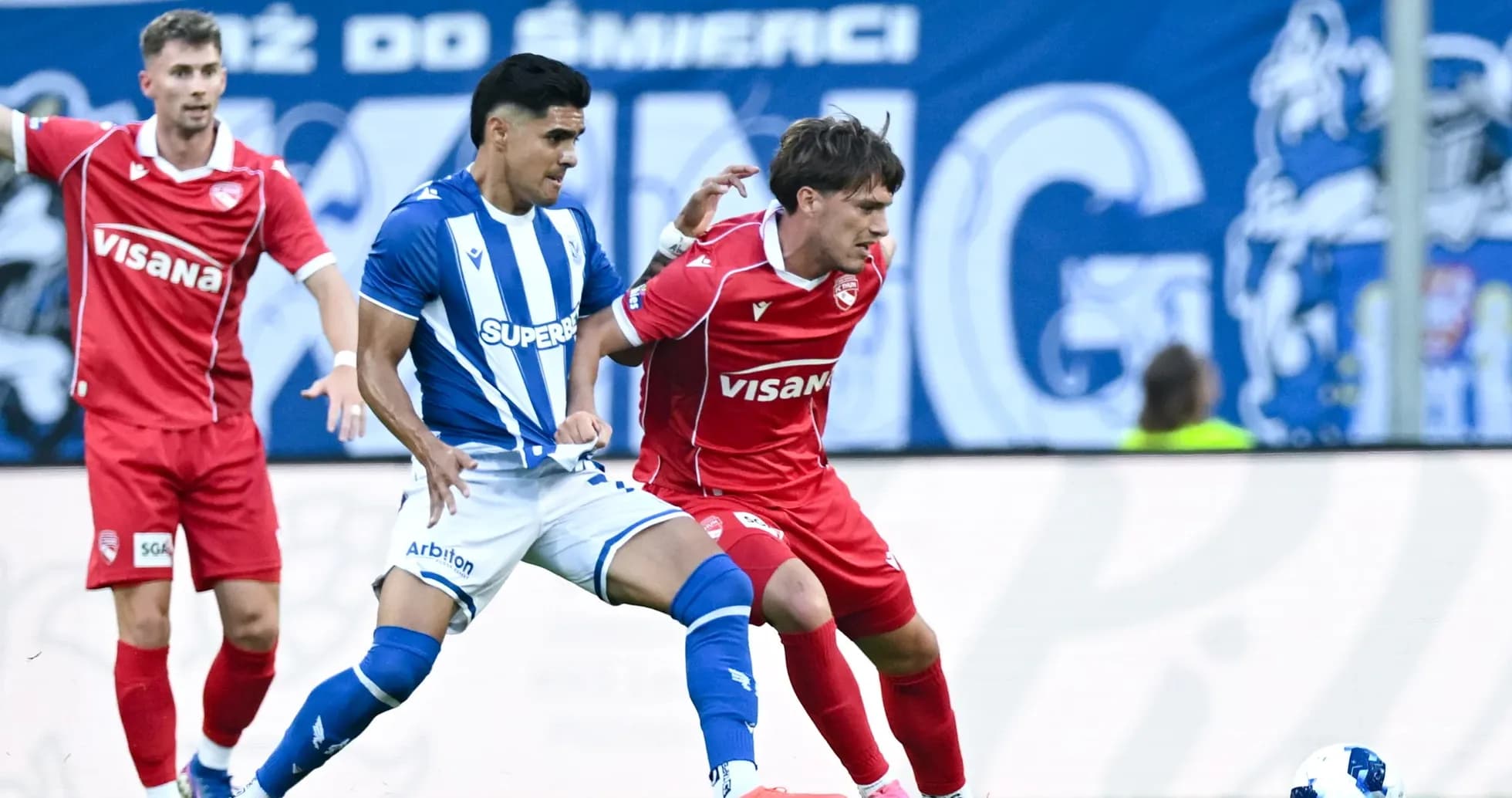
Lech Poznan’s 7-0 demolition of FC Thun at Enea Poznań was a tactical mismatch built on structure, intensity and ruthless execution. Within a 4-2-3-1, Niels Frederiksen’s side combined aggressive pressing with well-timed overloads in the half-spaces, turning a 56% share of possession into 11 shots on goal and a five-goal lead by half-time. Thun’s 4-4-2, by contrast, never solved the central overloads nor the rotations on Lech’s right side, and their attempts to respond with early second-half changes only opened more space for the hosts to exploit.
Lech’s base shape was a classic 4-2-3-1 but functionally very fluid. The double pivot of A. Kozubal and R. Murawski provided both circulation and vertical access, with Kozubal often dropping between the centre-backs to start build-up while Murawski stepped higher to connect with the attacking midfield line. Full-backs J. Pereira and M. Gurgul advanced aggressively, particularly on the right, where the triangle of Pereira, P. Rodriguez and P. Walemark consistently overloaded Thun’s left side.
First Half
The first-half avalanche reflected these structural advantages. Walemark’s opener at 10' came from Lech’s ability to pin Thun’s back four and find the free man between lines; with Thun’s double pivot occupied, the wide midfielder was forced to tuck in, leaving Walemark space to receive and finish. The second goal at 20' – A. Sayyadmanesh assisted by Rodriguez – underlined the value of a mobile “9” in this system: Sayyadmanesh drifted off the centre-backs into the right half-space, combining with Rodriguez, whose positioning as a central creator repeatedly broke Thun’s midfield line.
At 25', Walemark struck again, this time from deeper wide interplay. Gurgul’s assist highlighted how high Lech’s full-backs were allowed to operate; with Thun’s wingers pinned and their full-backs reluctant to step out, Gurgul had time to deliver into a disorganised box. By 31', when centre-back M. Skrzypczak finished a move assisted by Kozubal, Lech were fully camped in Thun’s half. The centre-back’s presence in the area reflected Lech’s territorial dominance: set-piece and second-ball situations kept the back line high, compressing the pitch and making counter-pressing immediate.
Murawski’s goal at 45', again assisted by Rodriguez, encapsulated Lech’s midfield superiority. With Thun’s central two overloaded by Rodriguez between the lines and Murawski arriving late, the visitors’ 4-4-2 block was constantly forced into emergency defending, leaving the edge of the box unprotected. Even Walemark’s substitution at 37' for D. Hakans did not blunt the threat; it simply refreshed the energy in the wide channel.
Thun's Response
Thun’s response was structural but ineffective. Coach Luca Privitelli Gian used the break and early second-half window to alter personnel within the 4-4-2: M. Gutbub was replaced by F. Dursun at 45+1', while both M. Heule and N. Zoukit came off at 46' for T. Strannegård and F. Saiz. The intention was clear – inject fresh legs and more technical security – but the underlying problems remained. The front two could not screen Kozubal and Murawski, and the wide midfielders were constantly caught between tracking full-backs and helping centrally.
Lech immediately punished the loosened structure. At 47', Hakans, who had replaced Walemark, scored from an assist by Sayyadmanesh, again illustrating the fluidity of the front four. With Thun’s lines stretched and their new midfield configuration not yet settled, Lech found space between and outside the full-backs, turning another wide overload into a clean finish.
Thun's Attacking Moments
Thun did produce moments of attacking intent, registering 4 shots on goal and 3 off goal, but they were largely transition-based and never sustained. A key turning point came at 66', when a potential goal by Furkan Dursun was disallowed by VAR. Tactically, that phase showed Thun’s best idea: early vertical balls into the channels behind Lech’s advanced full-backs. However, with the strike wiped out, the visitors lost the one avenue that had briefly unsettled the hosts.
Defensively, Thun’s issues were compounded by discipline and timing. They committed 16 fouls to Lech’s 8, a sign of persistent late arrivals into duels as they chased shadows. Yellow cards for Nils Reichmuth at 50' and Tom Strannegård at 70' underlined a reactive, rather than proactive, defensive posture; the midfield was constantly a step behind Lech’s rotations, forced into stopping moves rather than anticipating them.
Lech's Control
Lech, by contrast, managed the game with control and selective aggression. Their single yellow card, to Radosław Murawski at 87', came late and did not alter the tactical balance. Substitutions by Frederiksen were geared towards preserving intensity and rewarding dominance. At 64', Rodriguez and L. Palma made way for R. Gumny and G. Berggren, shifting the right side’s dynamic but not its superiority; Gumny later capped his cameo with a goal at 79', assisted again by the advanced Gurgul. Further changes at 80' – Kozubal for K. Delikat and Sayyadmanesh for W. Szymczak – allowed Lech to rotate without sacrificing their compact 4-2-3-1 rest defence.
Statistics
Statistically, the picture matches the eye test. Lech’s 56% possession was purposeful, converted into 11 shots on goal, 6 off goal and 3 blocked shots, plus 5 corner kicks. Thun’s 44% share yielded only 4 shots on goal and 3 off goal with 2 blocked shots, and their 3 corners rarely threatened. The foul disparity (16 for Thun, 8 for Lech) mirrors the control exerted by the hosts in both structure and timing.
Without goalkeeper save or passing data, the clearest indices are territorial and disciplinary. Lech’s defensive index in open play was strong enough to keep a clean sheet despite allowing a handful of efforts, while their overall form on the night was that of a side playing at a higher competitive rhythm. Thun’s shape never adapted to the overloads between their lines, and their adjustments in personnel could not compensate for systemic flaws. In tactical terms, this was a comprehensive dismantling: Lech Poznan imposed their model from the first minute and never relinquished control.