.svg&w=384&q=75 "Naijagoal logo")

Switzerland vs Algeria: World Cup Round of 32 Analysis
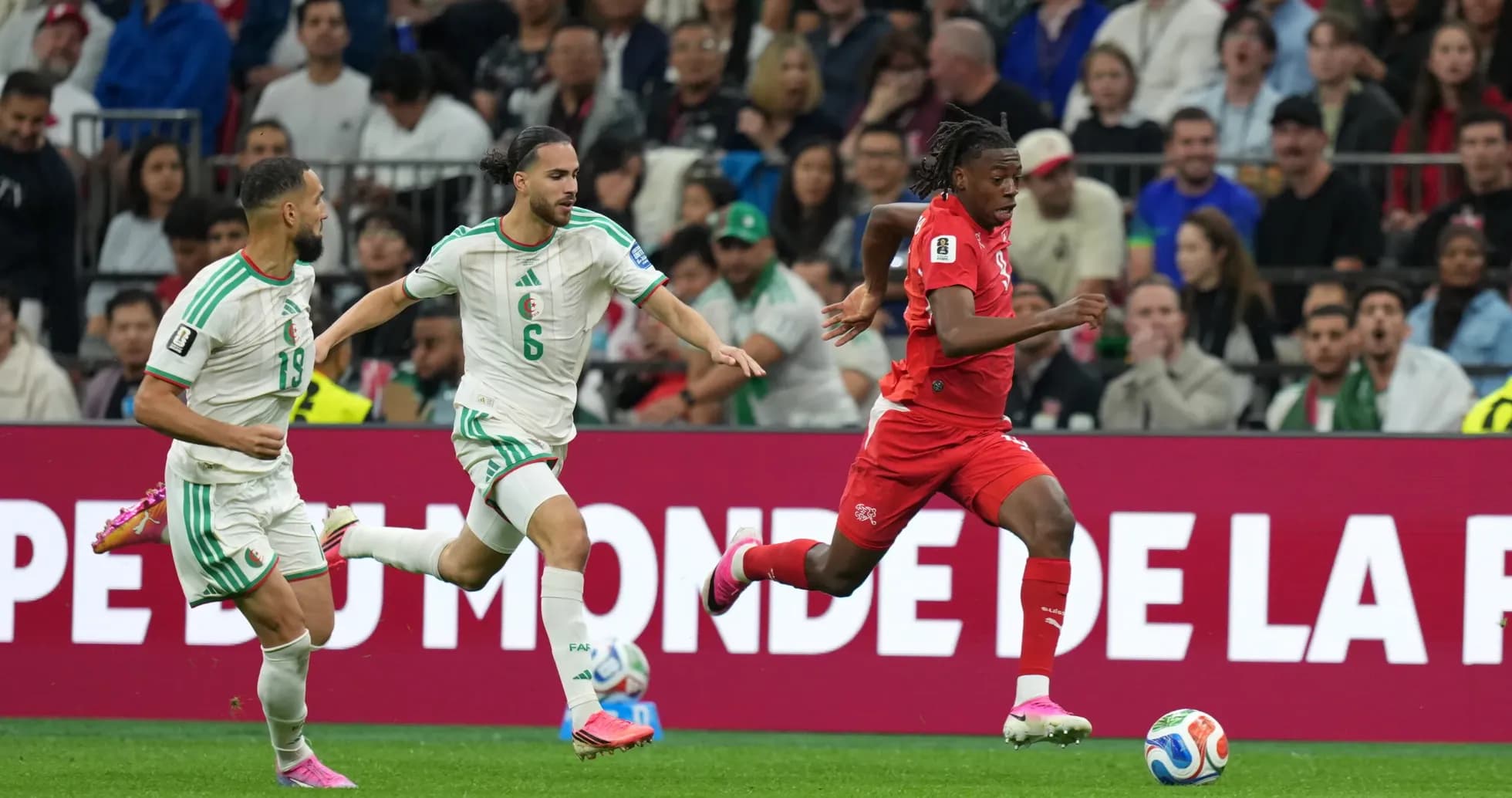
BC Place in Vancouver staged a World Cup Round of 32 meeting that felt like a clash of two very different footballing identities. Switzerland arrived as the polished group winners from Group B, top of their section with 7 points and a goal difference of 4 after 3 matches, their record built on control and efficiency. Algeria came from Group J in a more turbulent state: 3rd in their group, 4 points, and a goal difference of -2, a side that had shown flashes of attacking verve but carried defensive scars.
Over 90 minutes, Switzerland’s 2–0 win reflected the broader seasonal trends embedded in the data. Heading into this game, Switzerland had played 4 matches in total in this World Cup, winning 3 and drawing 1, with no defeats. At home (neutral venues where they were designated as the “home” side), they had played 3, winning all 3. Their attacking numbers were imposing: 9 goals in total, 8 of them as the home team, with an overall scoring average of 2.3 goals per game and 2.7 at home. Defensively, they had conceded just 3 in total, only 2 as the home side, an overall average of 0.8 goals against per game.
Algeria’s path was the mirror opposite. Across 4 matches in total they had just 1 win, 1 draw, and 2 defeats. On their travels, they had played 3, winning once and losing twice. Their total of 5 goals for contrasted starkly with 9 against, an overall defensive average of 2.3 goals conceded per game and 2.0 on their travels. Where Switzerland’s goal difference in the group phase was a positive 4 (7 scored, 3 conceded), Algeria’s was -2 (5 scored, 7 conceded). The patterns were clear: one side had built a platform of control, the other was trying to outscore the damage at the back and rarely succeeding.
Tactical Shapes
The tactical shapes at kickoff confirmed those identities. Murat Yakin kept Switzerland in their preferred 4‑2‑3‑1, a structure they had already used twice this tournament. Gregor Kobel started in goal, shielded by a back four of Denis Zakaria, Nico Elvedi, Manuel Akanji, and Ricardo Rodriguez. In front of them, the double pivot of Remo Freuler and Granit Xhaka was the brain and brake of the side, charged with controlling tempo and shutting down transitions. Ahead of them, Dan Ndoye, Johan Manzambi, and Ruben Vargas supported Breel Embolo as the lone forward.
Vladimir Petkovic, on the opposite bench, leaned into Algeria’s tournament template: a 4‑3‑3, one of the two systems they had alternated between. Lukman Zidane was in goal, with Rayan Belghali, Aissa Mandi, Ramy Bensebaini, and Rayan Ait‑Nouri forming the defensive line. The midfield triangle of Ramiz Zerrouki, Nabil Bentaleb, and Farès Chaibi was built to connect quickly with a high‑quality front three of Riyad Mahrez, Islam Maza, and Houssem Aouar.
The absences added a subtle twist to both plans. Switzerland were without L. Jaquez, ruled out with a muscle bruise, trimming Yakin’s defensive and rotational options. Algeria missed A. Benbouali due to a wound, limiting Petkovic’s capacity to change the profile of his attack from the bench. Neither absence altered the starting blueprint, but both narrowed the margin for in‑game adjustment.
Key Players
In the “Hunter vs Shield” duel, Switzerland’s offensive core met an Algerian defence that had already shown fragility. Manzambi entered the knockout stage as one of the World Cup’s form attacking midfielders: 3 goals and 2 assists in 4 appearances, with 4 shots in total and 3 on target, plus 14 dribble attempts with 5 successful. His 7.7 average rating underlined how central he had become to Switzerland’s attacking identity. Embolo, with 2 goals and 2 assists from 4 appearances and 8 key passes, offered a more direct, muscular threat, capable of pinning centre‑backs and combining in tight spaces.
Together, they were up against an Algerian back line that had conceded 6 goals on their travels before this match and 9 overall in 4 games. The numbers hinted at where the game would tilt: Switzerland’s home scoring average of 2.7 against Algeria’s away defensive average of 2.0 suggested a contest likely to be decided in Algeria’s penalty area, not Switzerland’s.
Midfield Battle
In midfield, the “Engine Room” battle was just as decisive. Xhaka and Freuler, both comfortable dictating from deep, faced Zerrouki, Bentaleb, and Chaibi. Algeria’s midfield had to walk a tightrope: protect a vulnerable back four that had already seen its biggest away defeat as 3‑0, while still feeding Mahrez and Aouar quickly enough to exploit transitions. Switzerland, by contrast, could lean on structure. Their overall record of failing to score in zero matches this tournament, combined with only 3 goals conceded in total, allowed them to be patient, recycling possession through Xhaka and Freuler and trusting their front four to eventually break through.
Discipline was another subtle undercurrent. Both teams had shown a tendency to collect yellow cards in the 31‑45 minute window, with 66.67% of their bookings in that range. That shared spike hinted at emotional spikes just before half‑time, a period where control of the midfield duel and game state would be particularly fragile. Yet across the tournament both sides had avoided red cards entirely, suggesting aggression was largely kept within tactical bounds.
Statistical Prognosis
From a statistical prognosis perspective, the outcome aligned almost perfectly with the pre‑match data. Switzerland’s clean sheet tally had been modest heading in—just 1 in total—but their underlying defensive average of 0.8 goals conceded per game and the stability of an unchanged back four made a shutout plausible against an Algerian side that had already failed to score in 2 matches in total. Offensively, Switzerland’s penalty record—2 taken, 2 scored, with no misses—added another layer of threat whenever they reached the box, even though this particular match did not go to spot‑kicks.
Following this result, the narrative of both campaigns hardened. Switzerland’s unbeaten run, their high home scoring rate, and the rise of Manzambi and Embolo as a dual spearhead confirmed them as a balanced knockout force: capable of controlling games through Xhaka and Freuler, defending robustly through Akanji and Elvedi, and deciding ties with the craft of Vargas, Ndoye, and their emerging young creator‑finisher in the No. 9 shirt. Algeria, for all the quality of Mahrez and the technical promise around him, left Vancouver as the numbers had warned: a side whose attacking flashes could not consistently outweigh the structural leaks at the back.