.svg&w=384&q=75 "Naijagoal logo")

Colombia Dominates Ghana in World Cup Match
Colombia’s 1-0 win over Ghana at Arrowhead Stadium in this World Cup Round of 32 tie was a textbook example of territorial and structural control translating into a narrow but fully deserved passage. With 61% possession, a 20–8 shot advantage and an xG of 2.18 to 0.26, Nestor Lorenzo’s side imposed their 4-3-3 for long stretches, pinning Ghana’s 4-1-4-1 deep and forcing them into a reactive, low-output game. The scoreline stayed tight, but the underlying dynamics were one-sided: Colombia consistently created superior positions between the lines and out wide, while Ghana relied on compactness and individual defensive interventions to stay alive, plus a strong performance from Lawrence Ati Zigi in goal.
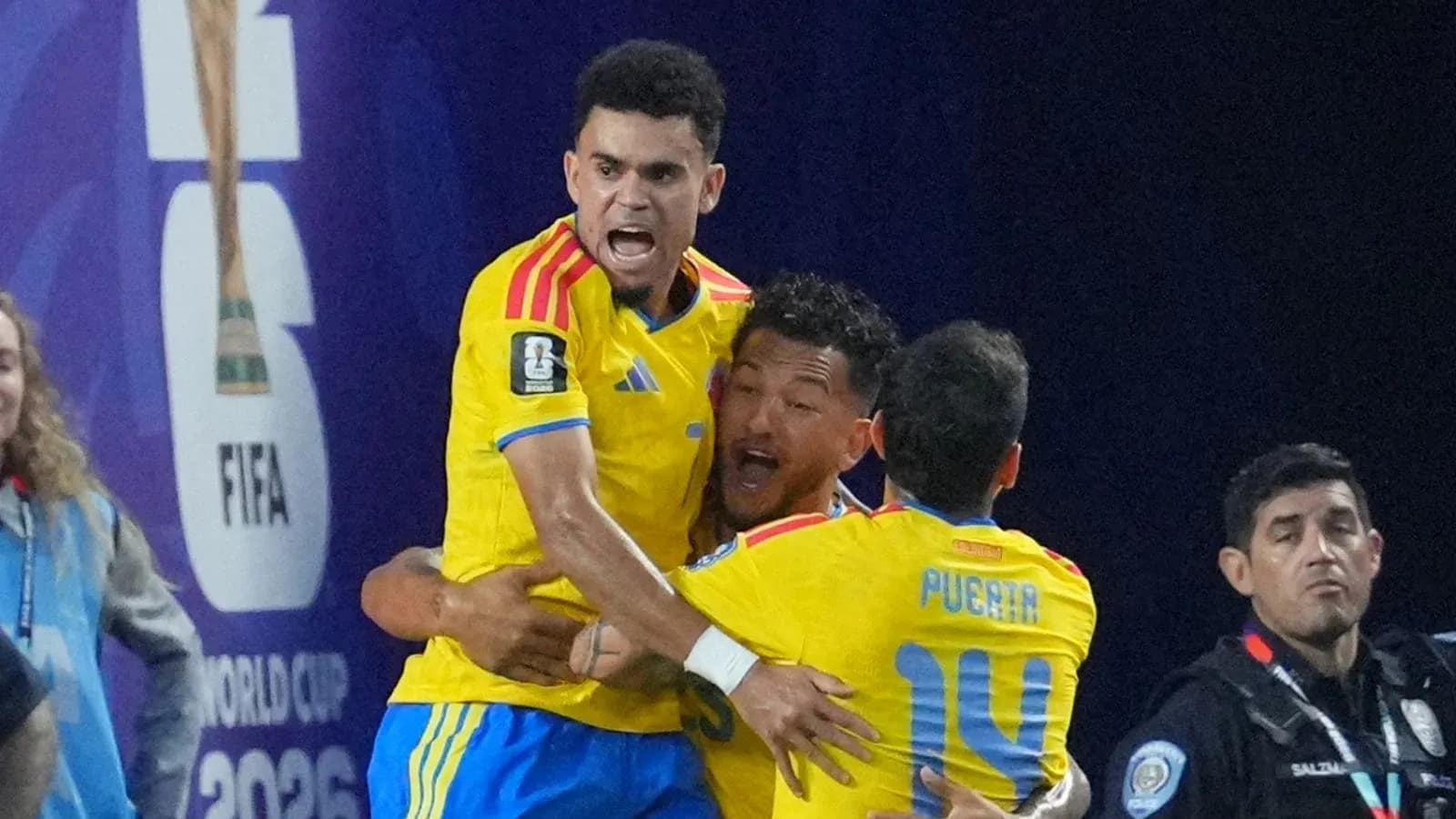
The decisive phase came early. An 8th-minute change saw Luis Javier Suárez (IN) come on for Jhon Córdoba (OUT), subtly reshaping Colombia’s front line. Within six minutes, that adjustment paid off: in the 14th minute, Jhon Arias finished a move assisted by Luis Javier Suárez, the only goal of the night and the action that set the game’s strategic tone. From there, Colombia could lean into controlled possession and structured pressing rather than chasing the match.
First Half
Ghana’s defensive discipline was tested almost immediately. At 12', Jhon Arias picked up a yellow card for “Tripping”, but that did little to blunt Colombia’s midfield dominance. Carlos Queiroz reacted on 13' by switching at right-back, with Alidu Seidu (IN) replacing Marvin Senaya (OUT), likely in search of more defensive aggression on Luis Díaz’s flank. It did not prevent Colombia from striking, and by half-time the 1-0 scoreline reflected Colombian superiority more than Ghanaian balance.
Second Half
The second half opened with another Colombian tweak: at 46', Richard Ríos (IN) came on for James Rodríguez (OUT), adding more legs and defensive presence in midfield to protect the lead. Ghana’s attempts to disrupt Colombia’s rhythm brought disciplinary costs. At 49', Caleb Yirenkyi received a yellow card for “Holding” as Ghana tried to break up Colombian transitions. Colombia thought they had doubled the lead on 56', but a potential goal by Luis Díaz was disallowed by VAR for offside, a key moment that kept Ghana within one strike despite their lack of attacking threat.
On 62', Queiroz made a double switch to refresh his midfield block: Elisha Owusu (IN) for Kwasi Sibo (OUT) and Abdul Fatawu Issahaku (IN) for Iñaki Williams (OUT). Yet the fresh legs also brought more edge: at 66', Abdul Fatawu Issahaku was booked for “Unsportsmanlike conduct”, underlining Ghana’s growing frustration. Colombia then rotated their own creator: at 73', Juan Fernando Quintero (IN) replaced Jhon Arias (OUT), a like-for-like move to maintain technical quality between the lines.
Ghana’s back line continued to defend aggressively. At 76', Alidu Seidu was shown a yellow card for “Tripping”, the third caution for Queiroz’s team. Two minutes later, at 78', Richard Ríos, who had been introduced to harden Colombia’s midfield, also saw yellow for “Tripping”, reflecting the more physical nature of the final phase. Ghana’s last push came with attacking substitutions on 79': Ernest Nuamah (IN) for Jordan Ayew (OUT) and Prince Kwabena Adu (IN) for Caleb Yirenkyi (OUT), moves aimed at injecting pace and direct running. Colombia’s final notable change was at 90', when Jaminton Campaz (IN) replaced Luis Díaz (OUT), a late adjustment to add fresh energy on the wing and help see out the result.
Tactical Analysis
Tactically, Colombia’s 4-3-3 functioned as a high-possession, territorial control system. The back four of Daniel Muñoz, Davinson Sánchez, Jhon Lucumí and Johan Mojica could hold a relatively high line because Ghana offered little depth threat; Ghana finished with only 2 shots inside the box and 0 shots on target. Jefferson Lerma, Gustavo Puerta and Jhon Arias initially formed a midfield that combined ball circulation with forward runs, with Arias especially effective attacking the right half-space. The early substitution of Córdoba for Luis Javier Suárez shifted the reference point up front, giving Colombia more vertical runs and diagonal movements that helped disorganize Ghana’s back four and opened the lane for Arias’s goal.
After the interval, the introduction of Richard Ríos for James Rodríguez subtly tilted Colombia from a creativity-first to a control-first midfield. With the lead and 61% possession, Lorenzo prioritized rest defense and counter-pressing security. Juan Fernando Quintero’s later arrival for Arias preserved a creative outlet without sacrificing structure. Out wide, Luis Díaz and Luis Javier Suárez stretched Ghana horizontally, forcing full-backs Gideon Mensah and the rotated right side to defend deep rather than support attacks.
Ghana’s 4-1-4-1, anchored by Thomas Partey, was designed to congest central zones and then spring forward through wide players and Jordan Ayew. In practice, Colombia’s pressing and ball circulation limited Ghana to 39% possession and just 8 total shots, 6 of them from outside the box. The central midfield four behind Ayew struggled to progress the ball cleanly against Colombia’s three-man midfield and front pressing line, often resorting to longer passes that Colombia’s centre-backs handled comfortably.
In goal, Camilo Vargas (Colombia) did not register a single save, a direct reflection of Colombia’s defensive control and Ghana’s inability to generate shots on target. Lawrence Ati Zigi (Ghana), by contrast, made 7 saves and, combined with Ghana’s total of 5 blocked shots, was central to keeping the scoreline at 1-0. The goals prevented figure of 1.92 for Ghana underlines how much Ati Zigi’s interventions and last-ditch defending exceeded the quality of chances Colombia created.
Statistical Overview
Statistically, Colombia’s dominance was comprehensive: 20 total shots to Ghana’s 8, with 8 on goal versus Ghana’s 0, and a 3–2 edge in corners. The passing figures further highlight the control: Colombia completed 586 passes, 532 accurate at 91%, compared to Ghana’s 376 passes, 312 accurate at 83%. Colombia’s xG of 2.18 against Ghana’s 0.26 aligns closely with the tactical picture of one side consistently in advanced positions and the other largely pinned back.
Discipline slightly favored Colombia numerically (2 yellow cards) over Ghana’s 3, but the pattern fits the game: Ghana’s cautions came as they tried to break up Colombian superiority and chase the match, while Colombia’s bookings reflected isolated duels rather than systemic defensive strain. Ultimately, the 1-0 scoreline, 1-0 at half-time and unchanged to full-time, slightly flatters Ghana; Colombia’s structure, ball circulation and chance creation were of a level that, on another day, would likely have produced a wider margin.