.svg&w=384&q=75 "Naijagoal logo")

Sweden’s Journey to North America: Potter's Impact and Team Dynamics
Sweden should not be here. Not by any conventional measure.
One point from the first four qualifiers under Jon Dahl Tomasson. A 1-0 defeat away to Kosovo in October 2025 that felt like a nadir, not a stumble. The Dane was sacked, the campaign looked broken and a proud football nation seemed to be drifting out of the World Cup picture without so much as a fight.
Then Graham Potter walked back into Swedish football.
Potter returns – and strips it back
For Swedish fans, Potter is not the Chelsea experiment or the West Ham struggle. He is the Östersund architect, the English coach who turned a fourth-tier club into cup winners, Europa League adventurers and Arsenal’s unexpected tormentors between 2011 and 2017. His name still carries the weight of that improbable rise.
When he spoke to Fotbollskanalen in October 2025, it barely sounded like a polite interest. It sounded like a plea. “I have feelings for Sweden. I love the country and I love Swedish football. Coaching the national team would be an incredible opportunity for me, absolutely.” Days later, he had the job.
Potter inherited a mess and did not pretend otherwise. The talk of expansive back-four football quickly gave way to something far more pragmatic. Sweden went back to type: a stubborn, organised defence, ruthless counterattacks, and a structure designed less to impress neutrals and more to suffocate opponents.
He had said he preferred a back four. When the stakes rose, he parked the theory and lined up with a 5-3-2 in the playoffs. Protect the penalty area. Kill space. Wait for the right moments. It was old-school Swedish, but with Potter’s fingerprints on the details.
The Swedish FA did not hesitate. Even without wins in his first two games, they were convinced enough to hand him a contract extension to 2030 in March. A long bet on a coach who speaks the language, knows the culture and badly needed a stage to rebuild his own reputation.
Nations League lifeline, Gyökeres takes centre stage
Sweden’s route back into contention came via the Nations League, a safety net that suddenly turned into a springboard. In Spain, in the semi-final against Ukraine, the plan clicked. Compact lines, quick transitions, and one man on a different level.
Viktor Gyökeres scored a hat-trick in a 3-1 win that felt like a statement as much as a result. The Arsenal forward, who had initially struggled to settle after his move to north London, looked like he had been waiting all year for this stage. Power, movement, conviction in front of goal – everything Sweden had been missing in the early qualifying chaos.
The final against Poland was far more brutal to watch. Sweden were second-best for long spells, forced back, forced to suffer. Yet they clung on, traded blows and stayed in the game. Then, in the 88th minute, Gyökeres did it again, sealing a 3-2 thriller and sending a nation into delirium.
On the touchline, Potter almost lost his composure. “Just an incredible evening, just so proud to be part of that and obviously proud to experience it,” he said afterwards. He called it the best night of his football life, described it like an out-of-body experience, watching the goal, the bench sprinting past him and wondering if he was really there.
Sweden, who had taken only two points from six games in their qualifying group, were going to the World Cup.
That is the Potter effect. Not a grand philosophy lecture. A team, patched up and rearmed, finding a way through when the door was almost shut.
A World Cup without Kulusevski
Now comes the hard part. Sweden head to North America to face Tunisia, Netherlands and Japan in a group that offers both opportunity and peril.
They will do it without their captain, Dejan Kulusevski. His absence cannot be dressed up. His influence on this side, on and off the ball, is enormous and “cannot be overstated” is no exaggeration here. Sweden lose a ball-carrier, a creator, a leader. They also lose a player who could knit together attack and midfield in exactly the kind of tight, tactical games they are likely to face.
On top of that, Alexander Isak arrives under a cloud. Last year he became the most expensive transfer in Premier League history, swapping Newcastle for Liverpool for £125m. The fee only added pressure to a first season at Anfield that never quite ignited. His form and fitness remain under scrutiny, even if he did score as a substitute in a 3-1 defeat to Norway on 1 June – a match that was worryingly one-sided from a Swedish perspective.
Right now, though, there is no debate about the talisman. This is Gyökeres’s team.
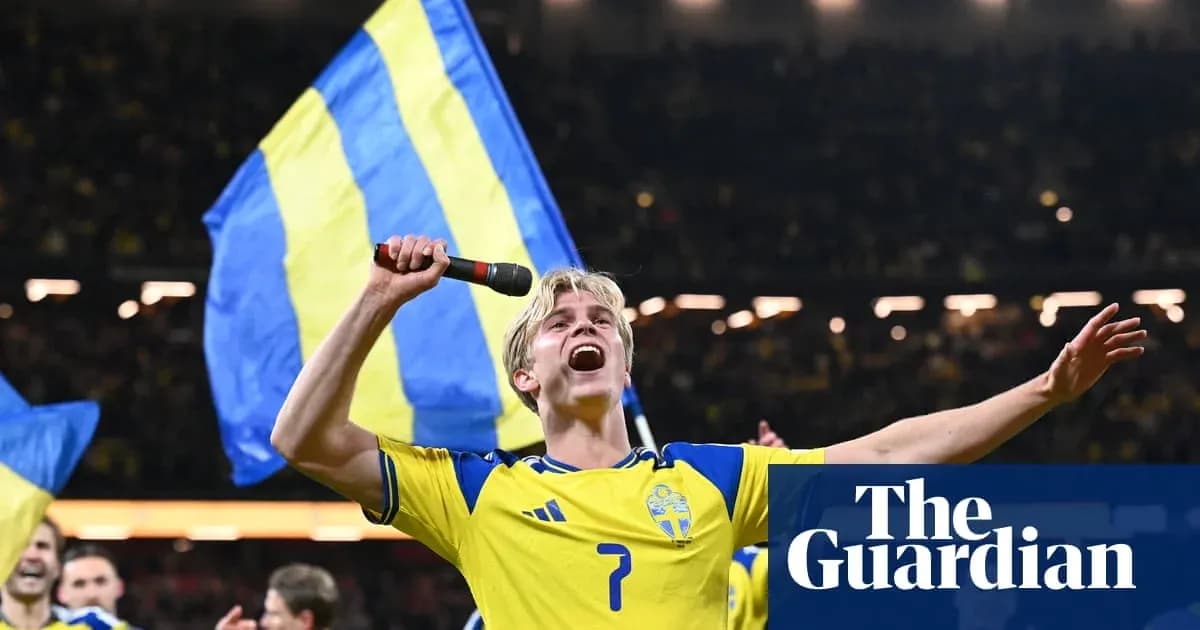
He has scored four of Sweden’s six goals in the two playoff ties and, with Kulusevski sidelined and Isak searching for rhythm, the Arsenal forward has become the emotional centre of the attack. His popularity exploded again after that late winner against Poland, with fans across the country posting their own versions of his goal celebration – the one inspired by Bane, Tom Hardy’s masked villain in The Dark Knight Rises.
If Sweden are to punch above their weight at this tournament, Gyökeres will almost certainly be the one swinging.
Lagerbielke, the baron at the back
The supporting cast is intriguing. Celtic’s Benjamin Nygren offers creativity, but one of the most compelling figures in this squad is a defender who looks built for knockout football.
Gustaf Lagerbielke, now at Braga, delivered a towering performance in the playoff final against Poland. He scored with a thunderous header and then helped shut down Robert Lewandowski, a task that has broken far more experienced centre-backs. A defender who relishes duels and dominates in the air is exactly what Potter’s 5-3-2 demands.
Lagerbielke also comes with a backstory that feels almost too neat: a former Celtic defender, a baron, and reportedly 254th in line to the Swedish throne. It is the kind of detail that sticks, the kind that ensures he will be a talking point long before kick-off in North America.
There is already talk of a move to one of Europe’s big-five leagues this summer. A strong World Cup could turn that speculation into a scramble.
Karlström, the anchor Sweden cannot do without
Sweden’s group demands very different types of battles. The Netherlands bring high-level technique and control. Japan offer relentless intensity, sharp passing and tenacity. Tunisia, rugged and disciplined, will not give an inch.
In the middle of all that, Jesper Karlström becomes vital.
The Udinese captain is a late bloomer, a player who needed time at Djurgården and then a move to Lech Poznan before his career really settled. He has been open about his struggles with gambling addiction during his time at Djurgården and how his family and the club helped him overcome it. That experience shows in his game now: calm, assured, unflustered.
On the pitch, Karlström is a classic deep-lying midfielder. Strong in the tackle, clever in his positioning, comfortable dictating the tempo. At 30, he is the steadying presence in a midfield that also features younger talents such as Yasin Ayari and Lucas Bergvall. When the matches tighten and the noise rises, Sweden will lean heavily on his ability to slow everything down.
If Sweden are to wrest control from the Dutch or blunt Japan’s rhythm, Karlström will be at the heart of it.
The travelling Swedes and an old Trump line
Swedish fans travel. They always have. Blågult supporters turn tournaments into yellow-and-blue carnivals, loud but approachable, full of banter and usually on good terms with whoever they happen to be sharing a square or a metro carriage with.
Their unofficial soundtrack is “Kanna på”, a song about beer pitchers that never stop arriving. It includes the line: “We are coming with 100,000 men.” The numbers in North America will not reach Viking invasion levels, but there will be a substantial Swedish presence, and they will make themselves heard.
The relationship between Sweden and the United States carries a strange, modern footnote. In 2017, Donald Trump stood on a stage and said: “Look what happened in Sweden last night,” as he talked about immigration and terrorist attacks. The only problem was that nothing dramatic had happened in Sweden the night before. He later said he was referring to a Fox News report, which did little to clear the fog.
Swedish paper Aftonbladet duly listed the day’s notable events. They included famous singer Owe Thörnqvist suffering technical problems in rehearsals, a man setting himself on fire in central Stockholm, and road closures in northern Sweden due to harsh weather. Reality, as so often, was far more mundane than the rhetoric.
Now Sweden return to the US under very different lights, not as a political talking point but as a football story that refused to die.
They arrive patched up, missing their captain, still unsure about their record signing, but led by a coach who has rebuilt them in his own, pragmatic image. They have a striker in Gyökeres who looks ready to own the biggest stage, a baron at the back, a reformed midfield anchor, and a fanbase ready to paint American streets yellow and blue.
For a team that once seemed destined to watch this World Cup from home, the question is no longer how they got here. It is how far this unlikely, Potter-led revival can really go.