.svg&w=384&q=75 "Naijagoal logo")

Slovan Bratislava’s Tactical Superiority in 2-0 Win Against Mjallby AIF
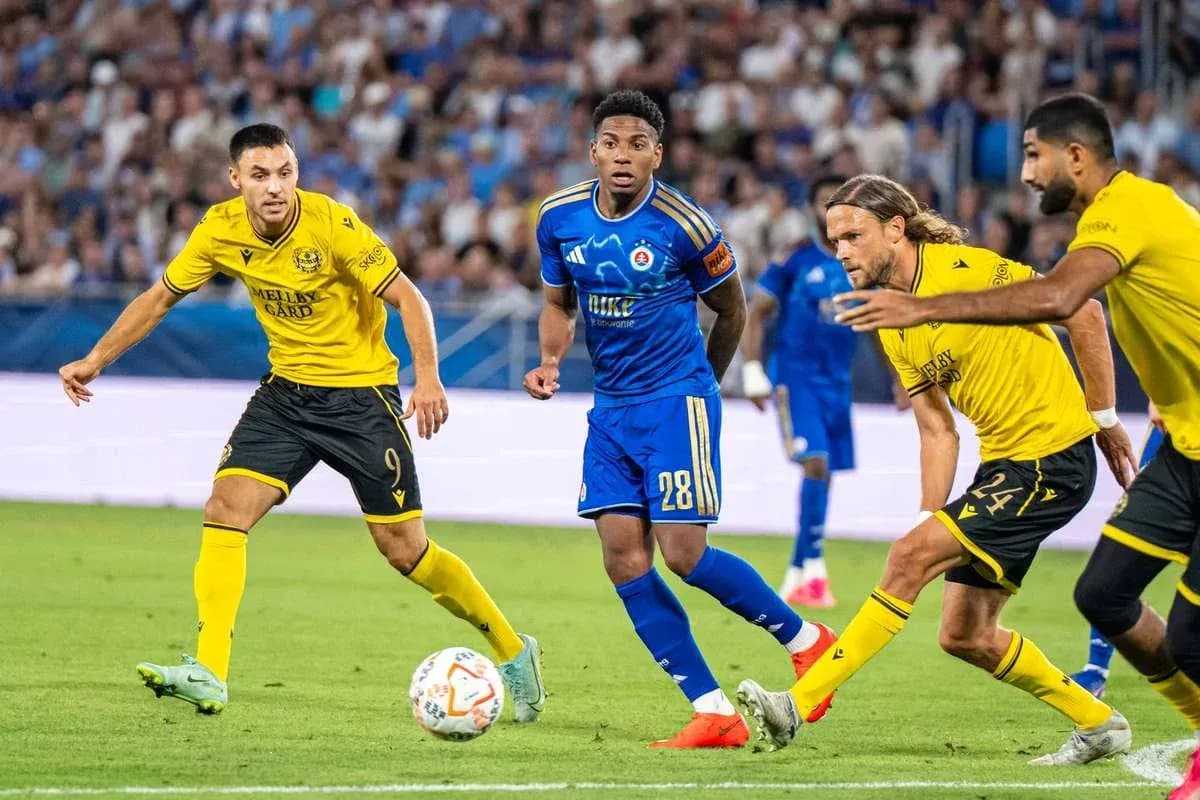
Slovan Bratislava’s 2-0 home win over Mjallby AIF at Tehelne Pole Stadion in the UEFA Champions League 3rd Qualifying Round was built on clear structural superiority rather than overwhelming volume of chances. With possession perfectly split at 50%-50% and both sides registering identical totals in blocked shots (0) and a similar spread of attempts (4 shots on goal to 2; 7 shots off target to 4), the difference came from how Slovan manipulated space within their 4-1-4-1 against Mjallby’s 3-4-3 and used that platform to control territory and tempo, especially after half-time.
Yaya Toure’s 4-1-4-1 for Slovan Bratislava was designed to dominate the second line. P. Pokorny sat as the single pivot in front of a back four of S. Cruz, S. Markovic, K. Bajric and C. Blackman, allowing the full-backs—particularly Cruz on the left—to advance aggressively once Slovan established settled possession. Ahead of Pokorny, the line of four, with A. Mustafic and R. Ibrahim central and S. Camara and M. Kianga wider, constantly sought to pin Mjallby’s wing-backs and drag their outside centre-backs into uncomfortable zones.
Mjallby’s 3-4-3 under Karl Aksum, with R. Wallinder in goal behind a back three of T. Pettersson, L. Svanberg and A. Iqbal, tried to compress central spaces and spring forward through the wing-backs V. Granath and I. Hoffmann and the midfield pairing of J. Gustavsson and V. Gustafson. Up front, the trio of A. Samuelsen, J. Bergstrom and J. Kjaer were meant to threaten in transition. However, with only 2 shots on goal and 4 off target, they rarely converted shape into genuine pressure.
First Half
The first half, goalless at 0-0, reflected tactical sparring more than chaos. Both teams kept a disciplined line, and the foul count—15 for Slovan, 9 for Mjallby—shows that the hosts were more aggressive in counter-pressing once they lost the ball. The yellow card for Tom Pettersson (“Foul”) at 43' and for Rahim Ibrahim (“Foul”) at 44' underlined a rising intensity in duels as Slovan tried to quicken the tempo before the interval and Mjallby fought to disrupt their rhythm.
Second Half
The decisive shift came immediately after half-time through Slovan’s bench management. At 46', T. Barseghyan (IN) came on for M. Kianga (OUT), a move that injected more direct ball-carrying and creativity from the flank. Within a minute of that change, the structural idea paid off: at 47', S. Camara finished a move created by S. Cruz, whose overlapping from left-back had been a recurring pattern. That goal did more than open the scoring; it forced Mjallby’s 3-4-3 to become more expansive, which played into Slovan’s hands.
Mjallby responded with a double change at 56', bringing on A. Youssef (IN) for I. Hoffmann (OUT) and T. Miettinen (IN) for L. Svanberg (OUT), aiming to freshen the flanks and add more dynamism in the wide channels. Yet Slovan’s ability to control the central corridor remained intact. Even as S. Camara picked up a yellow card for “Simulation” at 58', the hosts continued to dictate the flow between the lines.
Toure then doubled down on midfield energy and vertical threat. At 59', A. Yirajang (IN) replaced M. Kukharevych (OUT), and C. Martinez (IN) came on for R. Ibrahim (OUT), reshaping the attacking line to add fresh legs and more aggressive running off the ball. Despite Slovan accumulating cards—Alen Mustafić was booked for “Foul” at 62'—their pressing structure remained coherent, with Pokorny screening transitions and the centre-backs stepping in behind him.
Mjallby’s further changes at 72', L. Tidstrand (IN) for V. Granath (OUT) and O. Lindberg (IN) for J. Kjaer (OUT), signalled a push to rescue the tie, but it left more gaps as they tried to commit numbers forward. Slovan exploited exactly that. At 76', D. Matsuoka (IN) came on for A. Mustafic (OUT), adding fresh control in midfield, and two minutes later, at 78', A. Yirajang struck the second goal, again assisted by S. Cruz. The repeat pattern—full-back delivery and a late-arriving attacker—illustrated how Slovan consistently overloaded the left side against a tiring Mjallby wing-back and outside centre-back.
From there, game management took over. S. Camara, already on a yellow, was withdrawn at 83' for L. Hofstadter (IN), a pragmatic move to avoid disciplinary risk and add legs to protect the 2-0 lead. Mjallby’s final substitution at 87', with M. Agnarsson (IN) for V. Gustafson (OUT), could not change the underlying dynamic: Slovan’s structure, even with multiple midfield rotations, continued to block central access and force Mjallby to lower-quality wide deliveries that rarely translated into shots on goal.
Defensively, both back lines benefited from the lack of blocked shots (0 for each team), suggesting that most attempts either missed the target or were allowed to travel through to the goalkeepers. While the exact number of saves for D. Takac (Slovan Bratislava) and R. Wallinder (Mjallby AIF) is not specified, the shots on goal tally (4 for Slovan, 2 for Mjallby) indicates that neither goalkeeper was overwhelmed; instead, the match was decided by which side better converted territorial control and structural advantages into clear chances.
The disciplinary profile—3 yellow cards for Slovan Bratislava, 2 for Mjallby AIF, no reds—matches the tactical story: Slovan’s higher foul count and bookings came from a more assertive, front-foot approach, especially in counter-pressing and defensive transitions. Mjallby, with fewer fouls and cards, were more reactive, often defending deeper and relying on their back three to absorb pressure rather than stepping out aggressively.
Statistically, the 2-0 scoreline aligns with the pattern of play rather than sheer volume. With possession even at 50%-50%, Slovan’s edge came from quality and timing: they generated more shots on goal (4 vs 2), used their 2 corner kicks more efficiently than Mjallby’s 4, and crucially turned full-back advancement—particularly from S. Cruz—into both assists. The absence of recorded xG and passing data means we cannot quantify chance quality or circulation, but the event and shooting data, combined with the formations, strongly support the view that Slovan’s 4-1-4-1 offered clearer attacking routes and more effective use of substitutions than Mjallby’s 3-4-3.
In the context of a two-legged Champions League qualifier, this 2-0 home win gives Slovan Bratislava a tactically deserved advantage: a clean sheet, controlled risk, and evidence that their structural plan can repeatedly unbalance Mjallby’s back three down the flanks and through late runners from midfield.