.svg&w=384&q=75 "Naijagoal logo")

Fenerbahçe Defeats Sturm Graz 1-0 in Tactical Showdown
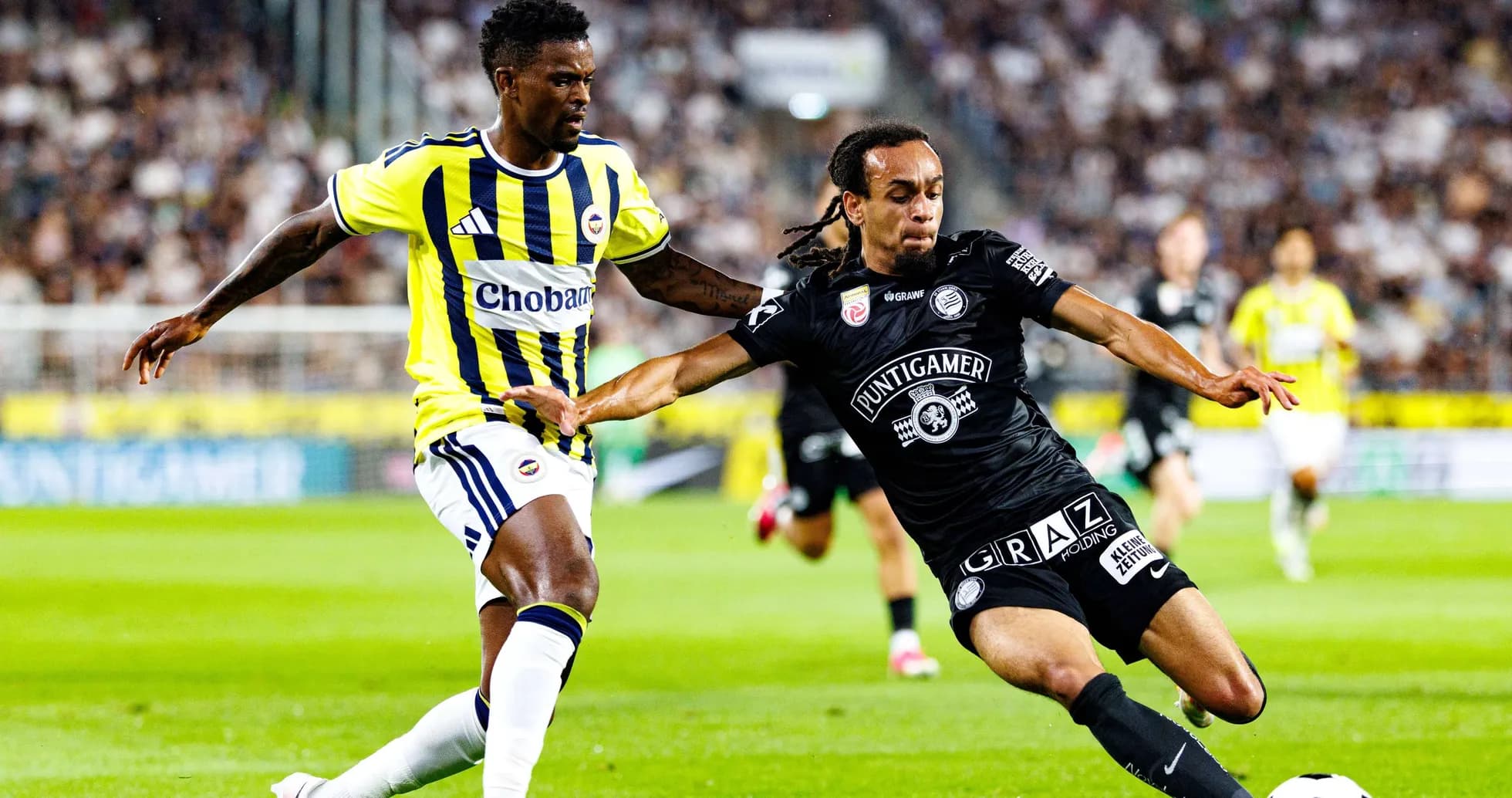
Sturm Graz approached the first leg at Merkur Arena with a clear structural idea in their 4-4-2, but Fenerbahçe’s 4-2-3-1 proved more efficient in both boxes, turning a balanced statistical game into a 1-0 away win.
Out of possession, Sturm’s 4-4-2 was compact and vertically disciplined. The double pivot of J. Gorenc Stankovic and S. Seidl screened central access into Talisca’s feet, forcing Fenerbahçe to circulate via the full-backs Nélson Semedo and Archie Brown. The home side’s block successfully limited clear central combinations, reflected in Fenerbahçe’s modest 11 total shots. However, the visitors still generated 8 shots inside the box, a sign that once Fenerbahçe broke the first line, their occupation of the penalty area was far more purposeful than Sturm’s.
In possession, Sturm Graz had 50% of the ball and actually out-shot Fenerbahçe 19–11, but the shot profile underlined their attacking inefficiency. Only 6 of those 19 attempts came from inside the box and just 2 were on target, with a remarkable 9 efforts blocked. This points to a pattern of hopeful shooting against a well-structured low block rather than clean chance creation. Fenerbahçe’s central pairing of N. Kanté and M. Guendouzi protected the zone in front of the centre-backs Milan Skriniar and Nathan Aké, stepping out aggressively to meet Sturm’s midfield ball-carriers and forcing them into crowded shooting lanes from distance.
Sturm’s 4-4-2 front line of A. Kayombo and S. Jatta tried to stretch Fenerbahçe’s back four with vertical runs, but the visitors’ back line controlled depth well. Skriniar and Aké dominated aerially and defended the space behind with good starting positions, which allowed Fenerbahçe to keep their line relatively high without conceding many transition chances. The fact that Sturm needed so many blocked shots to reach just 2 on target suggests their forwards were often receiving in front of the block rather than running in behind.
Key Tactical Shift
The key tactical shift for Sturm came with the triple substitution on 61 minutes: B. Beganovic (IN) came on for S. Jatta (OUT), J. Heil (IN) came on for A. Malic (OUT), and N. Weiper (IN) came on for A. Kayombo (OUT). This reconfiguration aimed to add fresh energy between the lines and more dynamism from wide areas. Later, R. Fosso (IN) came on for J. Gorenc Stankovic (OUT) at 70’, and P. Koller (IN) replaced P. Petrovic (OUT) at 79’, further tilting the side toward ball progression and late pressure. The effect was an increase in territorial dominance and volume of attempts, but without the precision to truly test the Fenerbahçe goalkeeper.
Defensively, Sturm’s back four were generally solid in open play, with Jeyland Mitchell and his partners limiting clear cut combinations. Mitchell’s yellow card at 84’ for “Foul” reflected the increased risk the home side took as they pushed numbers forward, occasionally leaving themselves exposed to counters and forced recovery fouls.
Fenerbahçe's Structure
Fenerbahçe’s 4-2-3-1 was built around control and vertical threat. With M. Guendouzi and N. Kanté anchoring midfield, they could commit the advanced line of M. Greenwood, M. Asensio, Kerem Aktürkoğlu and Talisca higher up. In the first half, Semedo and Brown provided width, but both full-backs also had to manage defensive duels, each picking up a yellow card for “Foul” (Semedo at 40’, Brown at 45’), illustrating Sturm’s attempts to exploit the flanks in transition.
After the break, Ismail Kartal adjusted his side to manage rhythm and protect legs. Between 62’ and 63’, M. Muldur (IN) came on for N. Semedo (OUT), Fred (IN) came on for M. Asensio (OUT), and O. Aydin (IN) came on for M. Greenwood (OUT). These changes refreshed both flanks and the advanced midfield line, preserving Fenerbahçe’s ability to counter while shoring up defensive intensity. At 73’, I. Yuksek (IN) replaced N. Kanté (OUT), maintaining the double-pivot structure with fresh energy, and at 77’ V. Muriqi (IN) came on for Talisca (OUT) to provide a more classic reference point up front for clearances and hold-up play as Fenerbahçe defended their lead.
Decisive Moment
The decisive moment came on 66 minutes, when Fenerbahçe earned and converted a penalty through Talisca. While the build-up details are not specified in the data, the fact that Fenerbahçe had 8 shots inside the box and 6 on target suggests they were consistently able to get their key attackers into threatening central positions. The penalty conversion turned a tactically balanced contest into a scoreline advantage that allowed Fenerbahçe to lean even more into control and game management.
From a passing perspective, both teams were almost mirror images: Sturm completed 383 passes with 311 accurate (81%), Fenerbahçe 397 with 318 accurate (80%). This symmetry in possession and pass completion confirms that the match was not decided by who held the ball, but by what each side did in the final third. Fenerbahçe’s shot efficiency—6 shots on goal from 11 total—contrasted sharply with Sturm’s wastefulness—2 shots on goal from 19.
The disciplinary profile also fed into the tactical picture. Fenerbahçe collected three yellow cards (Semedo, Brown, Aktürkoğlu for “Foul”), Sturm just one (Mitchell for “Foul”). The visitors were willing to break play and accept bookings to stop transitions, especially wide, while Sturm’s single card came late as they chased the game.
In strategic terms, Sturm Graz leave the Merkur Arena with a narrow 0-1 deficit that does not reflect their territorial and statistical parity, but accurately reflects the difference in penalty-box quality. Fenerbahçe’s structure in the 4-2-3-1, the protection offered by their double pivot, and the clinical exploitation of their few high-value moments have given them a strong platform in this 3rd Qualifying Round tie, while Sturm must now convert their volume and blocked efforts into genuinely dangerous chances in the return leg.