.svg&w=384&q=75 "Naijagoal logo")

Socceroos Face Tough Challenge Against USA in Golden Barley
The roar had barely settled over Enmore’s Golden Barley before it turned into stunned silence.
Hundreds of Sydneysiders had crammed into the pub in the early hours, beers in hand, voices already hoarse. They’d booed every glimpse of US manager Mauricio Pochettino on the big screen. They’d jeered the pre-match military flyover. It was raucous, defiant, exactly what you’d expect from a city that has adopted the Socceroos as a kind of shared heartbeat.
Then Cameron Burgess put the USA in front early, and you could hear a pin drop.
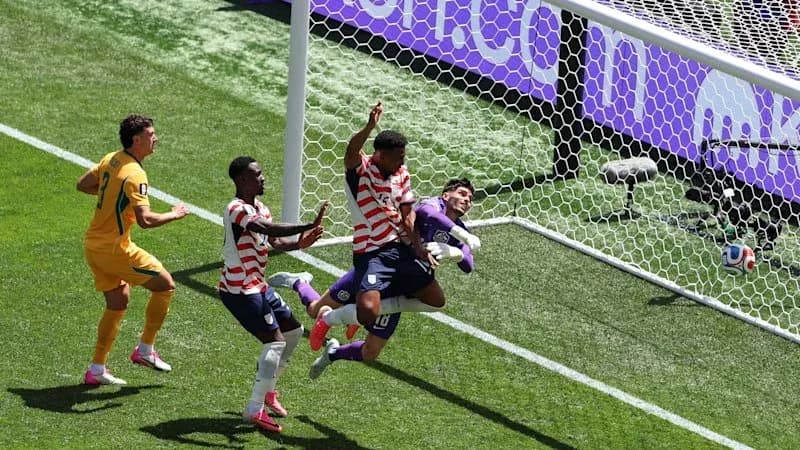
The mood shifted in an instant. All that early bravado was swallowed up by the reality on the pitch: the USA monopolising possession, dictating tempo, bullying Australia in every department. When a controversial decision – at least in the eyes of those inside the Golden Barley – paved the way for the Americans’ second, the atmosphere sagged again.
One punter muttered he might as well go home.
He didn’t. Almost no one did. Half-time arrived and with it the rituals of Australian football fandom: fresh pints, steaming party pies, a queue snaking to the bathroom. The disappointment was real, but so was the stubbornness. There were still 45 minutes left. And there was still Nestory Irankunda to come – the new cult hero everyone in the room seemed to be waiting for.
“It’s not over yet,” another fan declared, loud enough for the bar to hear.
Wise words. Play on.
Heat, mistakes and a USA side in total control
On the pitch, the story was brutally simple. The USA were better. Stronger in the tackle, sharper in the mind, cleaner on the ball. Every 50-50 seemed to break their way. Every Australian touch looked rushed, harried, a half-second behind.
Socceroos assistant coach Paul Okon didn’t sugarcoat it when he spoke to SBS.
“Conceding so early wasn’t ideal,” he admitted. “It’s hot out there. We struggled a little bit in the heat. We’re not getting our line high enough to put pressure on the ball. But it’s difficult.”
That heat – physical and tactical – told on Tony Popovic’s side. The defensive block sagged too deep, the press never quite clicked, and the USA gleefully played through the gaps. Australia, desperate to stay in shape, were caught between protecting themselves and chasing the game.
“What we don’t want to do is fall out of our structure and start chasing the ball,” Okon said. “We need to stay compact as much as possible and obviously try and have enough legs that once we get the ball we can hurt them.
“We’ll see some fresh legs in the second half, a bit of speed to hurt them once we have the ball.”
Those fresh legs arrived. Last weekend’s scorers, Nestory Irankunda and Connor Metcalfe, came on, joined by Jason Geria. Toure, Velupillay and Burgess made way. Mathew Leckie shuffled across to the left, Metcalfe sliding into his spot on the right.
It was a clear message: if Australia were going down, they were going down swinging.
Fed Square: soaked, sleepless and still singing
Across the country, the story felt eerily similar.
In Melbourne, the faithful at Fed Square had queued from 2am just to get a spot. They stood in persistent rain, wrapped in green and gold, refusing to let the scoreboard dictate their mood. Flares cut through the drizzle, a beach ball bobbed from head to head, and the chants rolled on.
Mel, a veteran of two decades of Fed Square football gatherings, turned up in a Socceroos jersey and a Donald Trump costume that made it look like Trump was giving him a piggyback. It was ridiculous, theatrical and perfectly on brand for a crowd that has always treated these nights – or mornings – as an event, not just a match.
Asked who would win, he didn’t blink. “Aussies of course.”
Not everyone had his certainty. For Madison Cambora, it was a first taste of the Fed Square experience: the early alarm, the shiver in the dark, the slow swell of noise as more fans arrived. She still thought it was worth it, even with the USA in control.
“I hope they come back from this,” she said. “I’m hoping all good things, but it’s not looking good.”
She wasn’t wrong. From the stands to the pubs, the same conclusion kept surfacing: the USA looked a class above. Physically, they were imposing. Psychologically, they were ruthless. Technically, they were a step ahead. Australia’s mistakes weren’t just punished; they were invited by relentless pressure.
For Popovic, the dilemma was obvious. His team had to attack in the second half. They had no choice. But opening up would give the USA exactly what they wanted – space to run, room to break, chances to turn a strong lead into a statement win.
At a bare minimum, Irankunda had to start the second term. Australia needed a spark, a runner, a reason for the Americans to glance over their shoulders instead of constantly looking forward.
Because right now, from Sydney to Melbourne, from the Golden Barley to Fed Square, one truth hung in the air like smoke from a flare: the USA had nothing to worry about. The question was whether the Socceroos, and their sleepless, soaked, stubborn supporters, could change that before the night was done.