.svg&w=384&q=75 "Naijagoal logo")
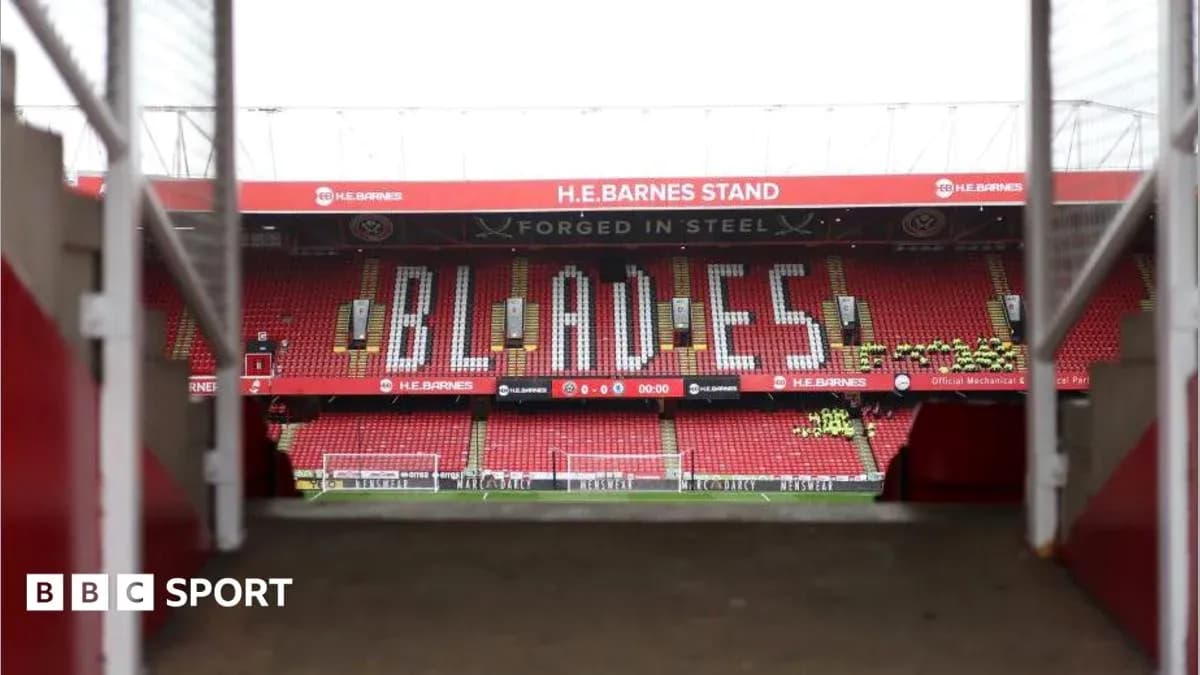

Sheffield United Faces High Court Showdown Over £35m Debt
Sheffield United face a day of reckoning in the High Court on Wednesday – and the fallout could rip straight into their Championship season.
At the heart of it is a £35m debt, a bitter ownership row and the threat of a 12-point deduction hanging over Bramall Lane like a storm cloud.
The £100m deal that never fully landed
COH Sports Bidco Limited (CSBL), an American-based consortium, agreed to buy Sheffield United from United World in December 2024 for just over £100m. The deal went through, the Blades changed hands, and a new era was supposed to begin.
But United World, the vehicle through which Saudi Arabian Prince Abdullah bin Mosaad Al Saud owned the club, say they are still owed more than £35m from that sale.
On 8 July, United World filed a winding-up petition. Not against Sheffield United, but against CSBL itself. If that money is not paid, or a settlement not struck, CSBL could be wound up when the case reaches the High Court on Wednesday.
On paper, the club is not the subject of the petition. In practice, the implications for Sheffield United and the English Football League are anything but straightforward.
A tangled ownership web
Prince Abdullah first bought 50% of Sheffield United in 2013 and took full control in 2019 after a long and acrimonious High Court battle. His tenure ended with the sale to CSBL – but the legal wrangling has not.
Under his ownership, the club were docked two points in the Championship last season for missed transfer payments to football creditors during the 2022-23 campaign. That punishment still lingers in the background as another financial dispute erupts.
CSBL made an initial payment when the sale completed. The first instalment due afterwards arrived late, only after a statutory demand and right up against the deadline. Now comes the crunch: a further £35m, which CSBL do not deny is outstanding.
Then the picture blurred again.
In June, the shares in Sheffield United were moved out of CSBL and into a new US-based company, 1919 Partners LLC, which became the club’s parent company. In effect, CSBL no longer controls the club.
Yet the people behind CSBL have not gone away. Businessmen Steven Rosen and Helmy Eltoukhy, who lead CSBL, sit on the Sheffield United board as co-chairmen through 1919 Partners LLC. The corporate shell has changed. The faces at the top have not.
That is where the EFL’s headache begins.
Accusations, counter-claims and rising tension
On Monday, United World broke cover with a pointed statement. It claimed the creation of 1919 Partners LLC was “an attempt to avoid paying CSBL’s creditors” and said no offer had been made to settle the £35m since the winding-up order was issued. Rosen and Eltoukhy, they argued, are “trying to take the club without paying for it”.
Those close to the current Sheffield United ownership hit back, but without engaging with every allegation.
“We are disappointed Prince Abdullah is trying to hurt the club and its supporters with publicity stunts,” their statement read.
They stressed that the 2024 deal between “sophisticated parties” had been well-advised by Abdullah’s own financial team, and insisted Sheffield United is now “financially healthy, unlike under Prince Abdullah when the club incurred a points deduction for missing payments to football creditors”.
They added that Eltoukhy and Rosen had invited Abdullah to reinvest in the club and rejoin the ownership group to help with promotion ambitions, insisting the co-chairmen are focused on “the sustainability of the club and the season ahead”.
United World fired back again on Tuesday. This time, the language hardened.
“Sophisticated and well-advised parties pay the price they agreed,” they said, dismissing any suggestion that offering shares in the company that was sold could count as payment. That, they argued, “was not part of the agreed deal and is not payment”.
The former owners went further, questioning the claims about the club’s health.
“If Sheffield United is as financially healthy as its owners claim, and the owners themselves have the means they are widely reported to have, then the money can be paid,” the statement continued.
“Paying it would answer all questions about the club’s situation at once. Instead, the owners are running a club they have not paid for and the club’s financial health, such as it is, is the result of the owners’ scheme to avoid paying for the club.”
Behind the legal language is a simple reality: two sides locked in open warfare, with Sheffield United’s season caught in the crossfire.
What can the EFL do?
Neither the EFL nor the new Independent Football Regulator (IFR) has publicly commented on the transfer of shares to 1919 Partners LLC.
The IFR did confirm on Tuesday that it is in contact with the relevant parties.
“We are aware of the winding-up petition in relation to COH Sports Bidco,” it said. “We are engaging with the club and relevant organisations on this issue, but we cannot comment further at this stage.”
The EFL rulebook draws a sharp line between a club going into administration and what it calls a “group undertaking” – a parent or related company – suffering an insolvency event. The latter is more nuanced and gives the EFL board room to weigh up a range of factors, including “the need to protect the integrity and continuity of the competition” and “the reputation of the league”.
If the High Court winds up CSBL, the EFL will be forced to confront an uncomfortable question: have Sheffield United’s owners effectively moved the club into a new company while leaving a huge chunk of the purchase debt behind in the old one?
If so, that could be treated as a breach and trigger sanctions. The board has the power to impose a 12-point deduction in relation to an insolvency event of this kind.
There is a precedent, even if it is not identical. In 2009, Southampton were docked 10 points after their parent company went into administration. An investigation concluded the club and the parent company were “inextricably linked as one economic entity”, and the mandatory penalty was applied.
Sheffield United’s case is different in structure, but the echoes are impossible to ignore.
High Court – and high stakes
United World insist they do not want the club dragged through months of uncertainty.
“As the former owners of SUFC, United World does not want to see SUFC facing months of uncertainty that will follow the winding-up order being granted on 19 August,” their statement said.
“But in the absence of Eltoukhy and Rosen, both billionaires, agreeing to pay what they owe, we have no alternative but to take all legal steps to protect our interests.”
So the saga moves to the High Court on Wednesday.
If a compromise is struck before the hearing, the crisis could ease – at least in the short term. If the judge grants the winding-up order against CSBL, the legal battle will intensify and the EFL will be under immediate pressure to decide how deeply that insolvency touches the football club itself.
The season has barely begun. Sheffield United are already playing with a shadow on the scoreboard that no manager can game-plan away.