.svg&w=384&q=75 "Naijagoal logo")

Rhode Island Dominates Westchester SC in USL League One Cup
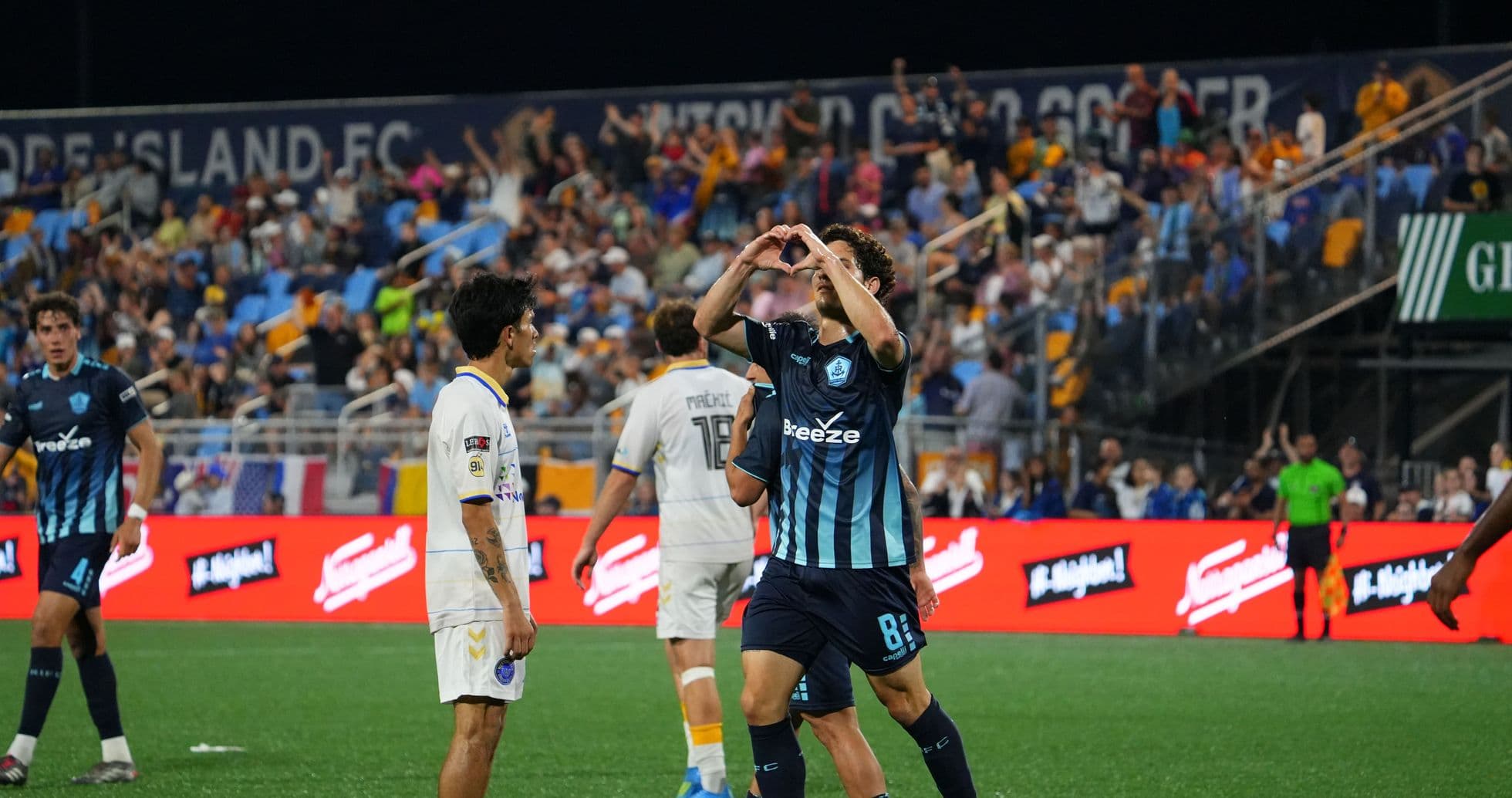
Under the Centreville Bank Stadium lights, Rhode Island’s 3–0 dismantling of Westchester SC felt less like a routine group-stage win and more like a statement about the evolving identities of these two USL League One Cup sides. Following this result, the table snapshot is stark: Rhode Island sit 3rd in Group 5 on 5 points with a goal difference of +3, while Westchester are 6th on 2 points with a goal difference of -3. One looks increasingly like a complete cup outfit; the other still feels like a collection of dangerous pieces without a coherent frame.
I. The Big Picture – A side coming of age at home
Rhode Island came into the competition with a clear statistical profile: at home, they had played 1 match, scored 3 and conceded 0, averaging 3.0 goals for and 0.0 against. On their travels they were more pragmatic, with 1.0 goals for and 1.0 against on average. Overall, 5 goals scored and 2 conceded across 3 games (total average 1.7 for, 0.7 against) painted them as a compact, efficient cup side.
This match reinforced that identity. A 2–0 half-time lead, then a controlled second half to close it out 3–0, extended their home record in the competition to 2 games, 6 scored, 0 conceded. The clean-sheet culture is no accident: Rhode Island already had 2 clean sheets in total before this, and they have yet to fail to score in any cup game.
Westchester, by contrast, arrived as an attacking paradox. Overall, they had scored 5 and conceded 8 in 3 games, averaging 1.7 goals for but a worrying 2.7 against. At home they were fun and chaotic (2.5 goals for and 2.5 against on average), but away they were brittle: 1 away game, 0 scored, 3 conceded, an away defensive average of 3.0 goals against. This 3–0 defeat simply repeated that away script.
II. Tactical Voids – Discipline and structure
With no explicit injury or suspension list, the absences here were structural rather than personnel-driven. Khano Smith’s Rhode Island named a settled-looking core: Koke Vegas in goal, with a defensive line built around N. Scardina, K. Yao, F. Nodarse and A. Sanchez, shielded by H. Bacharach Capdevila. Ahead of them, A. Shapiro‑Thompson and N. Fuson provided legs and verticality, while C. Holstad and A. Rodriguez connected to the spearhead, J. Williams.
The discipline metrics for Rhode Island this season are revealing. Their yellow-card profile is concentrated in the second half: 50.00% of their cautions arrive between 46–60 minutes and another 50.00% between 91–105. That suggests a side that grows more combative as game states tighten, but crucially, they have no red cards recorded in any time band. It is controlled aggression, not chaos.
Westchester’s disciplinary curve is more erratic. Half of their yellows arrive in the 31–45 window (50.00%), and the other half in the 76–90 window (50.00%). That points to a team that loses composure at the end of each half – precisely when Rhode Island tend to turn the screw. In a match where Rhode Island surged to 2–0 by the break and then calmly managed the second period, Westchester’s tendency to fray at the edges was brutally exposed.
III. Key Matchups – Hunter vs Shield, and the engine room
The central duel in this fixture was conceptual: Rhode Island’s emerging attacking “hunter” collective versus Westchester’s fragile “shield”.
Rhode Island’s attacking structure is less about a single star and more about a fluid front four. Williams, wearing 9, plays as the reference point, but the creative gravity often comes from Rodriguez in the 10 shirt, supported by the industrious wide work of Fuson and the connective passing of Holstad. This group is backed by a back line that, heading into this game, had allowed just 2 goals in 3 matches overall and none at home.
Westchester’s shield has been porous all tournament. Overall, they had conceded 8 in 3 before this match; their biggest away loss, 3–0, was already a warning sign, and Rhode Island simply reproduced that pattern. The back four of M. Jennings, T. Timchenko, C. Dickerson and J. Jimenez, with L. Marinelli behind them, were repeatedly stretched by Rhode Island’s rotations between the lines. Once the home side went 2–0 up by half-time, Westchester’s defensive unit lacked the compactness or leadership to reset.
In midfield, the “engine room” clash was between Rhode Island’s double pivot and Westchester’s central trio of S. Powder, A. Armas and B. Vasquez. Powder and Vasquez are naturally forward-thinking; Armas is tasked with anchoring. But against Rhode Island’s structure, they were often outnumbered and forced to defend running backwards. H. Bacharach Capdevila’s presence as a deeper controller allowed Shapiro‑Thompson and Fuson to step into half-spaces, constantly asking Westchester’s midfield to decide between tracking runners or protecting the back line. Too often, they did neither.
Further forward, Westchester’s attacking pieces – Diaz drifting, Evans offering vertical runs, Mackic linking – never truly pinned Rhode Island’s defence. Koke Vegas was protected by a line that has already shown, both home and away, that it can keep clean sheets; Rhode Island’s total of 2 clean sheets from 3 before this match was extended in emphatic fashion.
IV. Statistical Prognosis – What this result signals
Following this result, the statistical trajectories of the two squads are diverging. Rhode Island’s goal difference of +3 is the product of 8 goals for and 5 against across 3 group games, but the split is revealing: at home, they now have 6 scored and 0 conceded, an unmistakable fortress pattern. Their total averages of 1.7 goals for and 0.7 against suggest a side that reliably creates more than it allows. Even without explicit xG numbers, the shot and chance profile implied by these figures is of a team that wins the territory and quality battle more often than not.
Westchester, meanwhile, are living on the edge. Their total of 9 goals for and 12 against in 3 games produces a goal difference of -3 and an overall defensive average of 2.7 conceded per match. On their travels, 0 goals scored and 3 conceded per game underline the imbalance: they can be thrilling at home, but away they are too open, too easy to play through, and too quick to lose discipline late in halves.
Projecting forward, Rhode Island look like a side whose Expected Goals profile would sit comfortably positive: they score in every match, have never failed to score this campaign, and keep opponents to low totals, especially at home. Westchester’s would likely be volatile: big swings, defensive xG against consistently high, and away games that tilt heavily towards their opponents.
In narrative terms, this 3–0 was more than a scoreline. It was Rhode Island’s squad announcing that, in this cup, they are not just participants – they are constructing a clear, repeatable game model. Westchester, by contrast, leave Centreville Bank Stadium knowing their individual talents are not enough. Until their shield matches their hunters, nights like this will continue to define their story.