.svg&w=384&q=75 "Naijagoal logo")
Rayo Vallecano vs Girona: Tactical Insights from 1-1 Draw
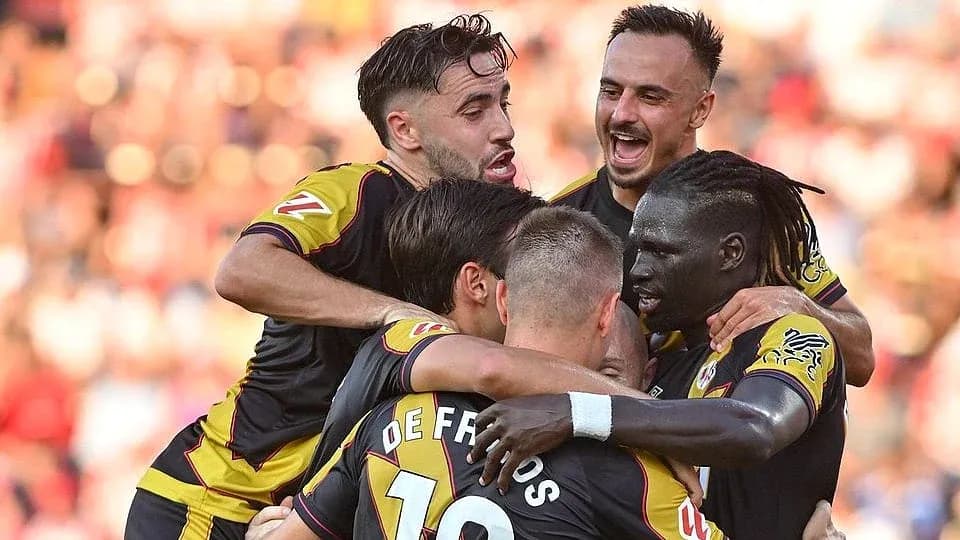
Rayo Vallecano and Girona shared the points at Campo de Futbol de Vallecas in a 1-1 draw that reflected both the hosts’ territorial control and Girona’s capacity to punish late. Inigo Perez’s Rayo, in a 4-3-3, imposed the tempo with 59% possession and a clear shot volume advantage (18-9), but Michel’s 4-2-3-1 absorbed long spells of pressure and stayed alive to strike at the death. Alemao’s 86th-minute breakthrough, assisted by Unai Lopez, looked decisive until Cristhian Stuani equalised in the 90th minute from a Viktor Tsygankov delivery. On the balance of xG (1.09 vs 0.86) and territory, Rayo edged the performance, yet Girona’s structural tweaks and late-game management salvaged a valuable away point.
Scoring Summary
The scoring opened late, after a match in which Rayo’s pressure had steadily mounted. At 86', Alemao (Rayo Vallecano) — assisted by U. Lopez — finally converted the hosts’ sustained possession into a goal, attacking into the box after Rayo had Girona pinned deep and circulating around the visitors’ 4-2-3-1 block. Girona’s response was immediate. In the 90', C. Stuani (Girona) — assisted by V. Tsygankov — levelled, capitalising on a rare clean attacking pattern after Michel’s substitution wave had reconfigured the frontline, with Tsygankov able to deliver into a classic penalty-box striker.
Disciplinary Incidents
Disciplinary incidents were few but tactically relevant. The card sequence, in strict chronological order, was:
- 44' Pedro Díaz (Rayo Vallecano) — Foul
- 90+4' Cristhian Stuani (Girona) — Argument
Totals: Rayo Vallecano 1 yellow, Girona 1 yellow, overall 2 cards. Earlier, in the 56', a potential turning point for Girona was erased when VAR intervened: a possible penalty involving Álex Moreno was reviewed and recorded as “Penalty cancelled”, removing what could have been a high-value chance against the run of play and reinforcing Rayo’s defensive resilience in their own box.
Substitutions Impact
Substitutions reshaped the tactical story on both sides. For Rayo, the 58' double change was about refreshing the midfield pivot and left side: G. Gumbau (IN) came on for P. Diaz (OUT), adding more distribution from deep, while Alemao (IN) came on for F. Perez (OUT), giving Perez a more direct, penalty-area reference on the left of the front line. This paid off decisively with Alemao’s goal.
At 68', Perez targeted both the central lane and right flank: Pacha (IN) came on for S. Camello (OUT), which nudged Rayo’s structure slightly, with Pacha’s defensive profile allowing more aggressive full-back behaviour, while C. Martin (IN) came on for J. de Frutos (OUT), injecting fresh legs and verticality in the wide channel. In the 88', the coach protected energy and balance in midfield after going ahead: N. Mendy (IN) came on for U. Lopez (OUT), sacrificing some creative passing for greater defensive coverage and duelling ability. Ironically, the attempt to close the game preceded Girona’s equaliser.
Girona’s changes were more about unlocking transitions and adding penalty-box threat. On 60', C. Echeverri (IN) came on for T. Lemar (OUT), and I. Martin (IN) came on for A. Ounahi (OUT), collectively shifting the attacking midfield band from a more possession-oriented trio towards one with greater dribbling and directness between the lines. The 72' move, H. Rincon (IN) came on for A. Martinez (OUT), refreshed the right side of the back line, ensuring Girona could still step out to meet Rayo’s wide overloads.
The key offensive switch came at 85': C. Stuani (IN) came on for F. Beltran (OUT). Michel moved from a more balanced double pivot to a structure that clearly prioritised box occupation, with Stuani as a classic number nine. That adjustment directly underpinned the 90' equaliser: with Stuani occupying the central defenders and Tsygankov able to deliver, Girona finally had the vertical reference they had lacked for most of the evening.
Tactical Overview
Structurally, Rayo’s 4-3-3 was built on a back four of A. Ratiu, P. Ciss, F. Lejeune and P. Chavarria, with Pedro Díaz at the base of midfield and O. Valentin and U. Lopez as the more advanced interiors. This gave Perez three players capable of receiving under pressure and recycling, which was reflected in the passing numbers: 486 passes, 405 accurate (83%). The front three of J. de Frutos, S. Camello and F. Perez initially sought to stretch Girona horizontally, with de Frutos and Perez holding width and Camello dropping to link.
Girona’s 4-2-3-1, with A. Witsel and F. Beltran screening in front of Vitor Reis and A. Frances, prioritised central compactness. A. Martinez and Álex Moreno were conservative in the first phase, keeping the line narrow and forcing Rayo outside. Ahead of them, Tsygankov, T. Lemar and J. Roca supported A. Ounahi, but the initial setup lacked a pure penalty-box striker, which limited Girona’s threat despite some promising pockets between Rayo’s lines.
Goalkeeper Performances
Goalkeeper realities underline the tactical patterns. A. Batalla for Rayo Vallecano faced 5 shots on goal and made 3 saves, with a goals prevented figure of -0.15, suggesting Girona marginally outperformed the quality of their chances when they did hit the target, particularly with Stuani’s finish. P. Gazzaniga for Girona also dealt with 5 shots on goal, producing 4 saves and the same goals prevented value of -0.15, indicating that Rayo’s finishing was slightly below the xG profile of their best looks, especially before the 86' breakthrough.
Statistical Analysis
Statistically, Rayo’s superiority with 59% possession, 18 total shots (5 on target) and 9 corners speaks to territorial dominance and sustained pressure. Their xG of 1.09 aligns closely with the single goal they scored, hinting at a performance that was productive but not wasteful on a massive scale. Girona, with 41% possession, 9 shots (5 on target) and 5 corners, generated an xG of 0.86, reflecting fewer but relatively efficient opportunities, particularly after the structural shift involving Stuani.
Discipline remained controlled: Rayo committed 10 fouls to Girona’s 9, with each side receiving exactly one yellow card, matching the logged events. In terms of overall form indicators, Rayo’s ability to control games territorially and create a higher volume of shots is a positive, but the defensive index is dented by conceding in the 90' despite numerical and positional control. Girona’s defensive index benefits from limiting Rayo to 1.09 xG under heavy pressure, while their overall form signal is that even in matches where they are second-best in possession, Michel’s side can recalibrate late and extract results through targeted substitutions and the presence of a specialist finisher like Stuani.