.svg&w=384&q=75 "Naijagoal logo")
Alaves Defeats Barcelona 1-0: Tactical Analysis of La Liga Clash
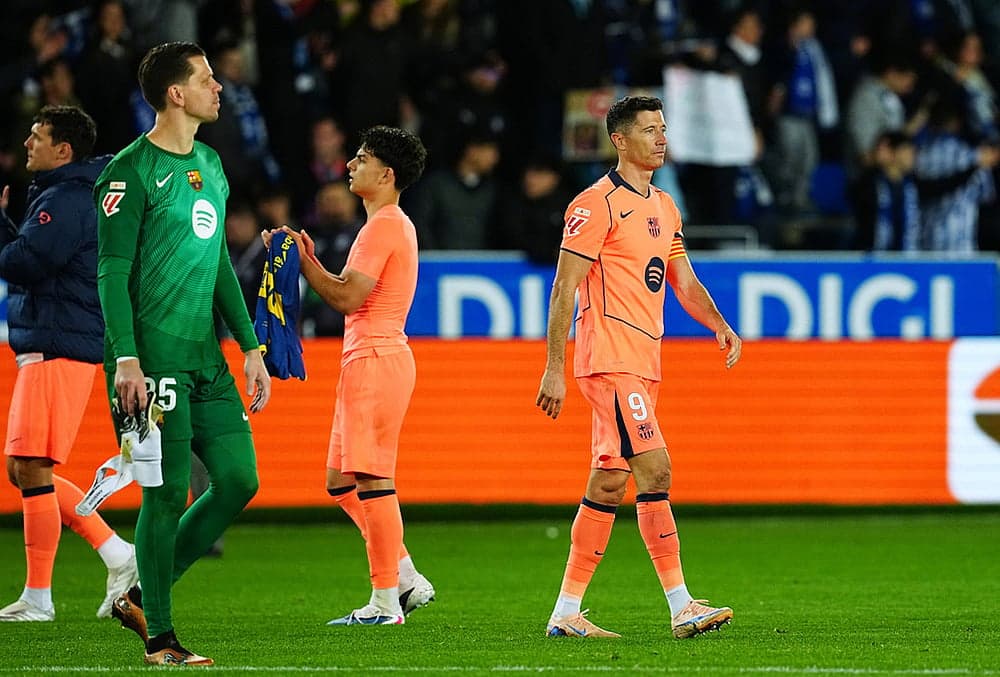
Alaves’ 1-0 win over Barcelona at Estadio Mendizorrotza was a classic case of structural discipline overcoming territorial dominance. In a La Liga match where Barcelona held 77% of the ball and completed 605 of 676 passes (89%), Quique Sanchez Flores’ side leaned into a deep 5-3-2 and maximised moments rather than volume. The decisive action arrived on the stroke of half-time, and from there Alaves managed the game through compact spacing, aggressive but controlled defending, and selective counter-attacks. Barcelona, despite their control and a marginal xG edge (0.59 to Alaves’ 0.66), never translated circulation into incision, failing to register a single shot on target.
I. Executive Summary
The fixture in Vitoria-Gasteiz finished Alaves 1-0 Barcelona, consistent with the half-time scoreline. Alaves’ 5-3-2 absorbed pressure and targeted transitions into the channels, while Barcelona’s 4-2-3-1 under Hansi Flick generated possession but not penalty-box presence. With both teams’ xG under 1.0 and a combined three shots on target, this was a game defined more by structure, defensive positioning, and tempo control than by sustained attacking waves.
II. Scoring Sequence & Disciplinary Log
The only goal came at 45'. I. Diabate (Alaves) finished a key transition move, assisted by A. Blanco, giving the hosts a 1-0 lead right on the cusp of the interval. That strike set the tactical tone for the second half: Alaves could now sit even deeper, while Barcelona were forced to chase into a crowded central block.
The disciplinary sequence was short but tactically revealing. At 46', Marcus Rashford (Barcelona) received a yellow card — Foul — immediately after the restart, signalling Barcelona’s urgency and Alaves’ intent to break quickly enough to draw recovery challenges. At 81', Abderrahman Rebbach (Alaves) was booked — Persistent fouling — a direct consequence of his role as an aggressive wide defender in the back five, repeatedly stepping out to disrupt Barcelona’s right-sided combinations. At 89', Joao Cancelo (Barcelona) collected another yellow — Foul — as Barcelona pushed to regain the ball high and force late pressure.
Total cards: Alaves 1, Barcelona 2, Total: 3.
III. Tactical Breakdown & Personnel
Alaves set up in a 5-3-2 that behaved as a 5-3-1-1 without the ball. The back five of A. Rebbach, V. Parada, V. Koski, N. Tenaglia and A. Perez compressed the width of the box, with the wing-backs staying relatively conservative rather than jumping early to press. The midfield trio of D. Suarez, A. Blanco and J. Guridi focused on screening central lanes into R. Lewandowski’s feet and blocking cut-backs, rather than contesting possession high. Up front, T. Martinez and I. Diabate worked diagonally into the channels, particularly targeting the space behind Barcelona’s advanced full-backs.
Despite Alaves’ 23% possession and only 190 passes (112 accurate, 59%), their use of the ball was pragmatic. Seven of their nine shots came from inside the box, and their xG of 0.66 reflects the quality, not quantity, of their chances. The goal at 45' was emblematic: a quick vertical link from midfield, Blanco finding Diabate in a seam as Barcelona’s rest defence was stretched. Once ahead, Alaves’ substitution pattern at 64' and 80' — A. Manas (IN) came on for I. Diabate (OUT), and P. Ibanez (IN) came on for D. Suarez (OUT), followed later by C. Protesoni (IN) for V. Parada (OUT) — progressively shifted the team towards fresh legs in midfield and defence, reinforcing the block rather than seeking a second goal.
In goal, A. Sivera’s statistical line is unusual: 0 Goalkeeper Saves with goals prevented at 0.12. That underlines how well the block functioned in front of him — Barcelona’s eight shots were either off target or blocked before reaching the frame. The back five’s timing in stepping out to block shots (three blocked for Barcelona) and compressing the half-spaces was decisive.
Barcelona’s 4-2-3-1 had clear theoretical advantages but lacked final-third punch. The double pivot of M. Casado and M. Bernal was tasked with controlling rhythm and providing security behind an attacking line of R. Bardghji, D. Olmo, Marcus Rashford and R. Lewandowski. With 676 passes and 605 accurate (89%), Barcelona circulated well, but their shot profile tells the story: eight total attempts, four inside the box, four from range, and crucially zero on target. Alaves’ compactness forced Barcelona to the outside and into low-probability crossing or long shots.
Hansi Flick’s triple substitution at 62' was a clear tactical gamble to inject more directness and fresh legs: F. Torres (IN) came on for R. Bardghji (OUT), Pedri (IN) came on for M. Casado (OUT), and X. Espart (IN) came on for P. Cubarsi (OUT). The idea was to add creativity between the lines (Pedri), more one-versus-one threat (F. Torres) and an extra attacking impulse from the back. Later, at 79', J. Cancelo (IN) came on for A. Balde (OUT), adding an inverted full-back profile to overload central zones, and at 87' T. Marques (IN) came on for M. Bernal (OUT) to push another technically strong midfielder into advanced positions.
However, these changes did not fundamentally alter the shot quality. Barcelona’s structure increasingly resembled a 2-3-5 in possession, but Alaves responded by dropping their midfield line even deeper, almost onto the edge of the box, and accepting that they would not contest the first pass but would contest the final one. The yellow cards for Rashford and Cancelo, both for Foul, emerged from transitional or counter-press situations where Barcelona’s attacking rest defence was forced to take risks to prevent Alaves from relieving pressure.
IV. The Statistical Verdict
On pure numbers, Barcelona’s dominance of territory and ball is unquestionable: 77% possession, a 486-pass edge, and four more corners (4 to 6 in Alaves’ favour, but Barcelona still active from set pieces). Yet the xG balance — 0.66 for Alaves, 0.59 for Barcelona — shows that the hosts generated the clearest single moment of the match and defended their area with high efficiency. Alaves’ three shots on goal from nine attempts, all largely engineered from inside the box, contrasted starkly with Barcelona’s eight attempts without testing Sivera once.
Defensively, Barcelona’s back line and W. Szczesny (three Goalkeeper Saves, goals prevented 0.12) were not heavily stressed; the issue lay further forward, in converting long possessions into box touches. Alaves’ overall form in this match was defined by collective discipline rather than individual heroics, while their defensive index — low xG conceded, heavy shot suppression in dangerous zones, and only eight fouls committed by Barcelona in response — underlines a game where the underdog’s structure outperformed the favourite’s possession model.