.svg&w=384&q=75 "Naijagoal logo")

Premier League Champions: Arsenal's Triumph Amidst Financial Concerns
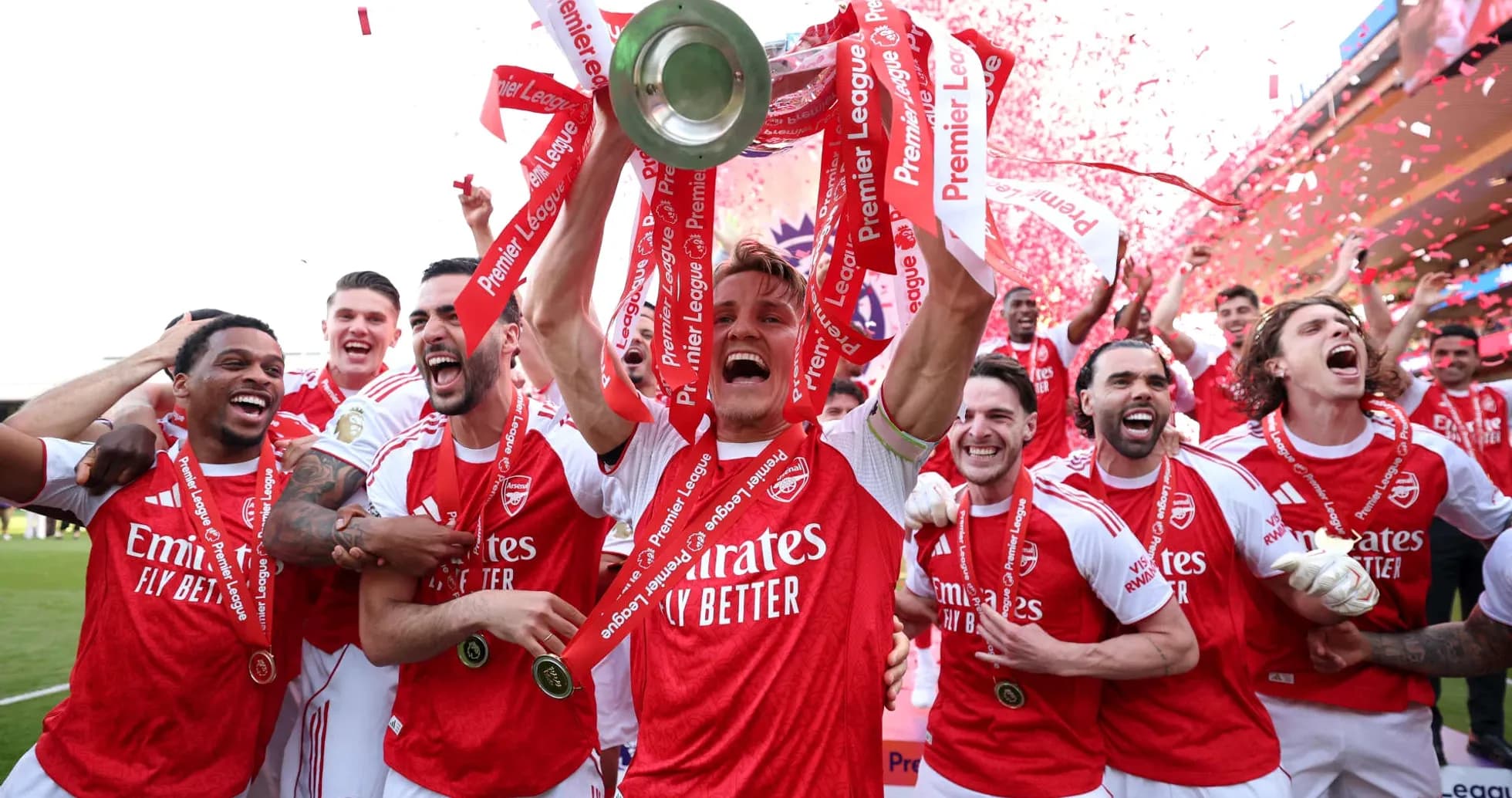
Martin Odegaard raised the Premier League trophy into the south London sky and, for a moment, English football looked unshakeable.
Arsenal, champions again after 22 long years, celebrating their 14th league title on the tight, raucous patch of Selhurst Park. A third different name on the trophy in three seasons, following Liverpool in 2024-25 and Manchester City in 2023-24. Variety at the top. A title race that keeps changing its cast. On the surface, this is the league every other country envies.
Scratch the surface, and the picture looks far less glossy.
The strongest league in the room
On competitive balance, England sits almost alone. Spain, the next wealthiest domestic competition, has long been a private argument between Barcelona and Real Madrid. Between them, they have taken 20 of the last 22 La Liga titles. In Germany, Bayern Munich have turned the Bundesliga into a near-monopoly, with 13 championships from the last 14 seasons. In France, Paris Saint-Germain have collected eight of the last nine.
Only Serie A can look the Premier League in the eye. Juventus, Inter Milan, AC Milan and Napoli have all held the Italian title in the last seven years, a spread that mirrors England’s own recent churn. Across Europe’s “big five,” the English top flight still feels the most open, the most volatile, the most alive.
The success has not stopped at the border. English clubs are filling up the latter stages of continental competitions and, this year, almost swept the board. Only PSG’s penalty shootout win over Arsenal in the Champions League final denied the Premier League a clean sweep, after Aston Villa and Crystal Palace had already lifted the Europa League and Europa Conference League.
Chelsea, for now, sit as holders of FIFA’s Club World Cup. For a league that sells its TV rights more lucratively than any other on the planet, that dominance fits the financial narrative. Money talks, and in English football it barely pauses for breath.
The Deloitte rich list underlines the point. Half of the world’s 30 highest-earning clubs are English. Not just the global giants either: AFC Bournemouth, Brentford and Brighton & Hove Albion — clubs that once lived far from the glamour — now operate in the financial stratosphere.
From the outside, this is the golden age. At home and abroad, English clubs win, earn and dominate.
The talent drain nobody expected
Look a little closer at the players, though, and the mood shifts.
An increasing number of England’s leading footballers now work outside their own league. Harry Kane, the captain and poster boy of the national side, leads that exodus. Last week’s sale of Anthony Gordon from Newcastle United to Barcelona pushed the trend further. Six members of England’s squad for the upcoming World Cup now play for foreign clubs.
For decades, that kind of move carried a certain pride. One of England’s best heading to Real Madrid or AC Milan? A badge of honour. Proof the country could produce footballers fit for the game’s grandest stages.
Now, the volume feels different. As The Times columnist Martin Samuel put it, “We used to think that was great. We felt proud when Real Madrid or AC Milan came for one of our own. Yet almost a quarter of the group? That’s a talent drain … It wouldn't be so troubling if the same level of quality was travelling in the other direction.”
That last line bites. English clubs still buy big, still spend heavily, but the very top tier of English talent is increasingly choosing to leave the supposed best league in the world. The Premier League remains the shop window. It is no longer guaranteed to be the showroom.
Rich league, poor profits
The financial contradictions run deeper than the transfer market.
Despite record-breaking TV deals and eye-watering commercial income, only four Premier League clubs — Newcastle, Aston Villa, Bournemouth and Liverpool — were profitable in the most recent season for which accounts are available. Four, in a division awash with cash.
Beyond the top flight, the picture grows starker. A string of clubs have fallen into administration in recent years, including storied institutions such as Derby County and Sheffield Wednesday. These are not forgotten names. These are pillars of English football, reduced to survival battles in the boardroom.
Many others cling on by exploiting accounting loopholes. Sale-and-leaseback deals on stadiums and training grounds. Creative valuations. Anything to stay within financial fair play limits designed to keep competition healthy and stop a handful of mega-rich owners — including sovereign wealth funds — from inflating wages and transfer fees to unsustainable levels.
The rules were meant to protect the game. The reality is a landscape where some clubs juggle the numbers just to stand still.
And those wealthy owners the league has grown used to? They may not be quite as eager to join the party as they once were.
Relegation, risk and restless owners
This season delivered a jolt to the Premier League’s powerbrokers.
Tottenham Hotspur, one of the six clubs that flirted with the doomed European Super League project in 2021, only narrowly avoided relegation. A club with a state-of-the-art stadium, global fanbase and ambitions of dining permanently at the top table found itself staring into the abyss.
West Ham United, the eighth-longest serving club in Premier League history and ranked 20th in Deloitte’s Money League, did not escape. They went down. All the commercial muscle in the world could not protect them from the brutal mathematics of the league table.
For investors — particularly American ones used to closed-shop franchises without the threat of relegation — that kind of jeopardy cuts both ways. The upside is enormous. So is the risk.
Samuel, again, captured the mood. Liverpool, Manchester United, Crystal Palace, Chelsea and Newcastle are “in one way or another, all for sale,” he wrote. Prospective buyers, he suggested, will “observe the fate of West Ham, and the near-miss at Tottenham, and shiver.”
If they shiver, you can be sure the executives at Premier League headquarters feel the chill too. The league sits at a strange crossroads: the richest, most-watched domestic competition in football, yet one where profits are scarce, owners are restless, and some of the country’s best players are heading for the exit.
Odegaard’s trophy lift at Selhurst Park looked like a crowning moment for English football. The real question is whether it marks the peak of an era — or the start of a more fragile one.