.svg&w=384&q=75 "Naijagoal logo")

Premier League 2026/27: A Season of Change and Chaos
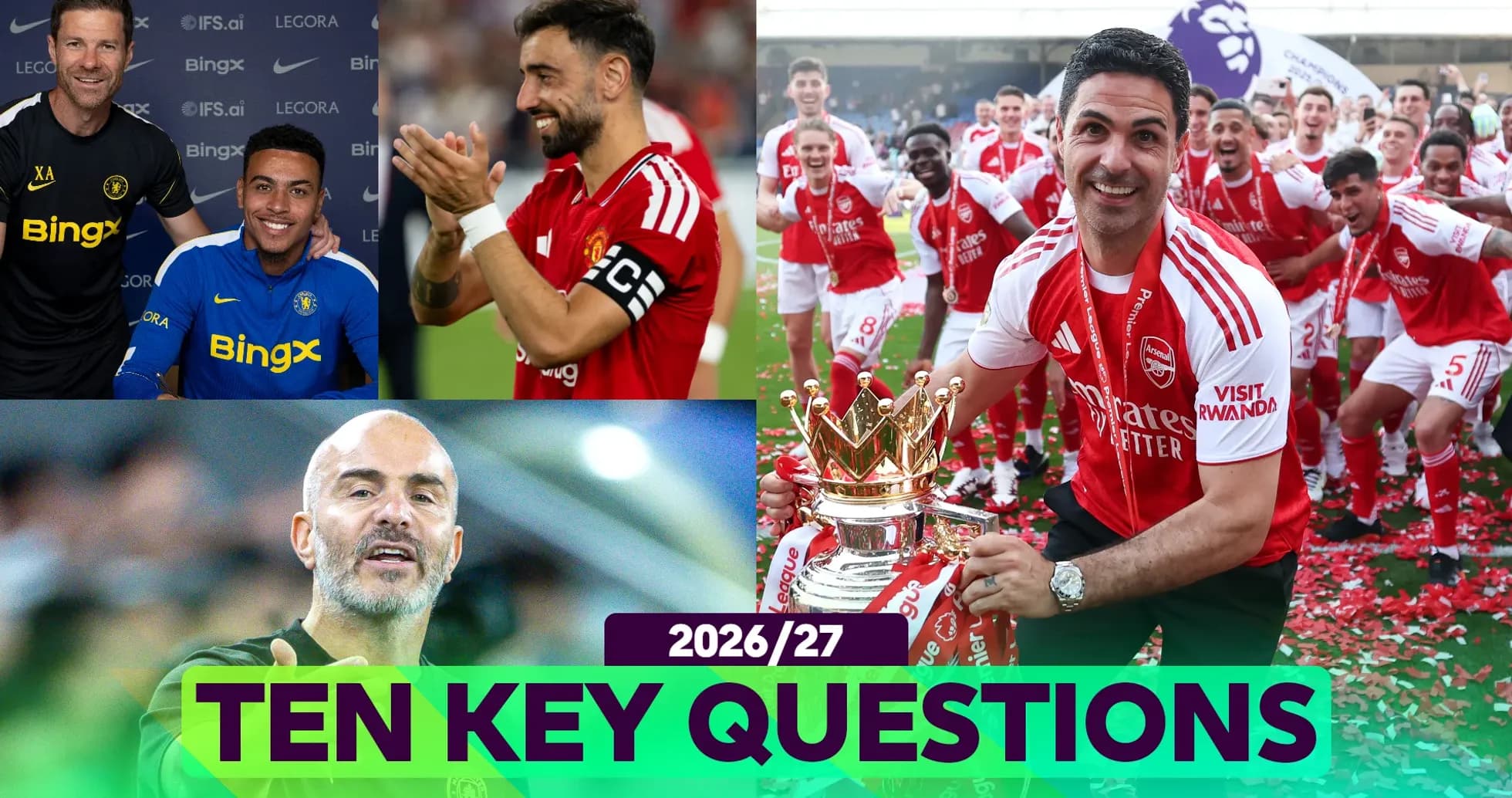
The Premier League is back, and this time it feels different. Not just another reset, but a hard reboot. Nine new managers, five members of the traditional "Big Six" starting again, and one club – Arsenal – standing still in the best possible way.
This is a season built on upheaval. Which is exactly why the team that already climbed the mountain might be best placed to stay there.
Arteta, the champions… and a rare shot at dominance
Only three managers have ever retained the Premier League title: Pep Guardiola, Sir Alex Ferguson and Jose Mourinho. That’s the company Mikel Arteta is chasing now.
He does so from a position of rare stability. While everyone else scrambles to sketch out new ideas and rewire dressing rooms, Arsenal walk into 2026/27 with the same core, the same tactical framework, and the same belief that finally delivered a title five years in the making.
The monkey is off their back. They are, in every sense, established Premier League royalty now. The pressure has changed. This is no longer a story about whether they can win it; it’s about whether they can keep it.
Around them, the chaos is obvious. Michael Carrick at Manchester United and Roberto De Zerbi at Tottenham Hotspur begin their first full campaigns. Liverpool, Chelsea and Manchester City all have brand new managers. That kind of churn usually buys patience, not trophies.
For Arsenal, it might buy something else: an edge. Especially against Manchester City, who have stepped into the unknown.
Life after Pep: Maresca walks into the storm
Manchester City are used to setting the pace. This year, they’re the great unknown.
Enzo Maresca inherits a dynasty, not just a team. He replaces a manager who turned City into an eight-time Premier League-winning machine and rewrote the tactical playbook along the way. That sort of succession rarely goes smoothly.
History offers two paths. Maresca could mirror Arne Slot at Liverpool, who slipped into the Jurgen Klopp void and found immediate continuity. Or he could resemble Unai Emery at Arsenal and David Moyes at Manchester United, both of whom discovered that following a legend can crush you before you’ve even settled into the office chair.
City’s hierarchy have tried to avoid that fate by staying inside the Guardiola family tree. Maresca is a true Guardiola disciple, a possession-obsessed coach whose ideas echo his former mentor almost to the letter.
That should help. But the dressing room has changed, too. Bernardo Silva and John Stones have gone, taking leadership, experience and tactical intelligence with them. The structure looks familiar; the faces do not.
Will that be enough to keep City at the top, or does this mark the beginning of a fallow period for the champions of the last decade?
Alonso at Chelsea: the next great Premier League coach?
If there is one appointment that electrifies the league, it is Xabi Alonso at Chelsea.
He arrives with the glow of an invincible season at Bayer Leverkusen in 2023/24 and the reputation of being one of the most coveted coaches in world football. He also arrives at the perfect time: Klopp and Guardiola have gone, the throne for the league’s next great coach is vacant, and Chelsea have handed him a squad that finally looks ready to be moulded.
The conditions are ripe for an explosive start. There is no European football at Stamford Bridge this season, the same advantage that helped Antonio Conte storm to the title in 2016/17. Only six managers have ever won the Premier League in their debut seasons; three of them did it at Chelsea. Alonso stepping into that club of Conte, Jose Mourinho and Carlo Ancelotti does not feel outlandish.
His free midweeks will be spent drilling complex, high-level tactical work into a group that has often looked talented but directionless. The squad, already strong, has been nudged in a new direction. Danny Welbeck and Jordan Henderson are the first over-30 signings of the BlueCo era, a symbolic break from the youth-only obsession and a nod towards balance and experience.
It feels like a strategy reset. Alonso is at the heart of it. The question is not whether Chelsea will look different. It’s how quickly that difference translates into results.
De Zerbi, Iraola and the fight to bring chaos back
Last season, some fans felt the Premier League had tilted too far towards structure and set-pieces. The numbers partly back that up. Goals per game dipped only slightly, from 2.40 to 2.36, but open-play Expected Goals told a sharper story.
Open-play xG per match has fallen from 2.28 in 2023/24 to 1.82 in 2025/26. That’s a big drop in pure attacking intent.
The new wave of managers looks tailor-made to drag the league back towards that 2023/24 chaos.
De Zerbi’s football is all about aggression: hard pressing, brave build-up, and relentless attacking patterns. He never really had the time to fully impose that style late last season at Spurs. He does now.
At Liverpool, Andoni Iraola brings his "heavy-metal" version of the game from Bournemouth, where his side frequently lit up the league with wild, high-tempo performances. This is exactly the brand of football many Liverpool fans craved as a spiritual successor to Klopp.
Elsewhere, Alonso’s Leverkusen and Real Madrid sides scored freely. New Bournemouth head coach Marco Rose comes from the RB Leipzig and Borussia Dortmund school of aggressive German pressing and vertical attacks. At Crystal Palace, Pierre Sage is built from the same cloth: quick transitions, hard pressing, fast breaks.
Stack them all together and the picture is clear. The league has hired chaos merchants. Open attacking football is back on the agenda.
Can Carrick really put Man Utd back in the title race?
Michael Carrick did not need long to change the mood at Manchester United.
He took over as caretaker on 14 January and three days later beat Manchester City 2-0. That result lit the fuse on a five-month run that earned him the job permanently and, more importantly, reopened a question that had felt dormant for years: can United actually challenge for the title again?
The data since his arrival is stark. Across his 17 league games in charge – almost half a season – United sat top of the table.
Premier League table since Carrick took charge
- Man Utd: 17 games, 12 wins, 3 draws, 2 defeats, 39 points
- Arsenal: 17 games, 11 wins, 3 draws, 3 defeats, 36 points
- Man City: 17 games, 10 wins, 5 draws, 2 defeats, 35 points
- Bournemouth: 17 games, 7 wins, 10 draws, 0 defeats, 31 points
- Liverpool: 17 games, 7 wins, 4 draws, 6 defeats, 25 points
Repeat that across a full campaign and United win the Premier League for the first time since 2013. Football rarely follows such neat arithmetic, but the evidence is strong enough to justify genuine optimism.
Carrick does not need a revolution. He just needs to keep doing what he has already shown he can do.
The year of the comeback star?
Change on the touchline usually means second chances on the pitch.
With nine new managers and several others only just bedding in, this season is loaded with potential comeback stories. Players who were sidelined, out of form or simply injured now find the slate wiped clean.
Phil Foden and Cole Palmer both endured disappointing campaigns and missed out on England’s World Cup squad. They will be desperate to reassert themselves as leading lights. Marcus Rashford and Mason Mount face a fight for relevance at Manchester United under a manager who owes them nothing.
At Liverpool, Harvey Elliott will expect more minutes. Omar Marmoush and Andy Robertson are also among those who struggled for game time last season and now see an opening. Yoane Wissa will hope a new manager can unlock better form.
Then there are the injured. Levi Colwill and Alexander Isak stand out as players whose absence made people forget just how good they can be. This season offers a clean runway. Some of these names will define the campaign.
Villa, Newcastle and the end of continuity
Twelve months ago, Aston Villa and Newcastle United were the continuity projects. Same managers, stable squads, clear identities. Both were tipped as Champions League contenders.
That sense of calm has vanished.
At Newcastle, the scale of change is huge. Eddie Howe has resigned, Matthias Jaissle has taken his place, and the new head coach must do it without arguably his three biggest stars: Bruno Guimaraes, Anthony Gordon and Sandro Tonali.
In their place come Lukas Hornicek, Bazoumana Toure, Aladji Bamba, Sean Steur and Ewen Jaouen. All arrived for sizable fees. All carry impressive CVs. None are proven in this environment yet.
Villa’s shift is less dramatic but still feels like a line in the sand. Unai Emery remains in charge, but key figures have gone. Youri Tielemans, Morgan Rogers and Lucas Digne have all left. In come Alejandro Garnacho, Johan Manzambi and Joao Gomes, signings that hint at a new phase rather than a gentle evolution.
Both clubs must now prove they can handle change as well as they once handled stability.
Europe’s lure: springboard or trap?
Nine Premier League clubs qualified for Europe last season. For those new to the Thursday-Sunday grind, the thrill of midweek lights comes with a warning label.
Aston Villa showed what is possible. They won the UEFA Europa League and still finished fourth. Crystal Palace accepted a drop to 15th in the league as a fair price for their UEFA Conference League triumph.
Others struggled. Nottingham Forest, Spurs and Newcastle all finished in the bottom half, their domestic form seemingly weighed down by the extra fixtures.
This year, Brighton & Hove Albion step into the Conference League for the first time and only their second-ever European campaign. They will look at Palace’s run and see a template. Palace themselves should now be experienced enough to juggle a Europa League campaign.
Bournemouth and Sunderland, both in the Europa League, have a different concern: squad depth. The football will be unforgettable; the league form might not be.
Hovering just outside that group are clubs like Leeds United. They have recruited well and may quietly fancy their chances of a top-nine finish, banking on rivals being stretched by European commitments. Brentford, who narrowly missed out on Europe last season, again enjoy free midweeks to absorb Keith Andrews’ detailed coaching.
The middle class is growing. Europe could either cement that or tear it apart.
Mid-table muscle and a league with no soft spots
Leeds and Brentford are not alone in thinking bigger.
Fulham have turned to former Real Madrid coach Alvaro Arbeloa, who has already dipped into his old club to bring in two Real signings. Fulham finished just a point outside the European places last season. The expectation is clear: build on Marco Silva’s foundation, don’t tear it up.
Nottingham Forest now have Oliver Glasner in charge, fresh from winning the Conference League and FA Cup with Crystal Palace. Even after selling Elliot Anderson to Manchester City, Forest will look at their seventh-place finish two years ago and see a realistic benchmark.
Everton look stronger as well. They should finally be settled in their new stadium and, crucially, they have continuity in David Moyes that few other clubs can match this season. The arrivals of Hayden Hackney, Christian Norgaard and Brennan Johnson are obvious upgrades.
Put it all together and the picture is stark. The Premier League has almost no obvious weak points. The days of a soft middle may be over.
Promoted trio step into the fire
Coventry City, Ipswich Town and Hull City arrive from the Championship with busy summers behind them and a clear lesson from last year: go big or go home.
Sunderland’s spending spree last summer powered them not just to safety but all the way into Europe. Alongside Leeds, they snapped a two-year trend of promoted sides going straight back down. Coventry, Ipswich and Hull have taken note.
All three have largely targeted established internationals from mainland Europe rather than loading up on Premier League veterans. Ipswich have added Issa Diop and Sasa Lukic. Hull have moved for Matt Targett and Jack Butland. The rest of their business leans heavily on continental experience.
Predicting how they will cope is almost impossible. Many expected Sunderland and Leeds to sink in 2025/26. They did anything but.
Coventry look the most prepared on paper. They stormed the Championship and have an experienced manager in Frank Lampard. Ipswich have recent Premier League experience and a head coach in Gary O’Neil who has already kept both Bournemouth and Wolverhampton Wanderers up.
Hull face the steepest climb. Opta’s "Expected Points" table had them 23rd out of 24 in the Championship last season based on xG for and against. That is a worrying underlying profile for a newly promoted side.
And yet, this is their first time back in the top flight since 2017. Even they will walk into the season with excitement and optimism.
Everywhere you look, there is hope. Arsenal chasing history. City trying to prove the dynasty doesn’t end with Pep. Alonso, De Zerbi, Iraola and others dragging the league back towards wild, attacking football. A swollen middle class refusing to be bullied. Promoted clubs swinging big.
The Premier League has rarely felt this deep, this volatile, this alive.
Who handles the chaos best? That might be what decides everything.