.svg&w=384&q=75 "Naijagoal logo")

Parma Secures 1-0 Victory Over Sassuolo in Season Finale
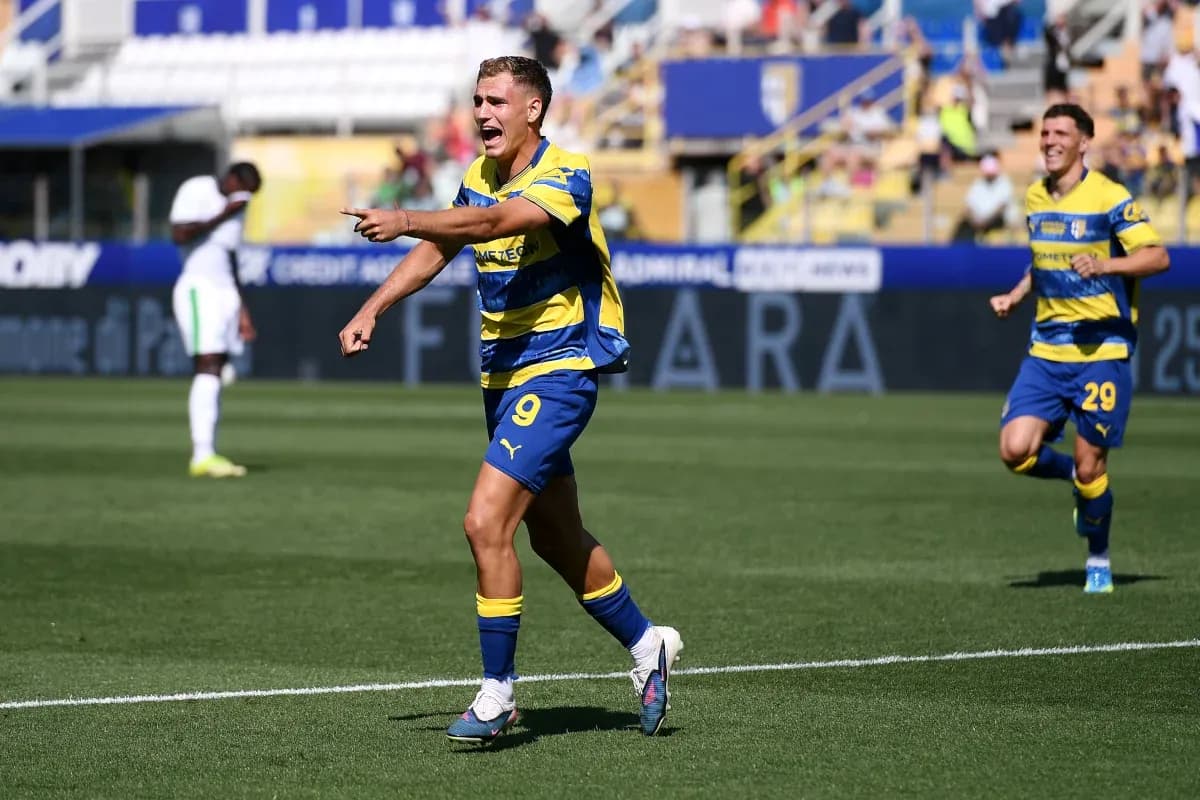
Stadio Ennio Tardini closed its Serie A season with a narrow, hard‑earned 1‑0 win for Parma over Sassuolo, a result that neatly encapsulated the contrasting identities of these two mid‑table sides. Following this result, Parma finished 13th on 45 points with a goal difference of -18, while Sassuolo’s more expansive but volatile campaign ended in 11th on 49 points and a goal difference of -4. It was not a knockout tie, but it had the feel of a 1/8 final: one game, two clear ideas, and a decisive moment separating them.
I. The Big Picture – Structures and Seasonal DNA
Carlos Cuesta doubled down on Parma’s season-long defensive blueprint, rolling out a 3-5-2 that has been his most trusted structure, used in 19 league matches. E. Corvi anchored the back three of L. Valenti, M. Troilo and A. Circati, with a hard‑working, almost ascetic midfield line of S. Britschgi, C. Ordonez, H. Nicolussi Caviglia, M. Keita and E. Valeri behind the front pair of M. Pellegrino and D. Mikolajewski.
It suited a side whose overall attacking numbers have been modest. In total this campaign, Parma scored 28 league goals, with only 16 at home. Their home average of 0.8 goals for per match and 1.3 goals against underlined a team that lives on fine margins, defensive organisation and clean sheets rather than offensive flurries. Thirteen clean sheets overall, including 5 at home, show that when the structure holds, Parma are difficult to break down.
Fabio Grosso’s Sassuolo arrived with their familiar 4-3-3, a shape they used 36 times this season. S. Turati started behind a back four of W. Coulibaly, T. Macchioni, J. Idzes and U. Garcia. The midfield trio of K. Thorstvedt, L. Lipani and I. Kone was tasked with linking to a high‑quality front three: D. Berardi on the right, A. Pinamonti central, and A. Laurienté on the left.
Sassuolo’s profile has been the mirror image of Parma’s: more goals, more volatility. In total this campaign they scored 46 and conceded 50. On their travels, they averaged 1.1 goals for and 1.3 against, a slight negative tilt that speaks to risk‑taking and open games. Their away record of 5 wins, 5 draws and 9 defeats reflects a side that can hurt anyone but is rarely in full control.
II. Tactical Voids – Absences and Discipline
Both coaches had to navigate significant absences. Parma were stripped of creative and attacking depth: A. Bernabe (muscle injury), B. Cremaschi (knee), N. Elphege (thigh), M. Frigan (knee), J. Ondrejka (leg), G. Oristanio (knee) and G. Strefezza (ankle) all missed out. It forced Cuesta to lean even more heavily on Pellegrino as the reference point in attack and on workmanlike midfielders like Nicolussi Caviglia and Keita to carry and recycle possession rather than produce line‑breaking genius.
Sassuolo’s list was equally weighty in structural terms: D. Bakola, D. Boloca, F. Cande, E. Pieragnolo, F. Romagna, A. Vranckx and S. Walukiewicz were all unavailable. The absence of Boloca and Vranckx, in particular, narrowed Grosso’s options for controlling central spaces and rotating his midfield. It is no coincidence that N. Matic, one of the league’s leading red‑card recipients, was kept on the bench; his disciplinary profile (7 yellows and 1 red in the league) has been both a shield and a risk all season.
Discipline loomed in the background of the tactical story. Parma’s season-long yellow-card pattern shows twin spikes between 46-60 minutes and 76-90 minutes, each accounting for 21.21% of their cautions – a team that tackles aggressively just after half-time and in the closing stretch. Sassuolo, meanwhile, see 28.92% of their yellows in the 76-90 minute window, and their reds have tended to arrive in the middle third of matches (50.00% between 46-60 minutes). This was always likely to be a game where the final quarter of an hour tilted on who could stay composed under fatigue.
III. Key Matchups – Hunter vs Shield, and the Engine Room
The headline duel was the “Hunter vs Shield”: A. Pinamonti against Parma’s defensive line. Pinamonti’s season – 9 league goals and 3 assists from 36 appearances – has been built on constant movement and persistence. Fifty‑seven shots, 30 on target, tell of a striker who keeps asking the question. But against a Parma side that, in total this campaign, allowed only 1.2 goals per match and kept 13 clean sheets, his usual supply lines were constricted.
M. Troilo, one of Serie A’s most card‑prone defenders with 7 yellows and 1 straight red, was central to that shield. He entered the match with 18 successful blocks and 18 interceptions, and his reading of the game again underpinned Parma’s back three. When Troilo steps out correctly, he compresses the space that Pinamonti needs to receive on the half‑turn; when he mistimes it, he leaves space for Berardi and Laurienté to attack the channels. On this day, the balance fell Parma’s way.
On the flanks, the duel between A. Laurienté and Parma’s wing‑backs carried a different tone. Laurienté closed the season as one of Serie A’s elite creators: 9 assists and 7 goals, with 54 key passes and 80 dribble attempts, 29 successful. His threat is not just in beating the first man but in the weight of the final ball. E. Valeri and S. Britschgi had to manage his runs inside and the overlapping threat of U. Garcia, forcing Parma’s outside centre‑backs to shuttle wide without breaking the line.
In the “Engine Room”, H. Nicolussi Caviglia and M. Keita were tasked with disrupting the rhythm of L. Lipani and I. Kone while tracking the late arrivals of K. Thorstvedt. Thorstvedt’s season numbers – 4 goals, 4 assists, 32 interceptions and 44 tackles – show a two‑way midfielder who can both break play and join attacks. Here, he was often forced to receive deeper, with Parma’s central trio narrowing the vertical lanes and accepting that Sassuolo would have more sterile possession in front of them.
IV. Statistical Prognosis and Tactical Verdict
From a probabilistic lens, this match always leaned toward a low‑scoring affair. Heading into this game, Parma’s overall average of 0.7 goals for and 1.2 against per match, combined with Sassuolo’s 1.2 for and 1.3 against, pointed toward an Expected Goals profile where neither side was likely to generate a flurry of high‑quality chances. Parma’s tendency to fail to score in 16 league matches, and Sassuolo’s 12 games without a goal, hinted that the first strike would almost certainly be decisive.
The 1-0 scoreline fits that statistical script. Parma’s defensive solidity, especially at home where they conceded 25 in 19 but often turned games into attritional battles, blunted Sassuolo’s more talented front line. Sassuolo’s away fragility – 24 conceded on their travels – again surfaced in the key moment, with Pellegrino’s presence and duel work (546 league duels, 233 won) embodying the direct, confrontational style that has allowed Parma to punch above their attacking numbers.
Following this result, the tactical verdict is clear: Parma’s disciplined 3-5-2, built on Troilo’s aggressive defending and Pellegrino’s focal‑point work, proved better suited to a tight, season‑ending contest than Sassuolo’s expansive 4-3-3. In a game where xG was always likely to be compressed, the side more comfortable suffering without the ball and protecting a one‑goal edge emerged on top, closing their campaign with a clean sheet and a statement that structure can still trump flair when the margins are this thin.