.svg&w=384&q=75 "Naijagoal logo")
Osasuna vs Atletico Madrid: Tactical Analysis of a 1-2 Defeat
Osasuna’s 1-2 defeat to Atletico Madrid at Estadio El Sadar was defined by contrasting game models: Osasuna’s territorial dominance and wing-heavy 4-2-3-1 against Atletico’s hyper-efficient 4-4-2 that leaned on penalty-box quality, transitional threat and late-game survival with ten men.
Osasuna’s structure under Alessio Lisci was clear. In possession they built from a 4-2-3-1 with Jon Moncayola and Lucas Torro as a double pivot, full backs Javi Galán and Jesús Galán (listed as J. Galan) pushing high, and Rubén García operating between the lines behind Ante Budimir. The numbers underline their territorial control: 58% possession, 477 passes, 415 accurate (87%). They turned that into volume rather than clarity, generating 23 total shots, 18 inside the box, but only 5 on target. The xG of 2.16 reflects sustained pressure but also some wastefulness in crowded central zones.
Atletico Madrid, in Diego Simeone’s 4-4-2, accepted a lower share of the ball (42% possession, 358 passes, 287 accurate, 80%) but shaped the game with early penalty-area moments and then deep block resilience. Their shot profile is the tactical headline: just 5 total shots, 4 on target, 4 inside the box, and an xG of 1.64. They traded volume for shot quality and game-state control, especially after the 15th-minute penalty from A. Lookman and the 71st-minute transition goal by A. Sorloth.
Key Tactical Moments
The first key tactical pivot came on 13 minutes with VAR confirming a penalty for Atletico. That sequence exposed Osasuna’s high defensive line and aggressive full-back positioning. With Javi Galán already stepping high, space appeared in the half-space channels. The subsequent Handball by Javi Galán in the box not only conceded the spot kick but also drew Osasuna’s first yellow, forcing him to temper his pressing and overlapping for the rest of his time on the pitch. Lookman’s conversion at 15 minutes gave Atletico a 1-0 platform to sink into a more compact mid-block, with Koke and R. Mendoza screening central access and funneling Osasuna wide.
Simeone’s early substitution at 18 minutes — R. Mendoza (OUT) for Robin Le Normand (IN) — was a clear defensive recalibration. With Le Normand joining the back line, Atletico effectively morphed into a back five in deeper phases, with Marcos Llorente able to step out aggressively onto Osasuna’s left while the three central defenders protected the box. This structural tweak is consistent with Atletico’s low shot concession: despite Osasuna’s 23 attempts, only 4 were blocked and many were forced from less stable body positions under heavy pressure.
Osasuna’s own first substitution at 37 minutes — R. Moro (OUT) replaced by Kike Barja (IN) — was an attacking adjustment to sharpen the right flank. Barja later became decisive with his 90th-minute goal, but the mid-game impact was more about stretching Atletico’s left side and trying to isolate one-versus-one situations against M. Ruggeri. However, Atletico’s wide midfielders, particularly O. Vargas, diligently tracked back, keeping most of Osasuna’s crosses and cutbacks under control.
Discipline and Tactical Tone
Discipline heavily influenced the tactical tone. Osasuna collected 6 yellow cards, Atletico 5 plus a red. For Osasuna: Javi Galán (14' Handball), Rubén García (30' Foul), Ante Budimir (45+9' Argument), Kike Barja (57' Argument), Alejandro Catena (85' Argument), and Enzo Boyomo (90+2' Foul). Atletico’s bookings and dismissal — Marcos Llorente (52' Argument; 79' Foul leading to a straight red after a second yellow), Koke (57' Foul), Marc Pubill (59' Foul), and Robin Le Normand (85' Argument) — show a side constantly walking the line to disrupt rhythm. Llorente’s double sanction at 79 minutes was the second major tactical hinge: Atletico were forced into a low, narrow 4-4-1, sacrificing counter-attacking outlets to protect their lead.
Simeone’s substitution pattern supported that defensive tilt. At 46 minutes, T. Almada (OUT) made way for A. Sorloth (IN), adding a more vertical focal point to attack space behind Osasuna’s high line. It paid off on 71 minutes when Sorloth scored from a Llorente assist, a classic Atletico transition: regain, early forward pass into the channel, and a ruthless finish. Then, at 82 minutes, A. Lookman (OUT) was replaced by C. Lenglet (IN), effectively locking in a back five and prioritizing aerial and box defence in the closing phase.
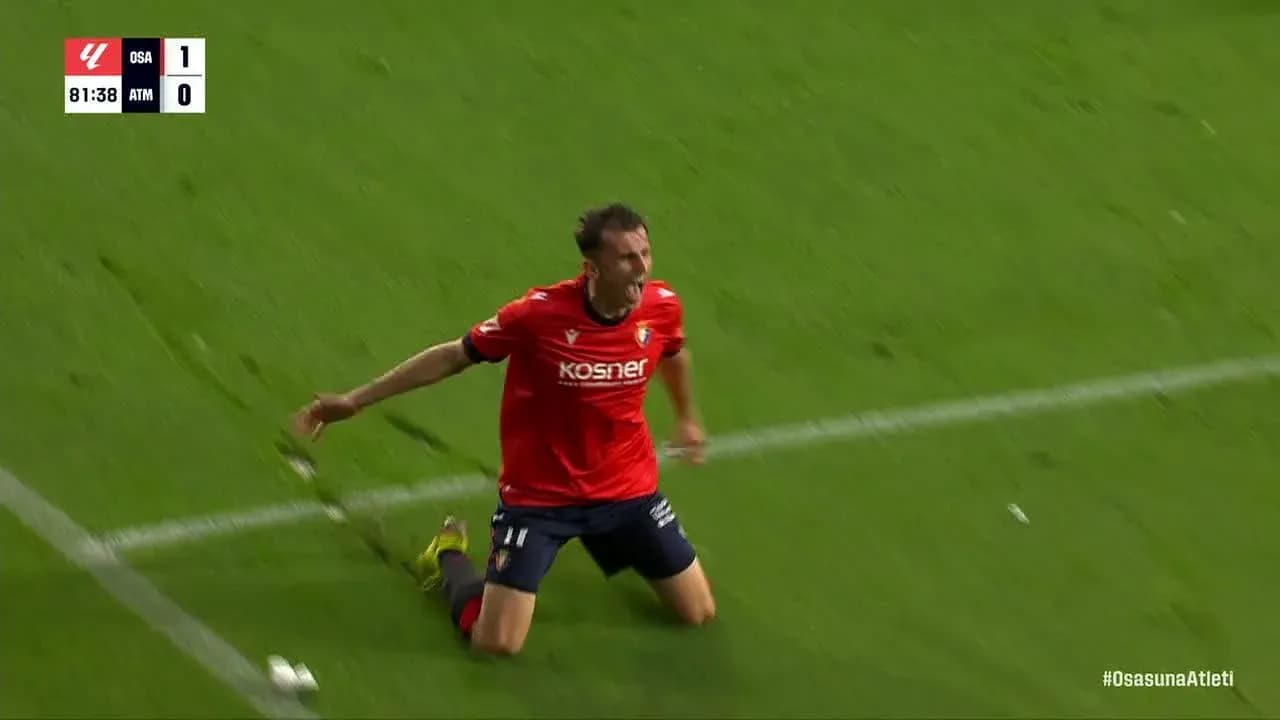
Lisci’s response was to flood the pitch with fresh legs and attacking profiles. On 60 minutes, Rubén García (OUT) was replaced by the other R. Garcia (IN, shirt 9), and Javi Galán (OUT) by A. Bretones (IN), keeping width but with more direct running and crossing. At 72 minutes, Lucas Torro (OUT) was swapped for A. Oroz (IN), and M. Gomez (OUT) for A. Osambela (IN), further tilting the structure toward a 4-1-4-1/4-1-5 in possession. This is reflected in the late surge of pressure and the eventual 90th-minute goal: K. Barja scoring from an R. Garcia assist, a move born of numerical overload in wide areas and second-ball dominance against a tiring, undermanned Atletico block.
Goalkeeping Perspectives
From a goalkeeping perspective, both A. Fernandez and J. Musso were statistically identical in goals prevented (0.32 each), but the context differed. Osasuna’s keeper faced 4 shots on target and made 2 saves; Atletico’s keeper faced 5 shots on target and made 4 saves. Musso’s work was about concentration and handling under sustained but often low-angle pressure, while Fernandez’s interventions came in higher-quality moments, especially around the penalty and transition phases.
Statistically, the verdict is of a game that matched each side’s seasonal archetype: Osasuna as high-volume, possession-leaning but not always efficient in the box; Atletico as low-volume, high-quality and structurally resilient, even under numerical inferiority. The xG split — Osasuna 2.16 vs Atletico 1.64 — aligns with the 1-2 scoreline as a narrow, game-state driven Atletico win rather than a smash-and-grab. Osasuna’s 8 corners to Atletico’s 4 and zero offsides against Atletico’s 2 further illustrate the home side’s territorial siege, but the visitors’ compact 4-4-2 (and later 4-4-1/5-3-1) ensured that most of that pressure translated into quantity, not decisive chances, until it was too late.