.svg&w=384&q=75 "Naijagoal logo")
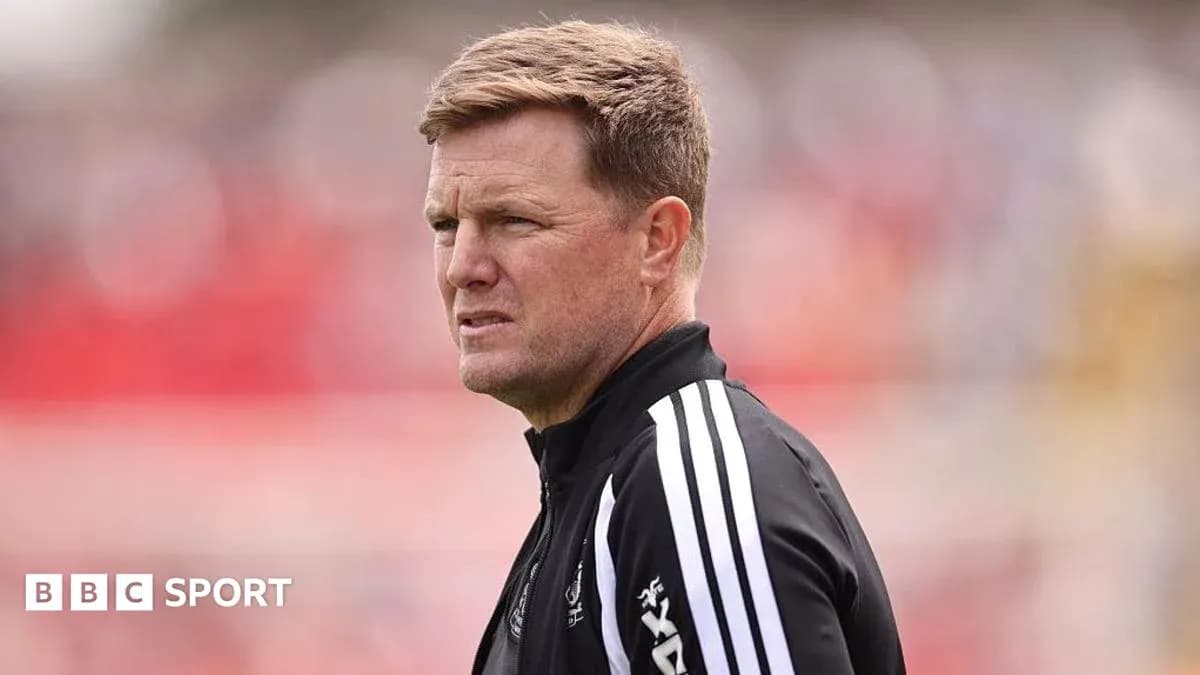

Newcastle Plans for Life After Eddie Howe
Newcastle had been braced for Eddie Howe’s exit for the best part of a year. The timing still jolted the club.
Sporting director Ross Wilson has revealed Newcastle were planning for a managerial change for “eight or nine months” before Howe finally stepped away in July, drained after nearly five years in charge and a transformative spell on Tyneside.
Howe had originally intended to go again this season. To carry on, to push a little further. Instead, he chose to walk, convinced a break would be best for everyone.
Planning for life after a “legend”
Newcastle’s summer was already turbulent. Key players out, a new era taking shape, and a squad being retooled under the weight of financial regulations. Howe’s departure, when it came, was not part of the original script.
Wilson insists it never descended into panic.
“It was not chaotic, it was not painful,” is the clear message from the sporting director, who says the club had mapped out their options well in advance. The process led them to Matthias Jaissle, but the German was not the only name on the board.
“We always knew where we were going to go,” Wilson said. Jaissle, he explained, “was always part of our planning,” even if no single candidate was ever pre-ordained as the successor.
The logic was simple. Howe, described by Wilson as “an exceptionally talented coach”, was always likely to attract other opportunities. Newcastle’s hierarchy felt they had a duty to be ready for the moment he chose to move on.
The Scot, appointed sporting director in October, admits he had been working in the background for most of his tenure with one eye on that moment. For eight or nine months, the club quietly shaped a profile, drew up lists, and prepared for the day the “legend of the club” would no longer be in the dugout.
Why Jaissle fit the blueprint
When the time came, Newcastle spoke to several candidates. Jaissle rose quickly to the top.
The club wanted continuity of idea, not a tear-up. Howe had built a side around intensity: aggressive pressing, front-foot football, and a squad drilled to hunt in packs. The next man had to embrace that, not dilute it.
Jaissle’s work at Red Bull Salzburg ticked those boxes. High pressing. High energy. A clear tactical identity. Just as important, a track record of developing younger players – a non-negotiable for a Newcastle project increasingly geared towards signings aged 24 and under.
His recent spell at Al-Ahli in the Saudi Pro League added another layer of experience, but it was that Salzburg pedigree that aligned cleanly with Newcastle’s long-term strategy.
After Wilson’s first meeting with Jaissle, the excitement inside the club was obvious. Chief executive David Hopkinson told Wilson he sounded “really excited about this one”. Wilson didn’t deny it.
“I remember saying ‘you’re probably right. I think this is it’,” he recalled.
So far, the early signs justify the conviction. Jaissle is unbeaten in his first four games in all competitions. The football has not yet fully clicked, but the structure is visible.
A transition that will take time
The 2-2 draw with Bournemouth underlined where Newcastle are: somewhere between old and new.
Only three of the eight summer signings – Lukas Hornicek, Amar Dedic and Nico Gonzalez – made the starting XI. For all the talk of a new era, the core of Howe’s side still carries much of the load.
It felt like a reminder of Jaissle’s own words. This is a “transition phase”, not an overnight revolution. Players need time to bed in, to adjust to the demands of a high-pressing system and the expectations of a club that now talks openly about challenging for the game’s biggest prizes.
Inside the boardroom, the targets are nuanced. Newcastle have modelled several financial scenarios based on where they might finish this season, but Wilson insists Jaissle has not been handed a hard, numerical objective for his first campaign.
Hopkinson has framed it differently: the long-term ambition is to “consistently and credibly compete” for top honours. That is the destination. The path there, they argue, cannot be reduced to one league position in year one of a new coach.
Walking the financial tightrope
For all the talk of style and succession, the reality of modern football bites hardest in the accounts.
Newcastle have entered into a settlement with Uefa after breaching European financial regulations. The message from Hopkinson is blunt: if the club want to sit at the top table, they must now operate strictly within the rules.
That means growth. Big growth.
The Magpies aim to increase revenues by 50% between now and 2030, driven largely by sponsorship. At the same time, player trading will remain central to the model. Buy well, develop, sell at the right moment, reinvest. Repeat.
“We want to have players here who are on a journey with us,” Wilson said. The flip side is built into the philosophy. “Equally, if some of those players’ journeys go at rapid speed, they might go somewhere else but, of course, that’s normal. That’s part of football.”
This summer underlined that reality with brutal clarity.
Guimaraes shock and missed targets
Newcastle had braced themselves for the exits of Anthony Gordon and Sandro Tonali. Gordon to Barcelona, Tonali to Tottenham Hotspur. Those moves sat inside the club’s planning.
Bruno Guimaraes did not.
Losing their talisman to Arsenal forced Newcastle to rip up part of their script mid-window. The Brazilian had been central to everything – on the pitch, in the dressing room, in the identity Howe had crafted. His departure was never part of the original plan.
On top of that, top targets Victor Munoz and Johan Manzambi slipped away to Liverpool and Aston Villa respectively, forcing further adjustments.
Wilson, though, maintains that “everything else that happened during the window was part of the plan”. Not every signing was the first name on their list, he admitted, but that, he argued, is the reality of elite recruitment.
“Clearly we were disappointed a couple of times but, again, that’s normal,” he said. “No club goes into the window and reaches the end getting every target they set out to get. If they say they did, it is a lie.”
So Newcastle emerge from a summer of upheaval with a new head coach, a reshaped squad, and a financial framework that leaves them little room for mistakes.
They have their man in Jaissle. They have their plan. Now comes the only part that really counts: can this carefully constructed transition actually carry them to the trophies they insist they’re ready to chase?