.svg&w=384&q=75 "Naijagoal logo")

Napoli's Early-Season Setback Against Como
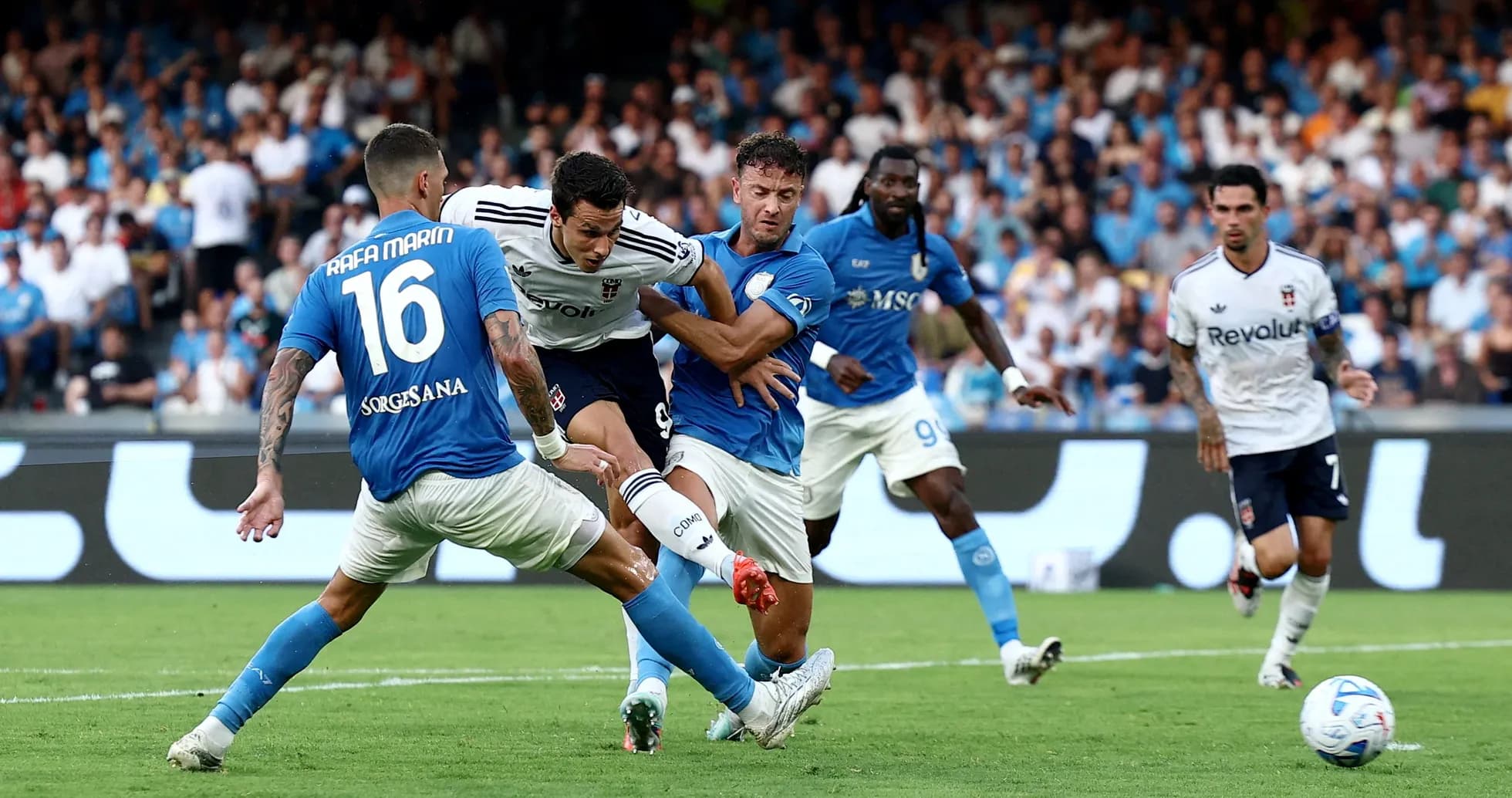
The evening at Stadio Diego Armando Maradona ended with a jolt to Napoli’s early-season narrative. Under Massimiliano Allegri, the hosts had the structure and the names to impose themselves, yet Como – guided by Cesc Fabregas – walked away with a 2–1 win, mirroring the half‑time score and announcing themselves as a composed, modern Serie A newcomer.
Following this result, both sides sit on three goals scored and two conceded overall, but the symmetry ends there. Napoli’s goal difference of +1 and record of one win and one defeat are coloured by a stark split: at home they have played 1, lost 1, scoring 1 and conceding 2; on their travels they have been perfect so far, with 1 win from 1, 2 goals for and none against. Como, meanwhile, are quietly efficient: unbeaten in 2 matches, with 1 win and 1 draw, all away from home, scoring 3 and conceding 2 on their travels. They leave Naples ranked 8th, above a Napoli side sitting 10th.
I. The Big Picture – Allegri’s 4‑3‑3 vs Fabregas’ 4‑2‑3‑1
Allegri leaned into a classic 4‑3‑3, but with a twist of power and verticality. A. Meret in goal sat behind a back four of G. Di Lorenzo, A. Rrahmani, R. Marin and M. Olivera. The midfield trio of F. Anguissa, S. Lobotka and S. McTominay suggested control with an edge: Lobotka as the metronome, Anguissa and McTominay to break lines and press. Up front, M. Politano and N. Lang flanked R. Hojlund, a front three designed to run aggressively into space rather than simply circulate the ball.
Fabregas answered with a 4‑2‑3‑1 that looked compact on paper but fluid in practice. J. Butez was shielded by Y. Couto, J. Ramon, T. Chalobah and A. Valle – a back line comfortable stepping high. In front, the double pivot of L. Milla and L. Da Cunha gave Como a stable base, freeing a creative band of three: A. Diao on the right, N. Paz centrally and M. Baturina on the left, all working behind lone striker T. Douvikas.
The clash of shapes defined the rhythm: Napoli tried to squeeze Como with a high press and wide overloads, while Como sought to draw that pressure in, then play through the first line and attack the spaces behind Napoli’s full‑backs.
II. Tactical Voids – Injuries and Hidden Costs
Napoli entered this fixture with a depleted defensive rotation. A. Buongiorno, L. Marianucci and P. Mazzocchi were all ruled out with knee injuries, stripping Allegri of depth and flexibility across the back line. With no natural alternative of similar profile on the bench, R. Marin and M. Olivera had to log heavy minutes, and Di Lorenzo’s remit expanded: he was both outlet and stabiliser on the right.
For Como, the absence of J. Addai through an Achilles tendon injury removed a direct, vertical option from the bench. It nudged more responsibility onto A. Diao and M. Baturina to carry the ball and win territory, but it also simplified Fabregas’ choices: his attacking structure had to be built around Douvikas’ movement and Baturina’s passing.
Disciplinary trends also framed the risk profile. Heading into this game, Napoli had collected their yellow cards in the 31–45 and 46–60 minute windows – 50.00% of their cautions in each of those ranges – hinting at a team that tightens the screw either side of half-time and can be drawn into late first‑half and early second‑half fouls. Como, by contrast, had no recorded yellow or red cards in the league so far, underlining a disciplined, positionally sound approach rather than one reliant on tactical fouling.
III. Key Matchups – Hunter vs Shield, Engine Room vs Engine Room
The clearest “Hunter vs Shield” duel was T. Douvikas against Napoli’s central pairing of A. Rrahmani and R. Marin. Douvikas arrived as one of Serie A’s early sharpest forwards: 2 goals from 2 appearances, with 6 shots and 5 on target, plus 28 duels contested and 12 won. His profile is not that of a pure penalty‑box poacher; he works the channels, backs into centre‑backs and forces them into constant decisions.
Napoli’s defence, overall, had been relatively solid before this: 2 goals conceded in total, with 2 at home and 0 away. But the structure around Rrahmani and Marin was stretched by Napoli’s attacking full‑backs. When Di Lorenzo and Olivera advanced, Douvikas could pin one centre‑back while Baturina and Paz attacked the half‑spaces, particularly on Napoli’s left. That is where Como’s creativity concentrated: Baturina had already produced 1 goal and 1 assist this season, with 53 passes at 88% accuracy and 2 key passes, making him the natural conduit for Fabregas’ transitions.
In the “Engine Room” duel, S. Lobotka and F. Anguissa faced L. Milla and L. Da Cunha. Lobotka’s task was to keep Napoli’s passing tempo high and stable; Anguissa’s, to win second balls and drive through Como’s first line. But Como’s double pivot was disciplined, rarely vacating the central lane, which forced Napoli to build wide and look for early service into Hojlund and Lang rather than slice through the middle.
On the creative side for Napoli, the shadow influence of K. De Bruyne loomed large even from the bench. Across the season he has 1 goal and 1 assist in just 57 minutes, with 6 key passes and 75% passing accuracy, ranking high among Serie A’s creators. His presence among the substitutes meant Allegri always had a late-game “surge” option: a specialist to unlock a compact block once legs tired. Similarly, A. Vergara, another impact substitute in previous matches with 1 goal and 1 assist in 23 minutes, offered energy between the lines. But the fact that Napoli went in 1–2 down at half-time complicated their substitution strategy: they needed both control and chaos, and balancing those demands is never simple.
On Como’s side, A. Diao and Baturina were the creative foils. Diao’s 4 shots, 1 on target and 4 key passes so far this season show a winger willing to both finish and create. His tendency to drift inside from the right targeted the space around McTominay and Lobotka, forcing Napoli’s midfield to turn and chase rather than defend facing forward.
IV. Statistical Prognosis – What This Result Tells Us
Following this result, the numbers sketch two distinct identities. Napoli have scored 3 goals in total with an overall average of 1.5 goals for per match, but at home that drops to 1.0, while they concede 2.0 at home compared to 0.0 away. Their only clean sheet so far has come on their travels. They have not failed to score in any match, which underlines their attacking baseline, but the home defensive fragility is a concern.
Como mirror Napoli’s scoring output with 3 goals overall and an overall average of 1.5 goals for per match, but their defensive metrics away – 2 goals conceded in 2 games, an average of 1.0 – are acceptable for a side that plays proactively. They have yet to keep a clean sheet, yet they have also never failed to score, a combination that suits Fabregas’ preference for open, controlled chaos in midfield.
With no penalties taken or missed by either side this season, there is no spot‑kick variance to explain this result. Instead, it comes down to structure and execution. Como’s 4‑2‑3‑1, already used in both league fixtures, looks settled. Napoli’s 4‑3‑3 is likewise consistent on paper, but still searching for its best version, especially at home where the balance between full‑back aggression and central protection is not yet right.
From an xG‑style perspective – even without explicit values – the shot profiles and creative hubs suggest that Como generated higher‑quality chances by attacking the spaces Napoli left, while Napoli’s pressure produced volume without enough clarity. Until Allegri tightens the distances between his lines at the Maradona and better integrates late‑game creators like De Bruyne and Vergara into a coherent plan, Napoli will remain a dangerous but vulnerable side.
Como, by contrast, leave Naples looking like a team whose underlying defensive solidity and attacking efficiency on their travels can sustain them near the top half. Their hunter, Douvikas, has the movement and numbers to trouble any back line, and their shield – the double pivot and disciplined back four – is proving just robust enough to let their creators decide matches.