.svg&w=384&q=75 "Naijagoal logo")

Morocco Stuns Netherlands in World Cup Thriller: Advances on Penalties
The final whistle of extra time had barely faded when Ismael Saibari took off, chased by a blur of red shirts. They caught him. Then they lost each other in a tangle of limbs, noise and disbelief. Morocco had done it again. Another European giant bent, another World Cup run still very much alive.
Across the pitch, orange shirts stood rooted. The Netherlands had led, had felt the story bending their way, had seen their match-winner live through something far bigger than football. And still the game, as it so often does, chose cruelty.
Gakpo’s goal, and a grief that ran deeper than the game
When Cody Gakpo slammed the ball into the net in the 72nd minute, the first instinct of every Dutch player was to sprint towards him. They didn’t celebrate from afar, didn’t point and clap. They piled on, substitutes and starters, engulfing him in a mass of bodies and shared emotion.
Gakpo had decided to play after the announcement that he and his partner had lost their unborn son. As he walked back to the centre circle, he pointed to the sky, tears in his eyes, Denzel Dumfries wrapping an arm around him. For a moment, the World Cup shrank. This was something else entirely.
In another version of this night, that goal wins it. The narrative writes itself: a player in mourning finds solace in a decisive strike; sport as balm, as redemption. But football never signs up to tidy scripts. It reserves the right to be savage.
Koeman’s gamble and a Dutch side that shrank
Ronald Koeman will wake up to questions. Many of them justified. His side had been flawed in the group stage, but not toothless: seven goals against Sweden and Japan, three more against Tunisia. Nobody scored more. Yet when the stakes rose, he stepped away from the very thing that made this team dangerous.
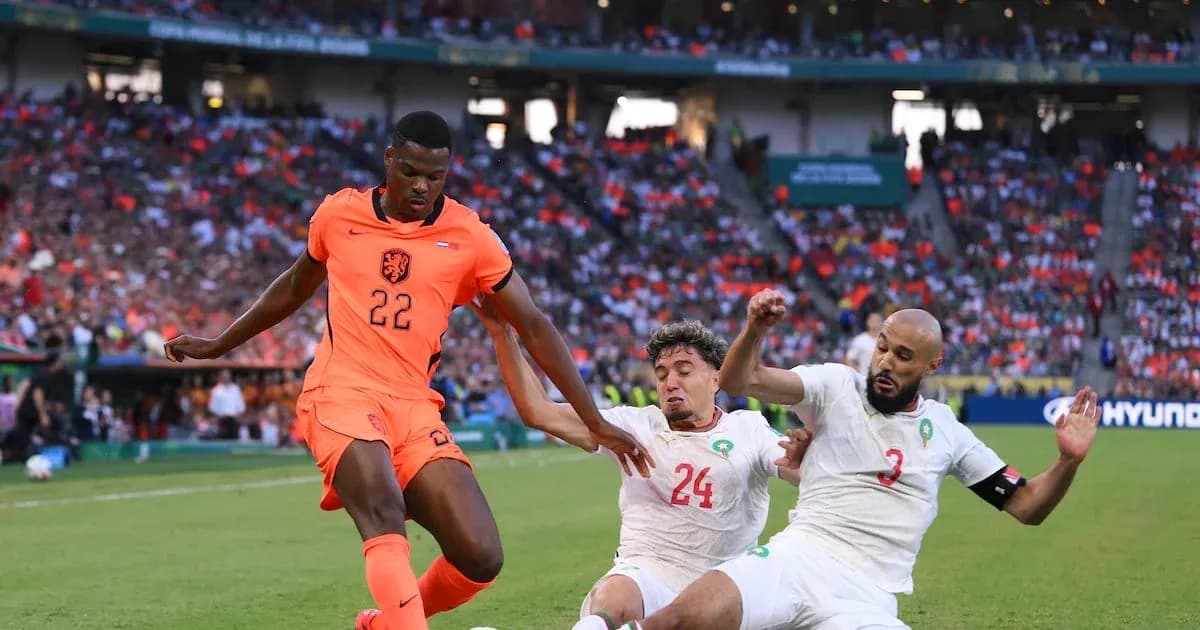
The familiar 4-3-3 was abandoned. Tijjani Reijnders was left out. A five-man defence took the field with one clear instruction: keep it tight. The price was obvious. Morocco had 70% of the ball, dictating the rhythm while the Netherlands retreated into themselves.
The anticipated end-to-end spectacle never arrived. Koeman, unrepentant afterwards, insisted he had read the level of the opponent correctly. He had a point: this is not a lightweight Morocco. But his plan produced a Dutch performance that was scratchy, cautious and largely reactive.
For almost the entire first half, they barely laid a glove on Yassine Bounou. Only when Micky van de Ven thundered a drive towards the top corner did the Morocco keeper need to extend himself, tipping the ball over. By then, Bart Verbruggen at the other end had already kept his team alive.
Morocco push, the break that changed everything
Morocco had started on the front foot. Verbruggen flew to deny Neil El Aynaoui, then again to stop Achraf Hakimi. The African side were not at their most fluid, hampered by Koeman’s low block, but they kept probing, kept nudging the tempo upwards.
Hakimi took charge after the interval, cutting inside, underlapping, dragging defenders into places they did not want to go. Van de Ven had to produce one desperate, crunching tackle to halt him. The Dutch, pinned back, had no control. They were hanging on.
Then came the pause that changed the pattern. One of Fifa’s hydration breaks – intended to protect players, not reshape tournaments – arrived midway through the second half. Koeman seized his moment. Brian Brobbey, ineffective, came off. On came Wout Weghorst, the battering ram.
Within seconds, the entire match flipped. Verbruggen launched long, Weghorst flicked on, and Crysencio Summerville raced clear. As he was challenged, he hooked the ball across and there was Gakpo, arriving with purpose, smashing it home. The emotion spilled out of him. For the Dutch bench, it felt like vindication.
For a while, it looked like 2010 all over again: a Netherlands side happy to absorb punishment, then land the one punch that matters. Morocco, stung, pushed harder. The tackles grew nigglier. Jan Paul van Hecke took blow after blow, his head finally bleeding after a third collision. In the stands, the theatre ramped up too, local fans reminding the Dutch of Mexico 2014, of Arjen Robben and that late, disputed penalty. Every Dutch touch was booed.
Still, the clock moved their way. Still, Koeman’s rope-a-dope seemed on course.
Talbi’s cross, Diop’s header, and a twist at the death
Then, in the first minute of added time, Morocco found the moment they had been chasing.
Chemsdine Talbi, on as a substitute, shifted the ball onto his right foot and shaped the kind of cross that defenders dread. It arced invitingly to the back post, where Issa Diop climbed, hung and thumped his header home. A thrilling finish. Morocco finally had what their pressure deserved.
Dutch faces told the story: disbelief, then devastation. They had been seconds away from a quarter-final. Now they were dragged into extra time.
The additional 30 minutes never caught fire. Legs were heavy, minds frayed. Verbruggen produced one more outstanding save, flinging himself to deny Soufiane Rahimi, but that was it. The game, tense and taut, headed to penalties.
Penalties, fine margins, and Africa’s door opens wider
From 12 yards, both sides blinked early. One miss each, and the shootout tightened. Then came the moment Koeman would later call a sliding-doors incident.
Rahimi stepped up. Verbruggen guessed correctly and got to it, appearing to have made the crucial save. The ball, though, had other ideas. It spun off his trailing heel and trickled over the line. Agony for the keeper, delirium for Morocco.
Quinten Timber then dragged his effort horribly wide. Hakimi clipped the post with his. The tension was suffocating. But Morocco held their nerve. When it was done, Bounou and Saibari stood as the heroes, bathed in noise and adoration.
Morocco 3–2 on penalties. Another European heavyweight gone. Another statement from Africa’s leading side.
Canada await next. The bracket has opened, the path suddenly less crowded for a team that no longer looks like a romantic outsider, but a hardened contender. The question now is not whether Morocco can trouble the favourites.
It is how far this team, carrying a continent’s hopes, intends to go.