.svg&w=384&q=75 "Naijagoal logo")

Mexico Celebrates World Cup Opening Victory: A Carnival Atmosphere
The signs were there long before a ball was kicked.
On the eve of Mexico’s World Cup opener, street sellers could barely keep up with the late rush for green jerseys. Mexico shirts were pulled from plastic bags, held up against the night sky, bargained over and bought in a hurry by fans who refused to face the tournament’s first whistle without the right colours on their backs.
Around El Ángel de la Independencia, the city’s beating heart of celebration, hundreds gathered in a rolling, improvised street party. Drums, horns, chants. Car stereos blaring, car horns answering. The traffic lights changed; nobody cared. The songs and the honking ran into the early hours.
If this was the build-up, the aftermath was always going to be wild.
Paseo de la Reforma turns into a World Cup carnival
Mexico’s players did their part. A 2-0 win over South Africa in the opening match of a World Cup spread across Mexico, Canada, and the USA was exactly the launch the hosts demanded.
Once the final whistle went, the city took over.
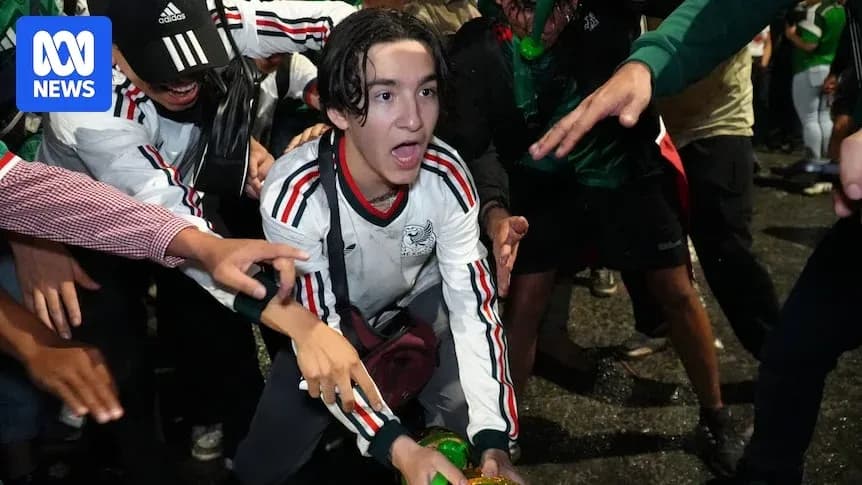
Paseo de la Reforma, usually a grand, busy boulevard, morphed into a pedestrian-only river of green shirts and waving flags. It felt less like a road and more like a World Cup dreamscape: beer flying through the air in jubilant showers, fake snow hissing from aerosol cans, conga lines snaking past plastic World Cup trophies held aloft as if they were the real thing.
Street food stalls did roaring trade. Tacos, tortas, elotes. Fans juggled snacks in one hand, glow sticks in the other. Souvenir sellers threaded through the crowds, while a free concert layered live music over the constant roar of celebration.
For an outsider, it might have looked like an over-the-top reaction to a group-stage victory. For Mexico, this is the script. A major men’s national team win means one thing: everyone converges on their own version of Fed Square, the victory monument on a chaotic roundabout, and parties until exhaustion finally wins. Often, it doesn’t.
Roars, cramps and a 17-year-old’s welcome
The energy had been building all day.
Outside the stadium, traditional performers entertained waves of supporters. Drums, dancers, colours. Inside, the noise ratcheted up to something close to delirium. Around 80,000 fans belted out songs during the opening ceremony, their voices rising when the World Cup’s unofficial queen, Shakira, took centre stage.
But the deepest, chest-rattling roars were reserved for the moments that matter most: goals.
Raúl Jiménez’s header, years after the horrific head injury that threatened his career, felt like a collective release. The stadium didn’t just cheer; it erupted, a roar loaded with relief, pride, and something close to gratitude.
Later, another sound rolled around the arena, almost as loud. When 17-year-old Gilberto Mora came on in the second half, the crowd made a decision in an instant. His name thundered from every side of the ground, a full-throated welcome usually saved for players already written into the country’s footballing folklore. Mora has barely started his story, yet fans have already cast him as a future leading man.
On the touchline, coach Javier Aguirre understood exactly what his players were feeling. He has lived this before, as a player at the 1986 World Cup on home soil. Now he watches a new generation wrestle with the same emotional overload.
“The start of the World Cup, is a brutal scenario, it makes your legs shake a little,” he said. “You come from the training centre to here, the people, the fans are in the street and that tells the player, ‘Wow, wow, wow.’”
The toll was physical as well as mental.
“Never, never in 25 matches we had one case of cramps, today we had three players with cramps,” Aguirre pointed out. “It’s a very strong emotional state.”
The squad has no choice but to clamp the lid back down, recover, and turn towards the next group game. The supporters? Their lid is gone.
“It means everything. It means a lot,” one fan said amid the chaos. “It’s putting us back on the map. It shows that Mexico is present in the world of football.”
Infantino’s “chillax” and the bigger questions
High up in the stands and in the VIP suites, FIFA president Gianni Infantino will have watched all this with a certain relief. A day earlier, he had bristled at the criticism aimed at his organisation in the run-up to the tournament, reaching for a word from a different era as he urged everyone to “chillax”.
Now the football has started, the mood music has changed. The chill pills, as he framed them, have been swallowed. The party is in full swing.
He can breathe a little easier, for now. The scrutiny, though, isn’t going anywhere.
Mexico lives and breathes this sport, but across the northern borders the landscape shifts. In Canada and the United States, “soccer” still trails other codes in the national pecking order. Big stars and heavyweight fixtures will fill the giant arenas, no doubt. The doubt lies elsewhere.
Will high ticket prices empty seats for the lesser-known teams and low-profile clashes? Will casual fans pay top dollar for an off-Broadway group game when their own domestic sports offer cheaper thrills?
And in the United States, another shadow lingers. Immigration and Customs Enforcement — ICE — has its own reputation. Will its presence be felt around World Cup venues, and if so, how will that shape who feels welcome to join the party?
Those questions will hover over this tournament as it unfolds across a continent. On this night in Mexico City, though, they stayed at arm’s length.
The streets answered in their own language: noise, colour, and a 2-0 win that turned a capital into a carnival. For now, the football is talking loudly enough.