.svg&w=384&q=75 "Naijagoal logo")

Manchester United Dominates Brighton 3–0 in Premier League Finale
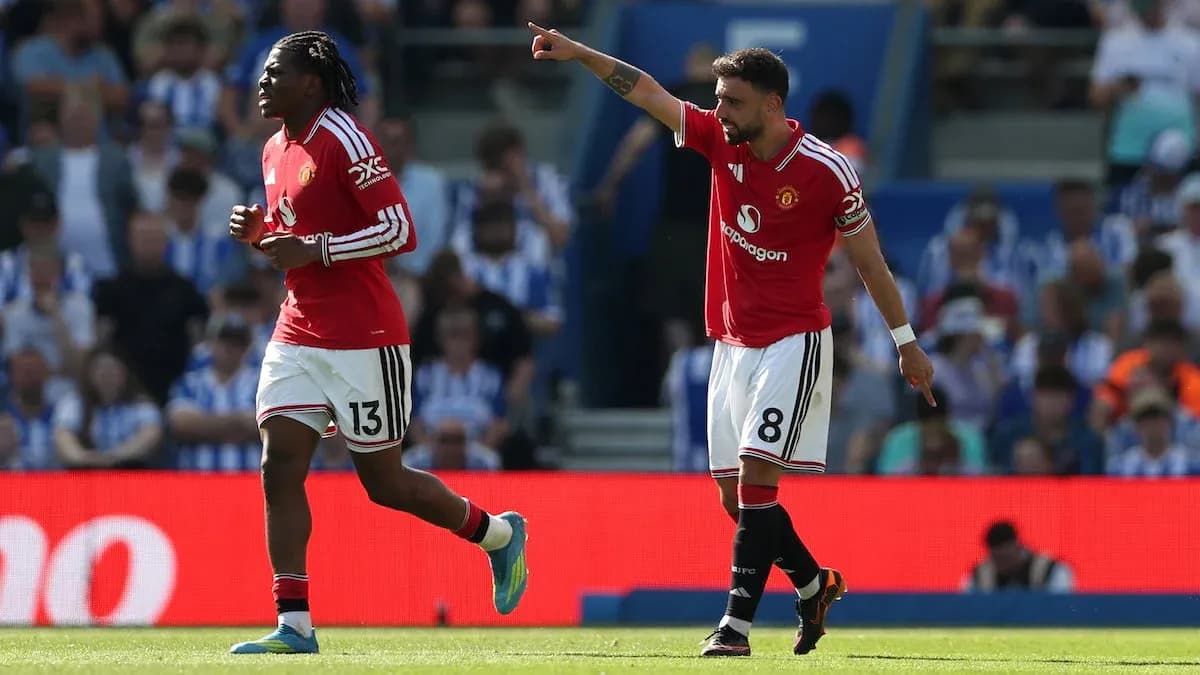
Amex Stadium’s final act of the 2025–26 Premier League season ended with a ruthless statement of intent from Manchester United. Under the grey Brighton sky, Michael Carrick’s side dismantled Brighton 3–0, sealing third place on 71 points and underlining the attacking DNA that has defined their campaign. Brighton, who finish eighth on 53 points and a goal difference of 6, were reminded of the gap that still exists to the very top, despite a season that promises European nights via the Conference League qualifiers.
This was a meeting of two 4-2-3-1 ideologies, but only one truly imposed itself.
Brighton’s structure was familiar: B. Verbruggen behind a back four of M. Wieffer, J. P. van Hecke, L. Dunk and F. Kadioglu; a double pivot of P. Gross and J. Milner; D. Gomez, J. Hinshelwood and M. De Cuyper supporting lone forward D. Welbeck. It is a system Brighton have leaned on heavily, lining up in 4-2-3-1 in 33 of their 38 league games. The idea is clear: build patiently, use Gross and Milner as tempo-setters, and rely on rotations between the three advanced midfielders to unbalance blocks.
Opposite them, Carrick mirrored the shape but not the intent. S. Lammens was shielded by N. Mazraoui, H. Maguire, L. Martinez and L. Shaw. In front, M. Mount and K. Mainoo formed a flexible double pivot, with A. Diallo and P. Dorgu flanking the division’s leading creator, Bruno Fernandes, behind B. Mbeumo. United have split their season between 4-2-3-1 (20 games) and 3-4-2-1 (18), but here Carrick trusted the back four to cope with Brighton’s possession and let his front four attack transitions with venom.
Season Statistics
Heading into this game, the numbers already hinted at a clash of philosophies. Brighton’s season overall produced 52 goals and 46 conceded; their goal difference of 6 was built on control at home, where they scored 30 and let in 20. They averaged 1.6 goals for and 1.1 against at the Amex, a solid platform but one that relied on structure more than individual chaos. United, by contrast, arrived as one of the league’s most potent attacks: 69 goals overall and 50 conceded, a goal difference of 19. On their travels, they scored 30 and conceded 26, averaging 1.6 goals for and 1.4 against away – not watertight, but always threatening.
Absences and Tactical Adjustments
The absences shaped the tactical voids before a ball was kicked. Brighton were without K. Mitoma, S. Tzimas and A. Webster, stripping Fabian Hurzeler of a direct wide outlet and an experienced centre-back option. Without Mitoma’s one-v-one threat, Brighton’s left side became more about combination play through De Cuyper than raw penetration. Webster’s absence placed even more responsibility on Dunk and van Hecke to manage Mbeumo’s runs and Bruno’s late surges.
United had their own scars. Casemiro, B. Sesko and M. de Ligt were all missing. Casemiro’s absence removed the league’s sixth-ranked card magnet and United’s most combative shield in front of the defence. It forced Carrick to lean on the intelligence and mobility of Mainoo and the box-to-box energy of Mount instead of a pure destroyer. Sesko’s absence trimmed some vertical depth in behind, and de Ligt’s injury removed a dominant aerial presence. Yet, the way Maguire and Martinez managed Brighton’s sporadic pressure suggested United have found a balance in their defensive rotation.
Discipline and Match Dynamics
Discipline was always likely to be a sub-plot. Across the season, Brighton’s yellow cards peaked between 46–60 minutes with 27.91% of their cautions, and they showed a late-game spike of 15.12% in both the 76–90 and 91–105 ranges. United’s profile was similar but sharper: 21.88% of their yellows came between 46–60, and 20.31% between 76–90, reflecting a side that often defends aggressively when protecting leads. Both teams finished this match without the red-card drama that has occasionally dogged United, but the underlying trends speak of sides that walk a fine line in the second half.
Key Matchups
The key matchups told the story of the afternoon.
In the “Hunter vs Shield” duel, D. Welbeck carried Brighton’s main goal threat. With 13 league goals in total this campaign, he has been their penalty-box reference, but his season from the spot has been imperfect: he scored 1 penalty but missed 2, a reminder that Brighton’s 100.00% team record from three penalties overall did not run through him. Up against United’s defence, which conceded 26 goals away and averaged 1.4 against on their travels, Welbeck found little space. Maguire and Martinez squeezed him between the lines, while Mainoo dropped in to close the lanes into his feet. Isolated, he was forced to drift, leaving Brighton’s box under-populated when crosses finally arrived.
At the other end, B. Mbeumo embodied United’s “Hunter” role. He ended the league season with 11 goals and 3 assists, backed by 59 shots and 32 on target. His movement into the right half-space and willingness to attack the back post exposed the spaces behind Kadioglu and around Dunk’s shoulders. With Brighton’s back four accustomed to controlling possession rather than defending repeated transitions, United’s wide rotations repeatedly dragged them out of shape.
The “Engine Room” duel was even more decisive. Bruno Fernandes arrived as the Premier League’s leading creator, with 21 assists and 9 goals in total. His 137 key passes and 1994 total passes at 82% accuracy underpinned United’s entire attacking structure. Here, he floated between Gross and Milner, constantly seeking to receive on the half-turn in the inside-right channel. Brighton’s double pivot, more comfortable dictating rhythm than man-marking an elite creator, struggled to contain him. Every time Brighton’s press arrived half a second late, Bruno punched passes into Mbeumo or Diallo, or switched play into Dorgu’s advancing runs.
On Brighton’s side, Gross was asked to be both metronome and enforcer. Yet without a true ball-winner alongside him, he and Milner were often outnumbered by United’s rotations, especially when Mount surged beyond Mainoo to create a three-versus-two. The result was a midfield that chased shadows more than it controlled territory.
Defensive Contrasts
Defensively, the contrast was stark. Brighton’s season-long average of 1.2 goals against overall and 1.1 at home spoke of a side usually able to manage games at the Amex. United, though, arrived with a relentless attacking profile: 1.8 goals for per game overall and 1.6 away. Following this result, the numbers feel like a fair reflection of reality. United’s 3–0 win fit neatly into their away scoring pattern, while Brighton’s inability to find the net – one of 4 home games this season where they failed to score – exposed the fragility of a system missing its most explosive winger.
The final verdict, viewed through the statistical lens and the tactical narrative, is of a contest where United’s xG would have comfortably outstripped Brighton’s, driven by the volume and quality of chances created by Bruno and finished by a multi-pronged front line. Brighton’s structure, so often their strength, became a cage; United’s flexibility within the same 4-2-3-1 framework turned the Amex into a stage for their Champions League-bound swagger.