.svg&w=384&q=75 "Naijagoal logo")
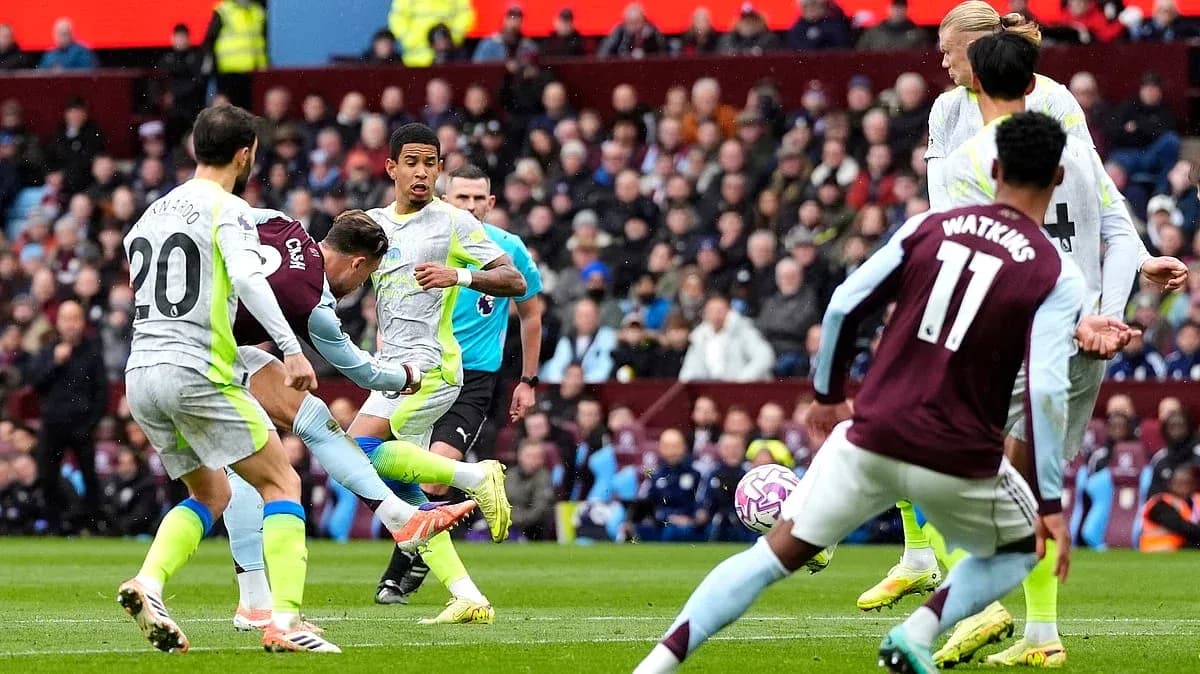

Manchester City vs Aston Villa: Premier League Upset at Etihad Stadium
Etihad Stadium’s final act of the 2025–26 Premier League season ended with a twist: Manchester City, chasing perfection at home, fell 1-2 to Aston Villa despite leading 1-0 at the break. Following this result, the table hardens into place with City in 2nd on 78 points and Villa in 4th on 65 – two sides whose campaigns have been defined by very different kinds of control.
I. The Big Picture – Seasonal DNA and the Shape of the Contest
Over the 38-game campaign, City have been a machine of accumulation: 23 wins, 9 draws, 6 defeats, with a goal difference of +42 (77 scored, 35 conceded). At home they have been particularly ruthless, winning 14 of 19, scoring 45 and conceding just 14 – an average of 2.4 goals for and 0.7 against at the Etihad. Their statistical profile screams territorial dominance and defensive suffocation, underlined by 9 home clean sheets and only 1 game at home in which they failed to score.
Yet this match saw Pep Guardiola roll out a relatively rare 4-2-2-2, a shape City had used only 2 times in total this campaign, compared to the more familiar 4-1-4-1 and 4-3-3 structures. J. Trafford started behind a back four of R. Lewis, J. Stones, R. Dias and N. Ake, with Nico and Bernardo Silva as the double pivot and a narrow band of A. Semenyo and Savinho behind a front pairing of P. Foden and T. Reijnders. It was an aggressive, box-heavy system, designed to pin Villa back and overload the half-spaces.
Aston Villa arrived with their season-long identity intact. Unai Emery’s side have leaned heavily on a 4-2-3-1, using it 34 times overall, and that same structure took the field in Manchester: M. Bizot in goal, a back four of A. Garcia, V. Lindelof, T. Mings and I. Maatsen, Douglas Luiz and L. Bogarde as the double pivot, with L. Bailey, R. Barkley and E. Buendia supporting O. Watkins. Villa’s campaign numbers – 19 wins, 8 draws, 11 defeats, with a goal difference of +7 (56 for, 49 against) – tell of a side willing to trade punches. On their travels they have been solid but not spectacular: 7 away wins, 6 draws, 6 defeats, scoring 24 and conceding 27, an away average of 1.3 scored and 1.4 conceded.
II. Tactical Voids – Absences and Discipline
If City’s void was structural – a less-used formation in a high-stakes finale – Villa’s was personnel-based. They travelled without three important figures: Alysson (muscle injury), B. Kamara (knee injury) and E. Martinez (finger injury), all listed as “Missing Fixture”. The absence of Kamara in particular stripped Villa of a natural screening midfielder, forcing Douglas Luiz and L. Bogarde into a more disciplined, conservative double pivot.
Emery’s response was to compact the central lanes and trust his back four to absorb City’s layered attacks. Mings and Lindelof were asked to defend the box rather than chase into midfield, while Maatsen and Garcia had to be measured in their forward runs.
Disciplinary tendencies also framed the risk profiles. Across the season, City’s yellow cards have shown a late-game surge: 20.90% of their bookings have come between 76-90', with another 16.42% from 91-105'. Villa’s peak is slightly earlier; 29.31% of their yellows arrive between 46-60', with a further 17.24% from 61-75'. That meant the second half was always likely to be the storm window – City pushing, Villa fouling to break rhythm, both sides walking a tightrope of control and chaos.
City’s campaign has been remarkably clean in terms of dismissals; their red-card distribution is effectively empty. Villa, by contrast, have one red card on the books, arriving between 61-75' (100.00% of their reds in that window). That single data point underlines their tendency to flirt with the edge once the game stretches after the hour mark.
III. Key Matchups – Hunter vs Shield, Engine Room vs Enforcer
The narrative duel of the season has been between the league’s elite forwards, and this fixture brought two of them into focus. For City, E. Haaland has been the apex predator: 27 goals and 8 assists in total, from 35 appearances, with 102 shots and 59 on target. His penalty record is lethal but not flawless – 3 scored and 1 missed – so any spot-kick is high-value but not automatic.
For Villa, O. Watkins has been the reference point: 16 goals and 3 assists, with 60 shots and 38 on target. He thrives on running channels and punishing high lines. In this match, Watkins operated against the Stones–Dias axis, looking for the spaces created when City’s full-backs and midfield stepped high.
The “Hunter vs Shield” dynamic, then, was less about Haaland directly (he did not start in this particular XI) and more about City’s attacking collective versus Villa’s away defensive record. On their travels, Villa concede 1.4 goals per game, while City at home score 2.4. In pure numbers, the expected direction of traffic was towards Bizot’s goal.
In midfield, the “Engine Room” belonged to Bernardo Silva and Nico against Douglas Luiz and L. Bogarde. Bernardo’s season – 2 goals, 4 assists, 2,196 passes with 90% accuracy, 53 tackles and 6 successful blocks – encapsulates his dual role as metronome and disruptor. He is also City’s leading yellow-card magnet with 10 bookings, a sign of how often he operates at the edge of the press. Douglas Luiz, meanwhile, had to balance build-up duties with shielding a back four already missing Martinez’s commanding presence behind them.
Further ahead, creativity came from different sources. For City, R. Cherki has been a quiet star of the campaign with 12 assists and 4 goals, plus 61 key passes and 105 dribble attempts, 50 successful. Though he began on the bench here, his profile hints at the change-of-pace option Guardiola could summon: vertical passing, one-v-one threat, and the ability to unlock compact blocks late on. For Villa, M. Rogers has been their hybrid playmaker-runner, with 10 goals and 6 assists, 47 key passes and 118 dribble attempts (42 successful). Even though he did not start this particular match, his season numbers explain why Villa can transition so sharply when he is on the pitch.
IV. Statistical Prognosis – What the Numbers Say About the Upset
Across the season, the Expected Goals story (while not explicitly provided) can be inferred from volume and efficiency. City’s overall scoring average of 2.0 goals per game, combined with 16 clean sheets and only 4 games in which they failed to score, points to a side that regularly generates high-quality chances and limits opponents to low-probability efforts. Their home goals-against average of 0.7 suggests that, on most days, City’s defensive xG conceded is low, protected by structure and possession.
Villa’s profile is more volatile. Overall they score 1.5 per game and concede 1.3, with 9 clean sheets but 10 games where they failed to score. On their travels, the 1.3 scored and 1.4 conceded underline a team that lives in the margins – capable of big away wins (their best away result is 0-2) but also heavy defeats (4-1 away).
On paper, then, a City home win was the probabilistic favourite: superior goal difference, stronger home metrics, and a more controlled defensive record. That Villa overturned a 1-0 half-time deficit to win 2-1 fits their season-long identity as a side that embraces risk, trusts its transitions, and is comfortable in the turbulence of the second half – precisely the window where their yellow-card profile spikes and where opponents’ legs and concentration begin to fade.
Following this result, the table confirms what the performance data has hinted at all season. Manchester City remain an elite, territorially dominant side whose occasional structural experiments can open small cracks. Aston Villa close the campaign as a high-variance, high-ceiling outfit: imperfect at the back, but armed with enough attacking punch and tactical clarity in their 4-2-3-1 to bloody even the biggest noses on their travels.