.svg&w=384&q=75 "Naijagoal logo")

Jordy Bos: A Left-Back's Unconventional Brilliance in San Francisco
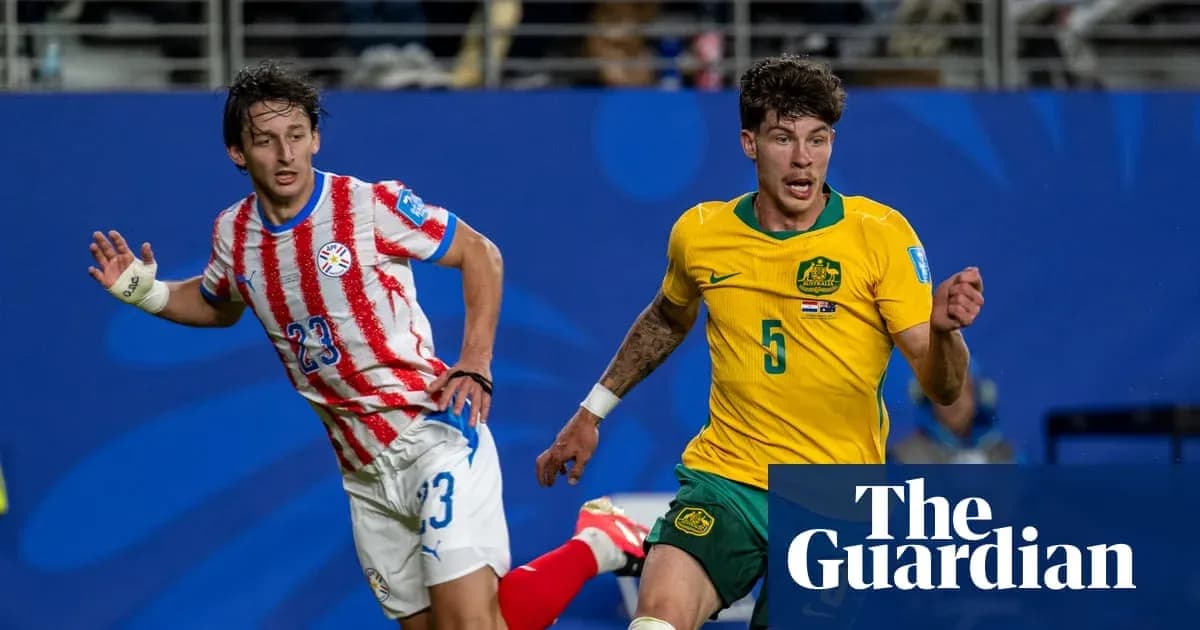
Jordan Bos did not so much play right-back in San Francisco as rip up the job description and start again.
The Socceroos’ nominal left-back kept tearing down that unfamiliar flank, first through one Paraguayan challenge, then a second, then into the box as if the touchline were a running track and the knockout rounds the finish line. Every surge dragged Australia 10, 20, 30 metres away from danger. Every stride lifted a team that had been tiptoeing towards the last 32.
At 0-0, the equation was simple and suffocating. A draw against Paraguay would be enough to secure second place in Group D. One mistake could still wreck it. Each time Julio Enciso slipped into space, or Patrick Beach had to fling himself into another save, the air tightened around the 12,000 Australians striping the stadium yellow by the San Francisco Bay.
Tony Popovic started checking the clock. The crowd did the same. This was not a night for swashbuckling scorelines; it was a night for survival, for a campaign that needed a jolt of belief after the flat defeat to the United States.
That jolt arrived in the form of a 23-year-old playing on the “wrong” side of the pitch.
A left-back who owned the right
Within a few kilometres of Google’s Mountain View headquarters, the Socceroos’ search for a spark threw up one emphatic answer. Bos kept appearing high on the right, bouncing off would-be tacklers, powering past another defender, then another. Each carry was a release valve. Each run forced Paraguay to turn and chase instead of probe and prod.
His first-half foil Cristian Volpato was withdrawn. So too Nestory Irankunda, the hero against Turkey and the spearhead many expected to decide this game. The pattern did not change. Bos stayed on the throttle, smashing into duels, driving into the area, refusing to play this out as a cautious, sideways full-back.
From the opposite wing, Ajdin Hrustic had the best view in the house.
“He’s a great player, he’s got power, you’ve seen it,” the substitute said afterwards, watching on as the plaudits rolled in. Aiden O’Neill, named player of the match, admitted the trophy probably belonged elsewhere and looked faintly embarrassed holding it.
Harry Souttar went beyond the usual captain’s compliments. Bos, he said, is “a special player, a special guy, and just takes everything in his stride,” before adding, with a grin, that “the guy’s body’s just unbelievable to look at”. Then came the line that will follow Bos around this tournament: if he keeps performing like this, “there’s no ceiling”.
The dressing room did not bother with restraint. Milos Degenek called him already a top-five left-back in the world, and the best at his age. When a journalist pushed the joke to right-back, Degenek shot back “Top 10,” and laughed.
Irankunda went higher still. “He’s the best player in the world, Jordy Bos, best winger in the world,” he said. “He might have to switch to a winger, in my opinion. He’s done so well at right-back today, but he got so high up the pitch today and he showed glimpses of what he can do with the ball.”
Hyperbole? Of course. But it tells you what Bos’s teammates had just witnessed.
A gamble that paid off
Popovic’s decision to start him on the right raised eyebrows before kick-off. The squad already carried natural options there in Kai Trewin and Jason Geria. Bos was the proven left-sided defender, a player whose stock had risen in the Dutch Eredivisie and who arrived at this World Cup as one of Australia’s most polished young talents.
Popovic, though, had seen this movie before. He had watched Bos operate on the right at Westerlo in Belgium. He had given him 30 minutes there against New Zealand nine months earlier. He knew the feet were good enough, the engine relentless enough, the mentality calm enough.
“We’ve seen that he can adapt and play on that side,” the coach said. “It’s the best game he’s played of the three [World Cup matches] by far.”
That is what made this performance so jarring in the best possible way. Bos came into the tournament as a symbol of this young Socceroos generation: talented, composed, promising rather than dominant. His first two outings were tidy, not transformative.
Then came Thursday. Out of position. One yellow card away from suspension. Up against a South American side who needed to win. That was the backdrop to the night he exploded.
At training this week, Hrustic had taken to calling him “Dani Alves”, a nod to the Brazilian who redefined the attacking full-back role from the right. Others had gone for Arjen Robben, the left-footed right winger whose trademark move became a footballing cliché. Bos brushed those off with a smile.
“Unfortunately I didn’t score like him, but I tried,” he said.
The numbers underlined the intent. No Australian took more shots than his three. He created the joint-most chances. He completed four dribbles and won more duels than anyone else on the pitch, including seven of nine in the air. This was not a full-back quietly doing his job. This was a one-man outlet, a constant, bruising threat.
“I was enjoying it too, honestly, tonight,” Bos admitted.
From comparisons to his own name
The Bale comparisons have followed Bos the longest. A left-back with the power and stride to play much higher, a player whose athleticism begs coaches to push him further up the pitch. Like the young Welshman at Tottenham, Bos looks too explosive to be chained to the back line forever.
So which of the greats does he see in himself? “Yeah, Robben … I don’t mind Bale, to be honest,” he offered, half-serious, half-amused by the names being thrown around.
The truth is it does not matter. Dani Alves, Robben, Bale – they are reference points, not blueprints. What counts is that on a tense night by the Bay, with Australia walking the tightrope between progress and disaster, a 23-year-old defender took the game by the scruff of the neck from an unfamiliar position and refused to let it drift.
The Socceroos did not need a goal to go through. They needed a pulse. They found it in Jordy Bos, on the wrong flank, at the right time.
From here, the comparisons will keep coming. The question now is simpler, and far more interesting: how far, and how fast, does he climb from this night onwards?