.svg&w=384&q=75 "Naijagoal logo")

Iran’s World Cup Opener: Politics and Protest in Los Angeles
In Los Angeles, Iran’s World Cup opener against New Zealand is supposed to be about football. It will be anything but.
This is a match framed by war, protest and the threat of a game being stopped not by a referee’s whistle, but by political instruction from Tehran. For the first time in the tournament’s 96-year history, a host nation is at war with one of the participants. The stage is SoFi Stadium; the mood is combustible.
A team playing under orders
Iran arrive in the United States already bruised by the build-up. Their base has been shifted to Mexico. Visa problems have dogged officials and staff. Travelling supporters have seen tickets stripped away. Every layer of normal World Cup preparation has been peeled back and replaced by tension.
Mehdi Taremi, the captain, did not bother to hide it.
“I have felt the tension from the first moment we arrived at this World Cup,” he said. “This kind of tension, it undermines that joy and it undermines the message of Fifa and our people, which is that football brings about peace. I feel like this World Cup could have provided a better atmosphere than it has.”
It was a rare, pointed public assessment from a senior Iran player. Not a rant. Just a clear sense that the tournament’s usual escapism has been swallowed by geopolitics.
The pressure around the squad is not only external. Head coach Amir Ghalenoei has been given explicit instructions from the Iranian government: if pre‑revolutionary flags appear in the stands, or if anti‑regime chants ring out clearly, he is to stop the game.
That is the surreal possibility hanging over tonight. A national team manager, in a World Cup match, under orders from his government to halt play if the dissent grows too loud.
Ghalenoei tried to steer the conversation away from that in his pre‑match press conference.
“We don’t pay attention to any of the hype and anything that goes on around us,” he said. “We are here to represent the respectful people of Iran, be it the Iranians inside Iran or the Iranian diaspora.
“We are not political people... football is separate from politics.”
On paper, that is the standard line. On the ground in Los Angeles, it looks impossible to maintain.
“We’re going to make it hell”
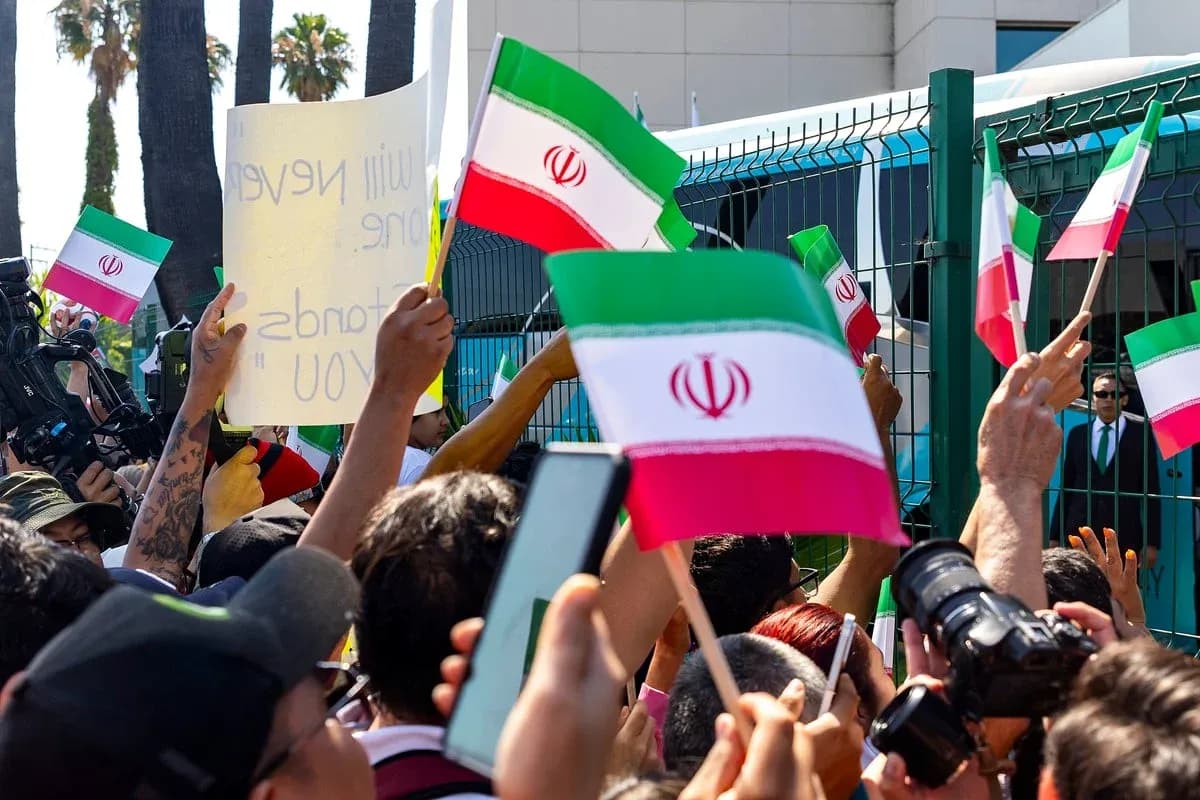
Outside the stadium, and in large pockets inside it, Iranian protesters intend to make sure this is not just another group game.
Against the backdrop of Tehran’s war with Washington, activists from across California and beyond are converging on SoFi Stadium. Their aim is blunt: to turn Iran’s opener into a loud, visible rejection of the regime.
“We’re going to make it hell,” one woman told the Daily Mail, explaining that buses are running from San Diego, Orange County and cities across Los Angeles to bring protesters to the ground.
The plan is choreographed. Boo the anthem. Turn backs to the pitch as it plays. Unfurl the pre‑revolutionary flag – the tricolour with the lion and sun – that Fifa has banned from stadiums.
“I know Fifa banned it but we will make a way to get it in,” she said. “So we're going to see this flag, not the terrorist regime’s flag.”
For Fifa, that presents another flashpoint in a tournament already wrestling with its own contradictions. The governing body wants a clean, controlled show. Instead, it may get a live test of what happens when political protest collides with an authoritarian state’s demands in front of a global audience.
If the anthem is drowned in boos and the old flag fills the camera shots, does Ghalenoei follow the order to stop the match? Does the referee cooperate? Does Fifa intervene? The questions hang over the fixture like low cloud.
What is clear is that many Iranians in exile have no interest in soft‑pedalling their anger just because their national team is on the pitch. For them, this is not a night for unity. It is a night to expose the regime, and if that means their own players feel the heat, so be it.
A World Cup on edge
The World Cup has always carried politics in its slipstream, but rarely has it been this stark. A host at war with a participant. A team effectively under government surveillance. A coach given instructions that cut across the sport’s own laws.
Taremi’s lament about the lost “joy” of the tournament is not a throwaway line. Iran’s squad are trying to live and work inside a pressure chamber, while their own people – those who fled and those who oppose from afar – prepare to turn their opening game into a rolling referendum on the regime.
Inside SoFi Stadium tonight, 22 players will line up for a football match. Around them, a country’s fractured identity will play out in real time. The whistle will blow, the ball will roll, and everyone will wait to see which comes first: a goal, or a moment that stops the game cold.