.svg&w=384&q=75 "Naijagoal logo")
Fulham vs Bournemouth: A Tactical Analysis of Diverging Seasons
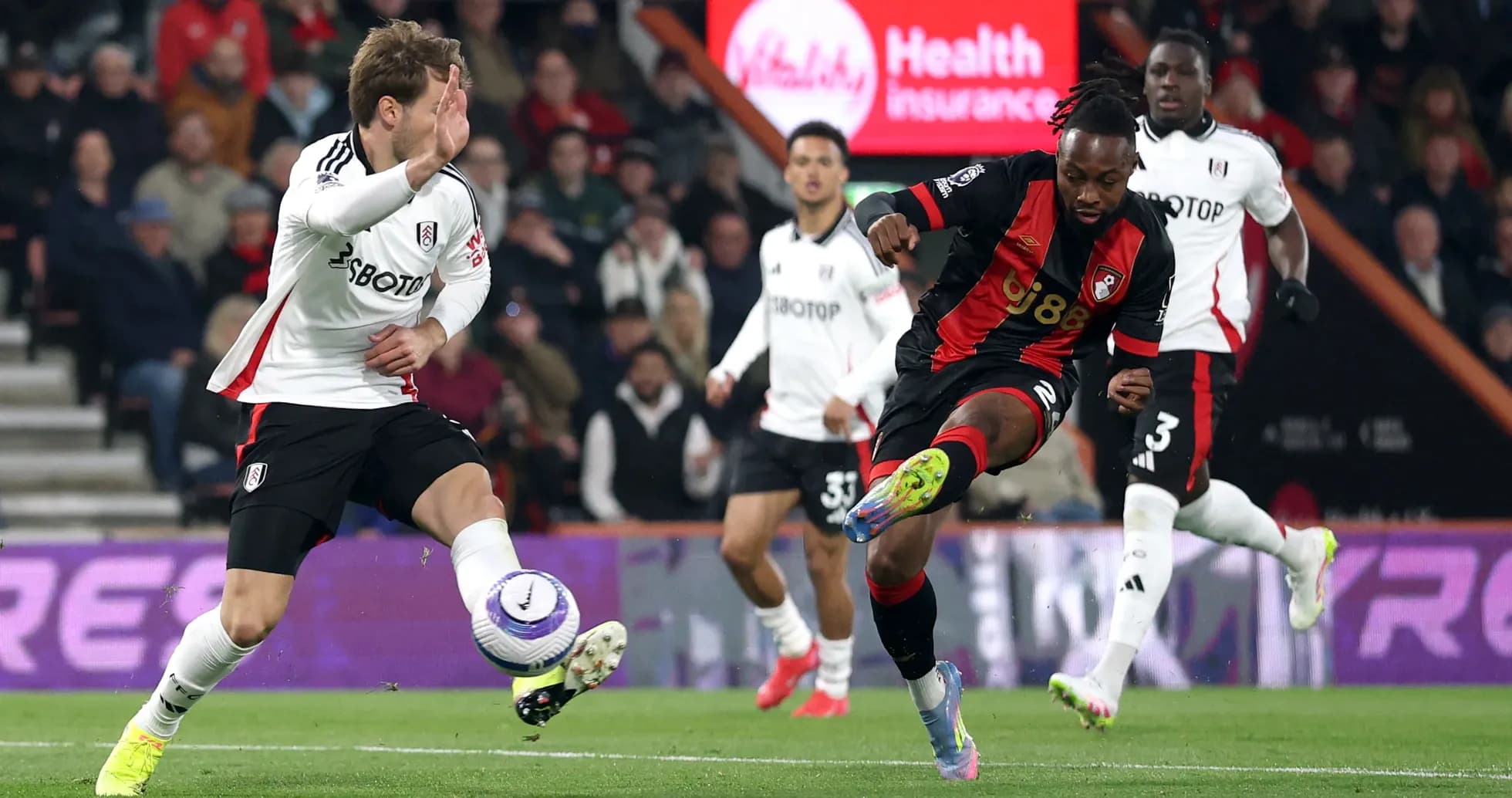
Craven Cottage felt heavy at full time. Under a grey London sky, Fulham’s season-long home resilience met Bournemouth’s quiet, methodical rise, and it was the visitors who walked away with a 1–0 win that underlined the contrast between these two squads heading into the final stretch of the Premier League season.
I. The Big Picture – Diverging trajectories
Following this result, the table tells a clear story. Fulham sit 11th with 48 points, their overall goal difference at -6, the product of 44 goals scored and 50 conceded in total this campaign. Craven Cottage has been their sanctuary: at home they have 10 wins from 18, scoring 28 and conceding only 20. On their travels, Bournemouth are built differently but just as effectively. They occupy 6th place with 55 points, their overall goal difference a slim but significant +4 (56 for, 52 against overall). Away, they have taken 6 wins and 7 draws from 18, scoring 28 but conceding 33.
The seasonal DNA is clear. Fulham are a home-centric side: 1.6 goals scored at home on average, only 1.1 conceded. Bournemouth are balance merchants: 1.6 goals scored both at home and away on average, but with a riskier defensive profile away, where they concede 1.8 per game.
Yet this match finished with Fulham blanked. For a team that has failed to score only 3 times at home all season, Bournemouth’s ability to choke the supply line at Craven Cottage is as telling as the single goal they found at the other end.
II. Tactical voids and absences – Holes in the structure
Both managers had to navigate notable absences. Marco Silva was again without A. Iwobi, ruled out through injury, and R. Sessegnon, sidelined by a hamstring injury. Neither is in the matchday squad, and both absences narrow Fulham’s options between the lines and at left-sided depth. Without Iwobi’s ability to receive under pressure and carry through midfield, Silva leaned heavily on Tom Cairney’s orchestration and the vertical energy of Emile Smith Rowe and Samuel Chukwueze.
On the Bournemouth side, Andoni Iraola had to remodel his midfield and defensive rotation. L. Cook (hamstring injury) and J. Soler (hamstring injury) were unavailable, while Álex Jiménez – one of the league’s leading yellow-card collectors with 10 bookings – was suspended. Jiménez’s absence removes a defender who has made 69 tackles, 11 successful blocks and 27 interceptions this season, but also takes away a disciplinary risk in a team whose yellow-card pattern spikes late: 27.71% of their league yellows arrive between 76–90 minutes, and a further 20.48% between 91–105.
Fulham’s own card profile this season hints at emotional volatility in the second half: 21.92% of their yellows land between 46–60 minutes, 20.55% from 76–90, and a striking 23.29% from 91–105. With Joachim Andersen already carrying a red card on his seasonal record, Silva’s back line walks a fine line between aggression and overreach.
III. Key matchups – Hunter vs shield, engine room vs disruptors
The headline duel on paper was Bournemouth’s attacking cadre, led statistically by Eli Junior Kroupi, against Fulham’s otherwise solid home defence. Kroupi, who started here as part of the visitors’ fluid attacking midfield line, has 12 league goals from 31 appearances and operates as a hybrid between winger and second striker. He is economical and decisive: 29 shots, 20 on target, and 2 penalties scored from 2 attempts. His movement into half-spaces asks constant questions of defenders like Andersen and Calvin Bassey, who must choose between holding the line and stepping into pockets.
Andersen’s season numbers underline his importance: 2884 minutes, 45 tackles, 19 successful blocks and 36 interceptions. He is Fulham’s organiser, the one who steps out to confront runners like Kroupi or Marcus Tavernier, while Bassey and Antonee Robinson manage the cover and wide channels. In this match, Bournemouth’s lone goal came as a product of that constant probing – the visitors repeatedly drew Fulham’s centre-backs into uncomfortable zones, then attacked the vacated spaces.
In the engine room, the duel was subtler but just as decisive. For Fulham, Saša Lukić and Cairney tried to dictate tempo. Lukić’s profile – 675 passes at 85% accuracy, 27 key passes, 44 tackles and 9 blocks – marks him as a two-way pivot. He is also a disciplinary tightrope walker, with 9 yellow cards and 50 fouls committed. Opposite him, Bournemouth’s Ryan Christie and Alex Scott were tasked with disrupting Fulham’s rhythm and springing transitions. Christie’s 27 tackles, 4 blocks and 12 interceptions, plus his capacity to carry the ball (39 dribbles attempted, 19 successful), made him the ideal link in Iraola’s counter-pressing scheme.
Wide and between the lines, Harry Wilson was Fulham’s creative axis. Across the season he has 10 goals and 6 assists, 38 key passes and 48 shots (24 on target), making him both finisher and provider. Bournemouth’s response was collective: Adam Smith and Marcos Senesi stepped out aggressively, supported by the work rate of Tavernier and Rayan, to deny Wilson the pockets where he usually thrives.
Up front, Rodrigo Muniz and Evanilson offered contrasting focal points. Muniz, leading the line for a Fulham side that averages 1.2 goals in total per game, thrives on crosses and second balls. Evanilson, spearheading a Bournemouth team that averages 1.6 goals in total per game, is more of a penalty-box reference for cut-backs and through balls. The decisive margin here was service: Bournemouth found their forward in higher-quality zones more often than Fulham did.
IV. Statistical prognosis – Why Bournemouth’s edge holds
Even without explicit xG numbers, the season-long patterns frame this result as more than a one-off. Heading into this game, Fulham’s defensive record at home – 20 conceded in 18 – suggested they usually control their box. Bournemouth, however, arrived as one of the league’s most consistent attacking units, with 56 goals in total and identical 1.6-goal averages at home and away.
Defensively, both sides share the same overall average of 1.4 goals conceded per match, but Bournemouth’s 11 clean sheets (5 away) versus Fulham’s 8 (5 at home) hint at a slightly higher ceiling when their structure is right. Their penalty records add another layer of reliability: Fulham have scored 4 of 4 penalties in total, Bournemouth 5 of 5, with no misses on either side this season.
What tilts the tactical prognosis in Bournemouth’s favour is their ability to sustain attacking threat while living with defensive risk. Their away goal concession (33) is high, but they offset it with offensive volume and late-game intensity – a team comfortable in chaos. Fulham, by contrast, rely on controlled home performances; when their creators like Wilson are smothered and their midfielders like Lukić are pressed into errors or early bookings, their structure frays.
Following this result, Bournemouth’s +4 overall goal difference and 6th-place standing look less like an anomaly and more like the logical outcome of a squad built to attack in waves and survive the turbulence. Fulham’s -6 overall goal difference and 11th place tell of a team that can be formidable at Craven Cottage but still lacks the consistent cutting edge and defensive ruthlessness to turn tight games like this into points.
In narrative terms, this match felt like a microcosm of the season: Fulham solid but slightly blunt, Bournemouth imperfect but relentlessly purposeful – and in the margins between those identities, a single away goal was always likely to be enough.