.svg&w=384&q=75 "Naijagoal logo")

Frosinone vs Como: A Tactical Analysis of Serie A Clash
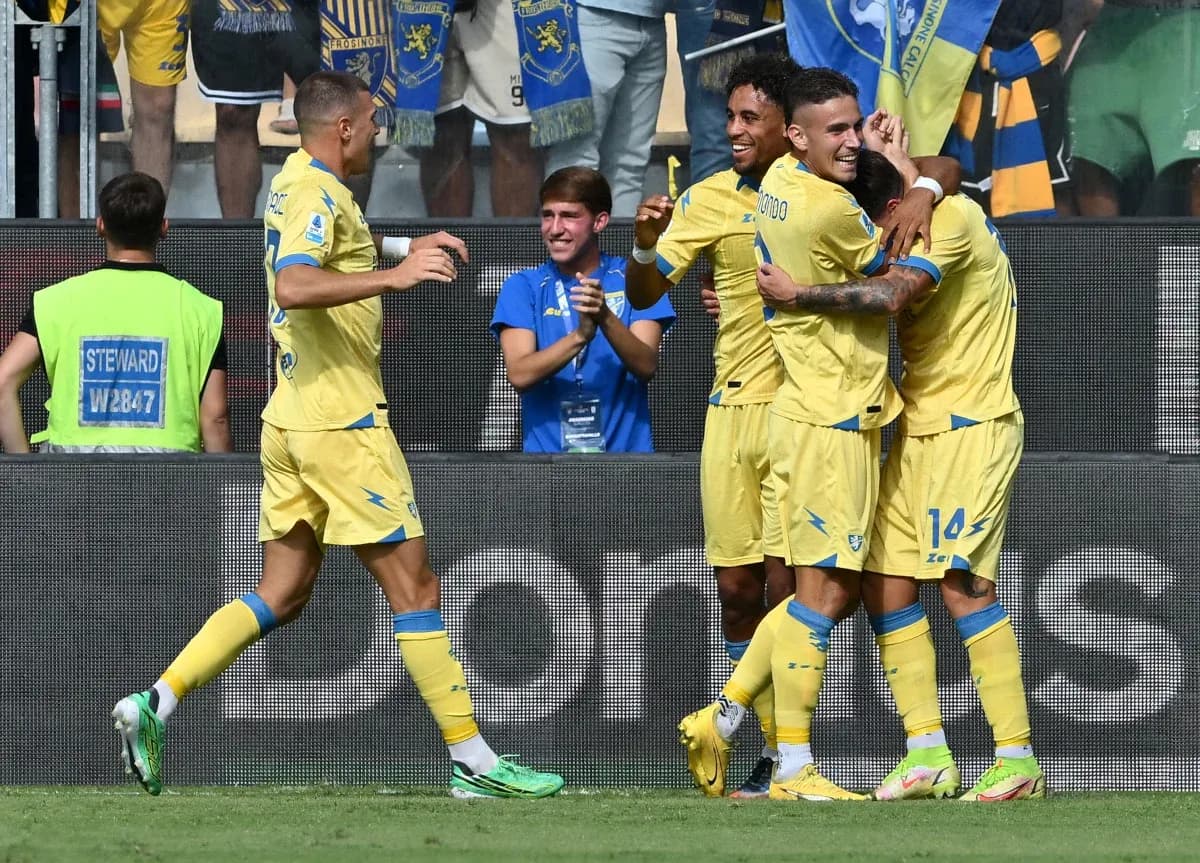
Under the clear afternoon light of Stadio Benito Stirpe, Frosinone and Como met in Serie A’s Regular Season - 5 in what felt less like a newly promoted duel and more like a clash between two fully formed ideas. By full time, the scoreboard read 2–0 to Frosinone, a result that did more than separate the sides on the day: it crystallised the emerging identities of Massimiliano Alvini’s energetic hosts and Cesc Fabregas’ possession‑driven visitors.
Heading into this game, both teams were locked on 10 points from 5 matches, but their routes there were subtly different. Overall, Frosinone had scored 9 and conceded 4, a goal difference of +5 built on a remarkably balanced split: 5 goals at home and 4 on their travels. Their defensive numbers at home — 3 conceded in 3 matches — suggested a side that could occasionally be got at, but whose structure was tightening with each week. Como arrived with the same total of 9 goals scored and 6 conceded overall, a goal difference of +3, and a more open profile: 7 goals scored and 5 conceded away, a team that embraced risk on their travels.
Tactics and Formation
Alvini doubled down on his preferred 4‑2‑3‑1, the only shape Frosinone had used in the league. L. Palmisani anchored the back line behind a young but increasingly assertive defence of A. Oyono, G. Calvani, I. Monterisi and G. Bracaglia. In front, the double pivot of G. Calo and P. Masini provided the platform for a highly creative trio: F. Ghedjemis wide, R. Schmid as the central playmaker, and G. Kvernadze cutting in from the left, all feeding the in‑form A. Raimondo.
Fabregas mirrored the 4‑2‑3‑1 on paper, but with a different spirit. J. Butez started in goal, shielded by Y. Couto, J. Ramon, T. Chalobah and A. Valle. The double pivot of L. Milla and L. Da Cunha was tasked with dictating tempo, while the advanced line of A. Diao, N. Paz and M. Baturina supported lone striker A. Douvikas. It was a shape designed to have the ball, but in Frosinone’s cauldron, it often found itself chasing it.
The tactical voids were subtle but decisive. Frosinone were officially without F. Grillitsch due to a thigh injury, a theoretical loss of experience in midfield. Yet the numbers suggested Alvini had already built a coherent engine room without him: overall, Frosinone averaged 1.8 goals scored and just 0.8 conceded per match, with 2.0 goals scored on their travels and 1.7 at home. The double pivot and the aggressive three behind Raimondo had become the true heartbeat.
Disciplinary trends added another layer. Overall, Frosinone’s yellow cards were spread across the match, but with a noticeable spike between 46–60 minutes, where 25.00% of their cautions arrived — a sign of a side that comes out of half time with intensity, sometimes spilling into aggression. Como’s yellows were more evenly scattered in the middle and late phases, with 25.00% each between 31–45, 46–60, 76–90 and 91–105 minutes. Neither side had seen a red card in the league, and neither had been involved in penalties — both had taken zero and missed zero — so this contest always looked destined to be decided in open play and in the duels between structures.
Key Matchups
Those duels were headlined by the “Hunter vs Shield” matchup: A. Raimondo against Como’s away defence. Raimondo arrived as one of Serie A’s most efficient young strikers, with 4 goals from 10 shots, 6 of those on target, and a rating of 7.02. He is not just a finisher but an active presser, engaging in 49 duels and winning 15, and even blocking 1 shot. Against him, Como’s away back line had conceded 5 goals in 4 away matches, an average of 1.3 per game on their travels. The numbers suggested that if Frosinone could connect the lines and find their No. 9 early, chances would come. The first half, which ended 2–0 to the hosts, confirmed that logic.
Behind Raimondo, the creative matrix of G. Kvernadze and R. Schmid shaped the narrative. Kvernadze, with 3 goals and 1 assist, 30 dribbles attempted and 16 successful, is Frosinone’s chaos agent between the lines. His 12 key passes and 85% passing accuracy speak to a player who not only carries the ball but chooses wisely when to release it. Schmid, meanwhile, leads the league’s assist charts with 3, having created 4 key passes and completed 130 passes overall. His average rating of 6.68 hides the weight of his final ball: he is the one who turns territory into incision.
Against them stood Como’s “Engine Room” of L. Milla and L. Da Cunha, but the more telling matchup was higher up: M. Baturina and A. Diao trying to bend the game back their way. Baturina’s 2 goals and 1 assist, plus 140 passes at 89% accuracy, show a metronome who can hurt teams if given time. Diao, with 2 goals, 1 assist, 22 dribbles attempted and 11 successful, is Como’s answer to Kvernadze — a wide attacker who can break lines by himself.
Yet Frosinone’s defensive spine, particularly G. Bracaglia and G. Calvani, has been quietly formidable. Bracaglia had already blocked 7 shots and made 5 interceptions, while Calvani added 11 tackles, 6 blocks and 7 interceptions. Together, they formed a back line that had conceded just 4 overall, 3 at home and 1 away. Their willingness to step out and engage meant that Como’s creative hubs rarely received the ball in comfort.
The disciplinary edge of Frosinone’s back line was a calculated risk. Bracaglia’s 3 yellow cards and Schmid’s and Raimondo’s 2 each hinted at a side that fouls to break rhythm, especially in transition. But with no red cards and no penalties conceded or missed, the aggression has been controlled rather than reckless.
Final Thoughts
Statistically, the prognosis for this fixture always leaned towards a tight but favourable outcome for the hosts. At home, Frosinone averaged 1.7 goals scored and 1.0 conceded; Como, on their travels, averaged 1.8 scored and 1.3 conceded. Two attacking sides, but only one with a genuine defensive platform. The 2–0 full‑time scoreline, after a 2–0 half‑time lead, reflected a team that struck early, then managed the game with maturity.
Following this result, the story of the afternoon is clear: Frosinone’s 4‑2‑3‑1 is no longer an experiment but an identity. The Hunter in Raimondo, the creators in Kvernadze and Schmid, and the Shield forged by Bracaglia and Calvani have combined to produce a side whose numbers and narrative now align. Como, for all their technical quality and the promise of Baturina and Diao, left Frosinone having run into a more complete idea — one that is beginning to look like a genuine force in Serie A’s upper reaches.