.svg&w=384&q=75 "Naijagoal logo")
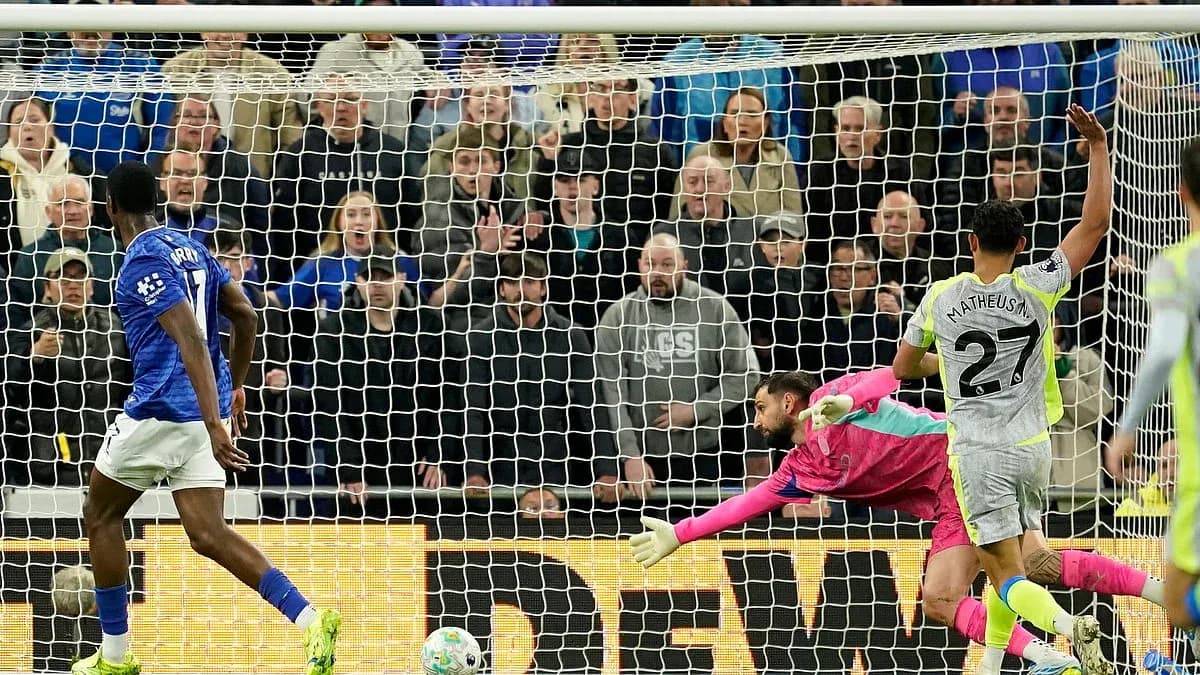
Everton vs Manchester City: A Tactical Showdown Ends in 3-3 Draw
Under the lights at Hill Dickinson Stadium, a 3-3 draw between Everton and Manchester City felt less like a routine Premier League fixture and more like a tactical stress test for both squads. Following this result, the table tells one story — Everton in 10th on 48 points with a goal difference of 0, City in 2nd on 71 points and a goal difference of 37 — but the 90 minutes told another: this was a meeting of two very different footballing identities pushed to their limits.
I. The Big Picture – Styles Colliding
Everton came into the night with a season-long profile of balance and volatility. Overall they have scored 44 and conceded 44 across 35 matches, mirroring that goal difference of 0. At home they average 1.4 goals for and 1.3 against, numbers that fit neatly with a 3-3 thriller: they rarely suffocate games, they invite chaos and try to ride it.
Manchester City arrived as a far more polished machine. Overall this campaign they have 69 goals for and 32 against from 34 games, averaging 2.0 goals scored and 0.9 conceded. On their travels they still carry menace — 31 away goals at 1.7 per game — but concede 1.1 away from home, a small but telling uptick that Everton exploited.
Both managers set up in a 4-2-3-1, but the shapes behaved very differently. Leighton Baines’ Everton used the system as a protective shell, while Pep Guardiola’s City treated it as a launch pad.
II. Tactical Voids – The Missing Anchors
The absentees shaped the tactical story as much as those on the pitch.
Everton were without J. Branthwaite, J. Grealish and I. Gueye, stripping Baines of a left-sided defender, a creative carrier and his most natural screening midfielder. The result was a back four of J. O’Brien, J. Tarkowski, M. Keane and V. Mykolenko, with T. Iroegbunam and J. Garner as the double pivot.
Without Gueye’s positional discipline, Garner’s responsibilities swelled. Already one of the league’s standout ball-winners — 113 tackles, 9 blocked shots and 53 interceptions this season — he was asked to both protect and progress. His 1,617 passes at 86% accuracy and 49 key passes show he can handle that dual role, but it left him constantly on the brink physically and emotionally, reflected in his 10 yellow cards this season.
For City, the void was even more symbolic. No R. Dias, no J. Gvardiol, and crucially no Rodri. Guardiola had to improvise a spine, using A. Khusanov and M. Guehi at centre-back, with Nico and B. Silva deeper than usual. City’s defensive record overall is elite, but the absence of their usual organiser and midfield metronome meant the back four were more exposed to Everton’s direct thrusts and transitional runs.
Disciplinary patterns hinted at the tension. Everton’s yellow card profile peaks late — 22.39% of their yellows arrive between 76-90 minutes — and their red cards are heavily back-loaded too, with 50.00% shown in that same 76-90 window. City, by contrast, spread their cautions more evenly but still show a spike from 46-60 minutes at 21.67%, a period when they often press hardest and risk more in the counter-press. In a game that ebbed and flowed, those windows were always going to be flashpoints.
III. Key Matchups – Hunter vs Shield, Engine Room vs Enforcer
Hunter vs Shield was brutally straightforward: E. Haaland against an Everton defence that concedes 1.3 goals per game overall and 1.3 at home.
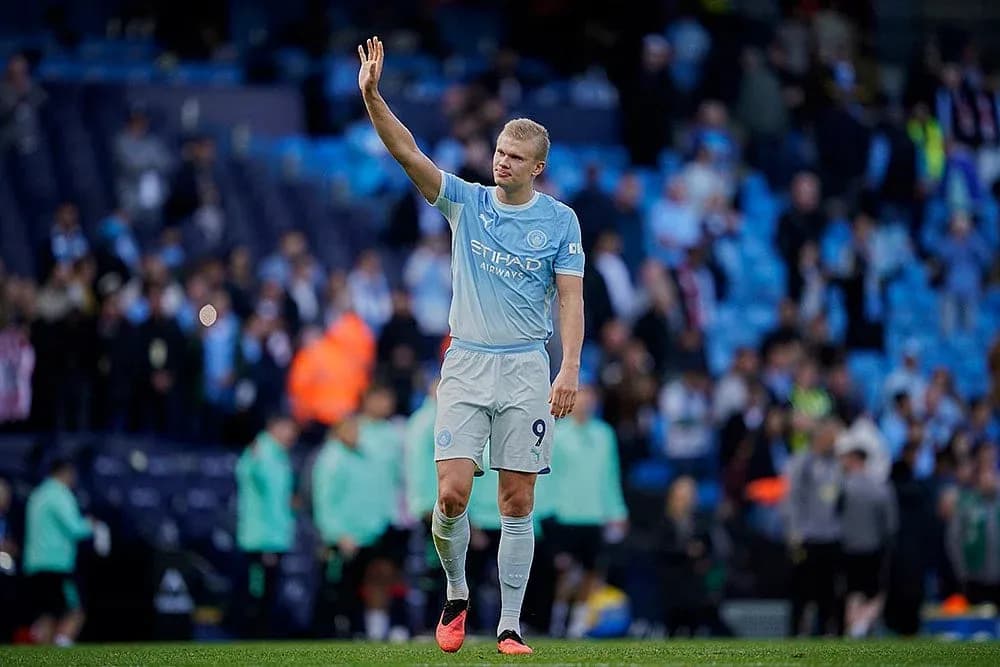
Haaland’s season numbers are devastating. Overall he has 25 league goals and 7 assists, from 96 shots and 54 on target. He has won 125 of 232 duels and drawn 25 fouls, a physical focal point who bends entire defensive structures around him. He is also not perfect from the spot, with 3 penalties scored but 1 missed; that single blemish means you cannot call him 100% reliable from 12 yards, but it also underlines how often he gets into those decisive zones.
Everton’s response was collective. J. Tarkowski and M. Keane handled the aerial duels, while O’Brien — who has blocked 16 shots this season and already owns one red card — stepped out aggressively. Pickford’s positioning behind them was conservative, wary of the space Haaland loves to attack.
The Engine Room battle was subtler but just as decisive. On one side, City had R. Cherki and B. Silva knitting patterns. Cherki arrives as one of the league’s most creative forces: 11 assists, 57 key passes, and 1,198 completed passes at 86% accuracy. His 97 dribbles attempted with 46 successful make him both a line-breaker and a tempo-setter. Bernardo, meanwhile, has 45 key passes and 1,952 completed passes at 90% accuracy, plus 42 tackles and 6 blocked shots — a hybrid of playmaker and harrying presser.
Opposite them, Garner was Everton’s enforcer-playmaker hybrid, with 7 assists of his own and those 49 key passes. Around him, T. Iroegbunam offered legs and simple distribution, while K. Dewsbury-Hall and M. Rohl floated between the lines to disrupt City’s rhythm. I. Ndiaye’s role as the nominal 10 was to spring transitions, connecting quickly into Beto.
Out wide, J. Doku was the chaos agent. With 132 dribbles attempted and 74 successful this season, plus 5 assists and 51 key passes, he is City’s most direct winger. His duels — 290 total, 154 won — tell of a player who constantly tests full-backs. Mykolenko and O’Brien had to narrow and double up, which in turn opened half-spaces for Cherki and B. Silva.
IV. Statistical Prognosis – What This 3-3 Says About Both
Following this result, the numbers reinforce what the eye suggested. Everton remain a side whose overall averages — 1.3 goals scored and 1.3 conceded — mask wild swings from game to game. Their 11 clean sheets overall show they can shut teams down, but 9 matches failed to score underline how reliant they are on rhythm and confidence. When their 4-2-3-1 clicks, with Dewsbury-Hall and Ndiaye feeding Beto and Garner dictating, they can go toe-to-toe even with an elite defence.
City, meanwhile, showed both their ceiling and their vulnerability. Overall they still boast 14 clean sheets and have failed to score only 4 times, but conceding 3 here fits the pattern of an away side that allows 1.1 goals per game on their travels. Without Dias, Gvardiol and Rodri, the structure around Haaland’s firepower and Cherki’s creativity is thinner; they can still overwhelm opponents, but they are more susceptible to direct, vertical attacks and second-ball chaos.
In xG terms — even without the raw model — you would expect City’s sustained pressure, Haaland’s shot volume and Doku’s dribbling entries to have produced a higher underlying total than Everton’s more selective forays. Yet Everton’s home scoring rate of 1.4 and City’s away concession of 1.1 point towards a “normal” expectation of roughly 1.5-2.0 xG for City and 1.0-1.3 for Everton. A 3-3 final, then, speaks of clinical finishing and defensive lapses on both sides rather than a pure reflection of chance quality.
The tactical verdict is clear. Everton, even from mid-table, have the tools and temperament to drag top sides into high-variance battles, especially at Hill Dickinson Stadium. City, for all their control, become a different beast when their defensive and midfield anchors are missing: still lethal going forward, but more human at the back.
In a season defined by fine margins at both ends of the table, this six-goal draw will be remembered less as an anomaly and more as a snapshot of where these squads truly are — Everton, bold and unstable; City, brilliant but, on nights like this, breakable.